

Introduction
AI RFP Analysis is changing how sales and proposal teams approach complex requests for proposals.
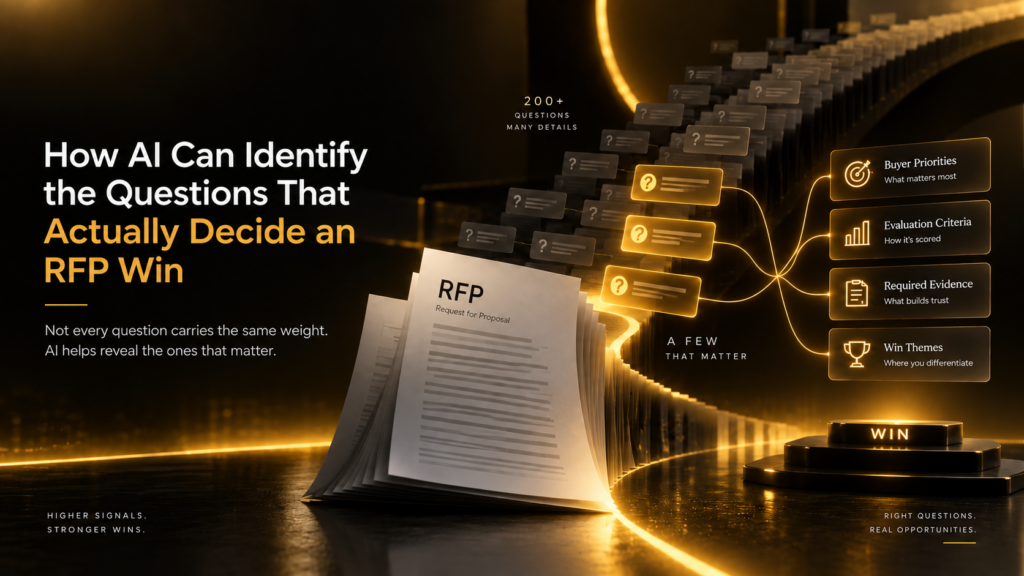
A typical enterprise RFP can contain hundreds of questions.
Some ask for basic company information.
Some verify compliance.
Some request technical details.
Some are mandatory.
And some can have a much greater influence on the final buying decision.
The challenge is identifying which questions actually matter.
A proposal team can spend hours answering every question with the same level of attention, only to discover that the most important buying signals were hidden inside a small number of requirements.
AI can help change that.
Instead of treating every RFP question equally, AI can analyze the document, identify patterns, connect questions to evaluation criteria, detect recurring priorities, and help teams determine where strategic attention should go.
That creates a fundamental shift:
From “How do we answer every question?”
to:
“Which questions could actually influence the decision, and how should we answer them?”
Why Not Every RFP Question Matters Equally
An RFP might contain:
- 200 questions
- 50 technical requirements
- 30 compliance questions
- 20 commercial questions
- 10 implementation questions
- Several pages of background information
At first glance, every question looks important.
But they don’t necessarily carry the same weight.
Consider these two questions:
Question A
“Please provide your registered company address.”
Question B
“Describe how your solution will integrate with our existing enterprise architecture while minimizing operational disruption.”
Both require an answer.
But they have very different strategic implications.
Question A is primarily administrative.
Question B could reveal:
- A major buyer concern
- A technical evaluation area
- A potential competitive differentiator
- A significant implementation risk
The challenge for proposal teams is recognizing that distinction quickly.
What Questions Actually Decide an RFP Win?
The questions that influence an RFP decision are often connected to one or more of these areas:
Business Outcomes
What result does the buyer expect?
Evaluation Criteria
How will responses be scored?
Strategic Priorities
What does leadership care about most?
Risk
What could prevent successful implementation?
Differentiation
Where can vendors meaningfully distinguish themselves?
Commercial Value
What determines whether the investment is justified?
Delivery Confidence
What evidence proves that the supplier can execute?
A question doesn’t have to explicitly say “this will determine the winner” to be strategically important.
Its importance may be hidden in the language, context, scoring structure, or relationship to other requirements.
AI Can Read the RFP as a Connected Document
One of the biggest limitations of manual RFP analysis is that teams often process questions individually.
Question 17 is answered.
Then Question 18.
Then Question 19.
But the meaning of a question can depend on everything around it.
For example:
Section 1:
The company wants to reduce customer-service costs.
Section 3:
The company wants to improve first-contact resolution.
Section 7:
The company requires integration with its existing CRM.
Section 12:
The company expects measurable operational improvements within six months.
Individually, these requirements look different.
Together, they reveal a much clearer priority:
The buyer wants an integrated solution that improves customer-service efficiency and produces measurable results quickly.
AI can analyze these connections across the document.
This allows RFP analysis to move from question-level reading to requirement-level understanding.
AI Can Identify Repeated Buyer Priorities
Repetition is often a signal.
Suppose an RFP mentions:
- scalability five times
- security eight times
- implementation risk seven times
- innovation once
That doesn’t automatically mean security is the only priority.
But repeated emphasis can indicate areas that deserve closer attention.
AI can identify recurring concepts, phrases, requirements, and themes across large documents.
It can then group them into broader categories.
For example:
Security
→ Data protection
→ Access controls
→ Compliance
→ Auditability
→ Risk management
Implementation
→ Migration
→ Integration
→ Timeline
→ Training
→ Change management
The result is a buyer-priority map.
AI Can Connect Questions to Evaluation Criteria
One of the strongest signals in an RFP is the evaluation framework.
If the buyer explicitly provides scoring criteria, those criteria can help identify which questions deserve the greatest attention.
For example:
| Evaluation Area | Weight | Strategic Importance |
|---|---|---|
| Technical Capability | 30% | High |
| Implementation Approach | 25% | High |
| Commercial Proposal | 20% | High |
| Security | 15% | High |
| Company Overview | 5% | Lower |
| Administrative Requirements | 5% | Lower |
A proposal team shouldn’t treat all six areas identically.
The 30% technical section and 25% implementation section deserve significant strategic attention.
AI can help map individual questions to these broader evaluation categories.
That creates a connection between:
Question → Requirement → Evaluation Area → Potential Impact
This is much more useful than simply producing a list of questions.
AI Can Identify Questions Hidden Inside Statements
Not every important requirement is written as a direct question.
Consider:
“The selected vendor must demonstrate the ability to support migration from multiple legacy platforms without disrupting existing customer operations.”
There is no question mark.
But there are several questions hidden inside the requirement:
- How will migration work?
- How will disruption be minimized?
- What legacy systems have you migrated before?
- What methodology will you use?
- What risks exist?
- What evidence can you provide?
AI can identify these implicit questions and convert them into response opportunities.
This is particularly useful in long enterprise RFPs where requirements are spread across narrative sections.
AI Can Detect Questions That Require Evidence
Some questions can be answered with a statement.
Others require proof.
For example:
“Describe your experience delivering similar enterprise transformations.”
A generic answer might say:
“We have extensive enterprise transformation experience.”
That doesn’t provide much confidence.
The stronger response requires evidence:
- Relevant case study
- Customer example
- Measurable result
- Implementation scale
- Industry relevance
- Technology experience
AI can help identify questions where evidence is likely to matter.
This allows proposal teams to retrieve supporting material before writing.
AI Can Find Questions Where Differentiation Matters
Some RFP questions are designed to establish basic compliance.
Others create opportunities to differentiate.
For example:
“Does your solution support API integration?”
If every serious competitor supports APIs, answering “Yes” doesn’t differentiate you.
But consider:
“Describe how your integration architecture reduces implementation complexity across legacy and modern systems.”
Now the response can demonstrate:
- Architecture
- Methodology
- Experience
- Implementation approach
- Relevant outcomes
AI can help classify questions based on their potential strategic role:
Compliance
Qualification
Differentiation
Evidence
Risk
Business Value
That classification helps teams determine how deeply each question should be answered.
AI Can Identify Questions That Reveal Buyer Pain
The buyer’s most important problem isn’t always stated directly.
Consider an RFP asking:
“Describe your approach to automating manual customer-service workflows.”
On the surface, this is a technical question.
But it may indicate a broader business problem:
- High service costs
- Repetitive employee work
- Long resolution times
- Poor customer experience
- Scaling challenges
AI can connect related requirements and identify the underlying business problem.
That changes how the response should be written.
Instead of:
“Our platform supports workflow automation.”
A stronger strategic response could focus on:
“Our approach is designed to reduce repetitive service work while improving resolution speed and maintaining human oversight for complex cases.”
The difference comes from understanding the reason behind the question.
AI Can Group Related Questions Into Strategic Themes
An RFP may ask similar things in different sections.
For example:
Question 12:
Describe your data-security approach.
Question 47:
Explain your access-control model.
Question 83:
How do you support audit requirements?
Question 119:
Describe your compliance framework.
These shouldn’t necessarily be treated as four completely independent responses.
They may represent one larger buyer priority:
Enterprise Security and Governance
AI can group related questions into strategic themes.
Possible themes include:
- Security
- Integration
- Scalability
- Cost
- Customer Experience
- Implementation
- AI Capabilities
- Compliance
- Support
- Business Outcomes
This gives proposal teams a clearer picture of what the buyer actually cares about.
AI Can Build an RFP Question Priority Map
Once questions are analyzed, AI can help classify them.
For example:
| Question | Theme | Evaluation Impact | Evidence Needed | Priority |
|---|---|---|---|---|
| Integration approach | Technology | High | Yes | Critical |
| Security architecture | Security | High | Yes | Critical |
| Company history | Qualification | Low | Limited | Standard |
| Implementation methodology | Delivery | High | Yes | Critical |
| Office locations | Administration | Low | No | Standard |
| Support model | Operations | Medium | Yes | Important |
This doesn’t mean lower-priority questions can be ignored.
Every mandatory requirement still needs an accurate response.
The difference is how resources are allocated.
Critical questions may require:
- Senior subject-matter experts
- Stronger evidence
- More review cycles
- Customized messaging
- Executive involvement
Standard questions may require straightforward factual responses.
The Questions With the Highest Strategic Value
A useful RFP analysis framework can identify five types of high-value questions.
1. Scoring Questions
Questions directly connected to evaluation criteria.
2. Pain-Point Questions
Questions revealing the buyer’s most important business problems.
3. Differentiation Questions
Questions where your capabilities can meaningfully stand apart.
4. Evidence Questions
Questions where proof can strengthen credibility.
5. Risk Questions
Questions that determine whether the buyer trusts your ability to deliver.
These questions deserve more than technically correct answers.
They deserve strategic answers.
AI Can Identify Contradictions Across the RFP
Another important capability is detecting inconsistencies.
Imagine one section says:
“Implementation must be completed within three months.”
Another section says:
“The selected vendor must complete a phased migration across five business units.”
These requirements may create a potential delivery challenge.
Or one section may say:
“The organization prefers a cloud-native architecture.”
while another requires:
“Compatibility with multiple legacy on-premise systems.”
AI can flag these relationships for closer review.
This helps teams identify questions they need to clarify before committing to an approach.
AI Can Identify Missing Questions Too
Sometimes the most important question isn’t in the RFP.
For example, an RFP may ask:
“Describe your implementation methodology.”
But it may not clearly specify:
- Who owns migration?
- Who provides data?
- What systems are in scope?
- What happens during delays?
- Who approves changes?
- What defines implementation success?
AI can analyze the requirements and identify potential gaps.
These become clarification questions for the buyer.
That can be strategically valuable because clarification can reveal additional information about:
- priorities
- constraints
- decision criteria
- timelines
- stakeholder expectations
The goal isn’t to manufacture questions.
It’s to identify information gaps that could materially affect the response.
AI Can Connect Important Questions to Past RFPs
Organizations often have years of proposal content.
The problem is finding the right answer at the right time.
Suppose an important question asks:
“Describe your experience integrating AI with enterprise commerce platforms.”
An AI-powered RFP system can search previous:
- RFP responses
- Case studies
- Technical documents
- Project summaries
- Customer references
- Product documentation
It can identify relevant material and surface it for the proposal team.
This transforms historical proposal content from a static archive into an active knowledge resource.
AI Can Help Determine Where Human Expertise Is Needed
Not every question needs the same person.
An AI analysis system can route important questions to the appropriate experts.
For example:
Security Question
→ CISO / Security Team
Architecture Question
→ Solution Architect
Commercial Question
→ Finance / Sales
Implementation Question
→ Delivery Team
Industry Question
→ Domain Expert
AI Capability Question
→ AI / Product Team
This creates a more structured response process.
Instead of sending the entire RFP to everyone, teams can focus each expert on the questions where their expertise matters most.
AI Can Turn RFP Analysis Into a Response Strategy
The ultimate goal isn’t simply to identify important questions.
It is to create a strategy for answering them.
A useful process looks like:
RFP
↓
Extract Questions & Requirements
↓
Group Related Topics
↓
Identify Buyer Priorities
↓
Map Evaluation Criteria
↓
Identify High-Impact Questions
↓
Find Required Evidence
↓
Assign Subject-Matter Experts
↓
Develop Win Themes
↓
Write Targeted Responses
↓
Review Against Evaluation Criteria
This transforms RFP analysis from a document-reading exercise into a strategic workflow.
AI RFP Analysis vs Traditional RFP Review
| Capability | Traditional RFP Review | AI RFP Analysis |
|---|---|---|
| Extract questions | Manual | Automated |
| Identify requirements | Manual | AI-assisted |
| Find repeated themes | Manual | Automated analysis |
| Map evaluation criteria | Manual | AI-assisted |
| Identify high-impact questions | Experience-dependent | AI-assisted |
| Find related questions | Manual | Automated |
| Detect contradictions | Difficult | AI-assisted |
| Find missing information | Manual | AI-assisted |
| Retrieve past responses | Manual search | Intelligent retrieval |
| Route questions to experts | Manual | Can be automated |
| Identify evidence needs | Manual | AI-assisted |
| Prioritize response effort | Manual | AI-assisted |
| Draft responses | Manual/AI | AI-assisted |
AI doesn’t eliminate the need for proposal expertise.
It helps proposal teams spend more of that expertise where it can have the greatest impact.
AI Doesn’t Know Which Questions Matter Without Context
It’s important to recognize a limitation.
AI should not simply label a question “high priority” without considering the actual RFP.
The system needs access to relevant context such as:
- Evaluation criteria
- Buyer objectives
- Requirements
- Weighting
- Industry
- Opportunity value
- Competitive environment
- Mandatory conditions
- Existing customer relationships
The quality of AI analysis depends heavily on the quality of information available to it.
This is why enterprise RFP intelligence requires more than an AI text generator.
It requires document understanding + enterprise knowledge + business context + workflow integration.
Human Judgment Still Matters
AI can identify patterns and surface potentially important questions.
But humans should validate strategic conclusions.
Proposal leaders may know things the RFP doesn’t explicitly reveal.
For example:
- The buyer’s previous vendor experience
- Known stakeholder concerns
- Competitive relationships
- Informal customer feedback
- Organizational politics
- Historical procurement behavior
AI should therefore act as an intelligence layer rather than an unquestioned decision-maker.
The strongest model is:
AI discovers signals.
Humans interpret the business context.
Teams build the response strategy.
How Businesses Should Use AI for RFP Question Analysis
Organizations can introduce AI into their RFP process step by step.
Step 1: Upload the RFP
Allow the system to analyze the complete document rather than isolated questions.
Step 2: Extract Requirements
Identify questions, statements, mandatory conditions, deadlines, and evaluation criteria.
Step 3: Group Related Requirements
Create themes such as security, integration, implementation, cost, and business outcomes.
Step 4: Identify High-Impact Questions
Prioritize questions based on scoring, strategic importance, buyer pain, differentiation, evidence, and risk.
Step 5: Identify Evidence
Connect important questions with case studies, references, capabilities, and previous responses.
Step 6: Assign Owners
Route questions to the right subject-matter experts.
Step 7: Develop Win Themes
Create a small number of consistent reasons the buyer should select your organization.
Step 8: Draft Responses
Generate targeted responses using approved enterprise knowledge.
Step 9: Review Strategically
Check whether important questions are adequately answered and supported with evidence.
Step 10: Improve Over Time
Capture lessons from each RFP and use them to strengthen future responses.
The Future of RFP Analysis Is About Finding What Matters
The future of RFP automation isn’t simply about generating proposal content faster.
It’s about understanding what deserves attention before content is generated.
A proposal team shouldn’t have to spend equal effort on every question.
The real opportunity is to identify:
Which questions reveal the buyer’s priorities?
Which questions carry the greatest evaluation weight?
Which questions create differentiation opportunities?
Which questions require proof?
Which questions reveal delivery risk?
Which questions could change the strategy of the entire response?
AI can help surface these signals from large and complex RFPs.
That changes the workflow from:
Read → Answer → Submit
to:
Analyze → Prioritize → Strategize → Answer → Prove → Submit
How Moptra Can Help Businesses Build Intelligent RFP Workflows
At Moptra, we help businesses move toward intelligent, AI-powered workflows that can transform complex business processes.
For RFP teams, the opportunity extends beyond generating proposal text.
AI can support:
- RFP document analysis
- Requirement extraction
- Question classification
- Buyer-priority identification
- Knowledge retrieval
- Evidence discovery
- Response automation
- Workflow orchestration
- Human-in-the-loop review
- Enterprise application integration
The objective isn’t simply to produce more words faster.
It’s to help teams understand which information matters, why it matters, and how it should influence the response.
Explore Moptra AI to learn more about agentic AI and intelligent enterprise workflows.
You can also explore AI Agents for Sales, HR, and Operations to see how AI-powered agents can support broader business functions.
For a deeper look at AI-powered RFP workflows, explore Moptra’s work around AI RFP Assistants and proposal automation.
The Future of AI-Powered RFP Strategy
The next generation of RFP systems will increasingly move beyond:
“Generate a response.”
toward:
“Understand the opportunity.”
An intelligent RFP system could eventually analyze a document and produce a strategic map showing:
Buyer Priorities
↓
Evaluation Criteria
↓
High-Impact Questions
↓
Risks
↓
Differentiation Opportunities
↓
Required Evidence
↓
Recommended Win Themes
↓
Response Strategy
This makes AI a strategic layer across the proposal process rather than simply a writing assistant.
The real competitive advantage isn’t answering every question faster.
It’s understanding which questions can influence the decision—and making sure those questions receive the strongest answers.
Conclusion
An RFP can contain hundreds of questions.
But not every question has the same strategic importance.
Some simply establish compliance.
Some collect basic information.
Others reveal the buyer’s priorities, expose risks, influence evaluation scores, create opportunities for differentiation, or determine whether the buyer trusts a vendor to deliver.
The challenge is finding those questions quickly.
AI RFP Analysis can help proposal teams analyze large RFPs as connected documents rather than isolated questions.
It can identify repeated themes, map requirements to evaluation criteria, detect hidden priorities, group related questions, surface evidence needs, identify contradictions, and help teams prioritize where human expertise should be applied.
The goal isn’t to ignore the other questions.
It’s to understand where strategic attention matters most.
The future of RFP response can therefore move from:
“Answer everything.”
to:
“Understand everything, prioritize what matters, and answer strategically.”
Because winning an RFP isn’t only about how well you answer the questions.
It’s also about knowing which questions are really deciding the conversation.
Frequently Asked Questions
What is AI RFP Analysis?
AI RFP Analysis uses artificial intelligence to analyze RFP documents, identify requirements, detect themes, map evaluation criteria, prioritize questions, retrieve relevant information, and support proposal strategy.
How can AI identify important RFP questions?
AI can analyze factors such as evaluation criteria, scoring weights, repeated requirements, buyer priorities, business outcomes, risk areas, differentiation opportunities, and evidence requirements to identify questions that deserve greater strategic attention.
Can AI determine which RFP questions have the highest score?
If the RFP provides explicit scoring or weighting criteria, AI can help map questions to those criteria. Where scoring information isn’t provided, AI can identify potential importance based on document context, but human validation remains important.
Can AI identify buyer priorities from an RFP?
Yes. AI can analyze repeated concepts, requirements, objectives, constraints, and related questions to identify themes that may represent important buyer priorities.
Can AI find hidden questions in an RFP?
Yes. AI can analyze narrative requirements and statements to identify implied questions that may need to be addressed in the response.
Can AI identify which questions require evidence?
AI can flag questions involving experience, capabilities, performance, implementation, security, or outcomes where supporting case studies, references, certifications, metrics, or other evidence may strengthen the response.
Can AI help identify RFP questions that differentiate vendors?
Yes. AI can help distinguish basic compliance questions from questions where solution approach, methodology, experience, architecture, or measurable outcomes may provide opportunities for differentiation.
Can AI detect contradictions in an RFP?
AI can compare requirements across different sections and flag potentially conflicting timelines, technical requirements, business objectives, or other conditions for human review.
Does AI replace proposal teams?
No. AI can accelerate analysis, retrieval, classification, and drafting, while proposal teams remain important for strategy, customer understanding, competitive positioning, judgment, and final approval.
How can Moptra help with AI-powered RFP analysis?
Moptra can help organizations build AI-powered workflows that combine document analysis, enterprise knowledge, intelligent retrieval, workflow automation, AI agents, system integrations, and human-in-the-loop review for complex RFP processes.
Related Posts
Why Your HCL Commerce, Java, a...
In today’s rapidly evolving digital commerce landscape, choosing the right technology is just one piece of the puzzle — the r...
The future of Ecommerce : How ...
E-commerce has grown exponentially in recent years, and with that growth has come a need for businesses to keep up with the latest...
Why Moptra Leads Salesforce Co...
Salesforce Commerce Cloud is transforming e-commerce, but choosing the right implementation partner is key to unlocking its full p...