
Introduction
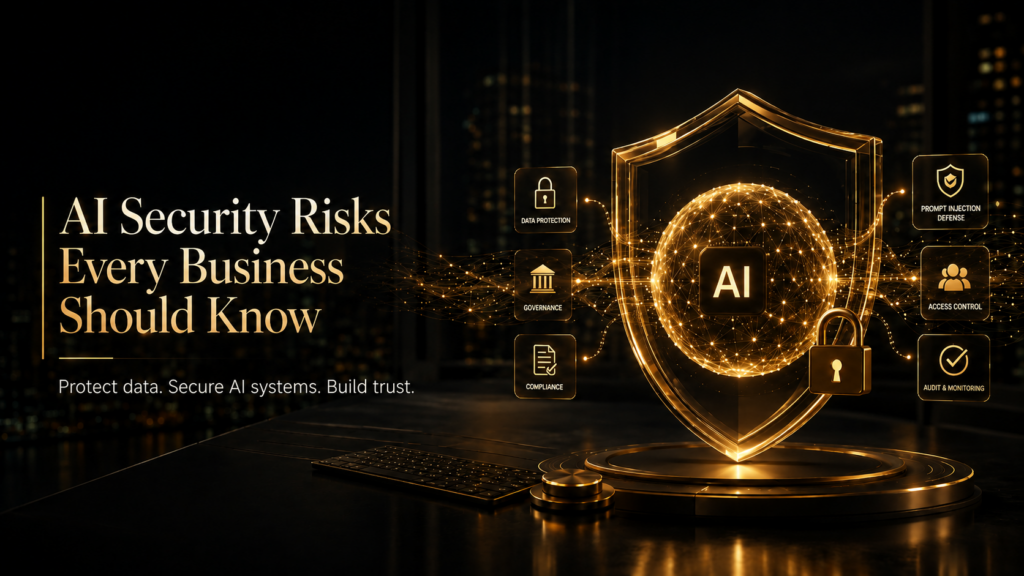
AI security risks are becoming a major concern as businesses increasingly adopt artificial intelligence to automate workflows, improve customer experiences, and accelerate decision-making. While AI offers significant advantages, it also introduces new security challenges that organizations cannot afford to ignore.
From sensitive data exposure and prompt injection attacks to unauthorized access and AI-generated misinformation, businesses need a proactive approach to secure their AI systems. Organizations that combine AI innovation with strong governance and cybersecurity practices will be better positioned to build customer trust and reduce business risk.
At Moptra, we help organizations implement AI solutions with security, governance, and compliance built into every stage of deployment.
Why AI Security Matters More Than Ever
Businesses are integrating AI into critical operations such as:
- Customer support
- Marketing automation
- Enterprise search
- Product recommendations
- Knowledge management
- Software development
- Sales enablement
- Workflow automation
As AI becomes more deeply connected to business systems, protecting sensitive information becomes increasingly important.
Without proper security measures, AI can become a new attack surface for cyber threats.
What Are AI Security Risks?
AI security risks refer to vulnerabilities that can affect AI models, business data, infrastructure, or customer information.
These risks may impact:
- Confidentiality
- Data integrity
- System availability
- Regulatory compliance
- Customer trust
- Business reputation
Understanding these risks is the first step toward building secure AI solutions.
1. Sensitive Data Exposure
Many AI systems process confidential business information.
This may include:
- Customer records
- Financial data
- Product documentation
- Contracts
- Internal knowledge bases
- Employee information
If access controls are weak, sensitive information could be exposed to unauthorized users.
Best Practices
- Encrypt sensitive data
- Implement role-based access
- Mask confidential information
- Monitor AI usage logs
- Apply zero-trust security principles
2. Prompt Injection Attacks
Prompt injection is one of the fastest-growing AI security concerns.
Attackers attempt to manipulate AI systems by submitting carefully crafted prompts that override instructions or expose confidential information.
For example, an attacker may try to convince an AI assistant to ignore its security rules and reveal restricted business data.
Best Practices
- Validate user inputs
- Restrict AI permissions
- Separate public and private data
- Continuously test AI prompts
- Apply prompt filtering techniques
3. Unauthorized Access to AI Systems
AI platforms often integrate with:
- CRM systems
- ERP software
- Customer databases
- Cloud storage
- Internal documents
- Business applications
If authentication is weak, attackers may gain access to valuable business information.
Best Practices
- Multi-factor authentication (MFA)
- Single Sign-On (SSO)
- Identity management
- Least-privilege access
- Continuous access monitoring
4. AI Hallucinations and Misinformation
AI models can sometimes generate incorrect or misleading information.
If businesses rely on these responses without verification, the consequences may include:
- Poor business decisions
- Customer misinformation
- Compliance issues
- Brand reputation damage
Best Practices
- Use verified business knowledge
- Enable human review
- Maintain updated knowledge bases
- Validate AI-generated outputs
5. AI Model Misuse
Employees or external users may unintentionally use AI systems in ways they were never designed for.
Examples include:
- Uploading confidential documents
- Sharing customer information
- Generating inappropriate content
- Bypassing internal policies
Organizations should establish clear AI usage policies.
Best Practices
- AI usage guidelines
- Employee training
- Acceptable use policies
- Regular audits
6. Third-Party AI Risks
Many businesses rely on external AI providers.
Potential concerns include:
- Data handling practices
- Service availability
- Vendor security
- Compliance requirements
- API vulnerabilities
Businesses should evaluate vendors before integrating AI into critical workflows.
Best Practices
- Conduct vendor risk assessments
- Review security certifications
- Monitor third-party access
- Sign data processing agreements
7. AI Compliance and Regulatory Challenges
As governments introduce AI regulations, businesses must ensure compliance with applicable laws and industry standards.
Important considerations include:
- Data privacy
- Customer consent
- AI transparency
- Audit trails
- Record retention
- Risk assessments
Strong governance helps organizations remain compliant while reducing legal risk.
8. AI Governance Is Essential
Technology alone cannot solve AI security challenges.
Businesses also need governance frameworks covering:
- AI policies
- Risk management
- Model monitoring
- Human oversight
- Ethical AI practices
- Security reviews
Governance ensures AI systems remain secure, transparent, and accountable.
How Businesses Can Build Secure AI Systems
Organizations should adopt a layered security approach.
Key recommendations include:
- Encrypt sensitive information
- Restrict user access
- Monitor AI activity
- Validate AI outputs
- Secure APIs
- Maintain audit logs
- Train employees
- Perform regular security testing
- Keep AI models updated
- Integrate cybersecurity with AI governance
Security should be embedded throughout the AI lifecycle rather than added after deployment.
How Moptra Helps Businesses Build Secure AI Solutions
At Moptra, security is a fundamental part of every AI implementation.
Our capabilities include:
- Secure AI deployment
- AI Knowledge Assistants
- Enterprise AI integration
- Workflow automation
- Role-based access control
- AI governance consulting
- Secure chatbot implementation
- AI search solutions
- Enterprise application integration
We help businesses deploy AI responsibly while protecting sensitive business data and maintaining compliance.
Best Practices for AI Security
To reduce AI-related risks, businesses should:
- Develop an AI governance framework.
- Protect sensitive business data.
- Review AI-generated responses before publishing.
- Limit AI access to confidential systems.
- Conduct regular security assessments.
- Train employees on responsible AI usage.
- Monitor AI systems continuously.
- Choose trusted AI technology partners.
These practices help organizations adopt AI confidently without compromising security.
The Future of AI Security
As AI becomes embedded in enterprise operations, security will become just as important as functionality. Organizations will increasingly invest in AI governance, continuous monitoring, identity management, secure integrations, and responsible AI practices.
Businesses that prioritize security from the beginning will build greater customer trust, reduce compliance risks, and create a stronger foundation for long-term AI adoption.
Conclusion
AI is transforming how businesses operate, but every new technology introduces new risks. Understanding AI security risks is essential for protecting business data, maintaining customer trust, and ensuring regulatory compliance.
By combining strong governance, secure system design, employee awareness, and continuous monitoring, businesses can safely unlock the full potential of AI.
With Moptra’s expertise in enterprise AI, secure integrations, workflow automation, and AI governance, organizations can adopt AI confidently while keeping security at the center of every implementation.
Frequently Asked Questions
What are AI security risks?
AI security risks include threats such as data leakage, prompt injection attacks, unauthorized access, AI hallucinations, model misuse, insecure integrations, and compliance challenges.
Why is AI security important for businesses?
AI systems often process sensitive business and customer data. Strong security measures help protect information, reduce cyber risks, maintain compliance, and build customer trust.
How can businesses secure AI systems?
Businesses should implement encryption, role-based access control, multi-factor authentication, governance frameworks, monitoring, regular security assessments, and employee training.
How does Moptra help organizations build secure AI solutions?
Moptra helps businesses implement secure AI solutions through AI governance, enterprise integrations, workflow automation, AI Knowledge Assistants, secure chatbots, and role-based access controls while following industry best practices.
Related Posts
Custom Development offered by ...
Magento is now Adobe Commerce On a single platform, create multi-channel commerce experiences for B2B and B2C customers. From cata...
Scaling eCommerce Success with...
In an era where online commerce is thriving, businesses are challenged to not only establish their eCommerce presence but also to ...
Why Moptra Infotech, a New Age...
If you're a high volume e-commerce brand looking to integrate HCL Commerce into your online store, it's important to choose a ...