

Introduction
AI chatbots are moving far beyond answering simple customer questions.
Businesses are increasingly using them to search internal knowledge, support employees, retrieve customer information, assist sales teams, analyze documents, automate workflows, and interact with enterprise systems.
But this creates an important question:
Can an AI chatbot use sensitive business data without exposing that data?
The answer is yes — but only when the chatbot is designed with security and privacy as part of its architecture.
A business chatbot may need access to information such as:
- Customer records
- Employee information
- Financial data
- Contracts
- Internal documents
- Product information
- Sales opportunities
- Support tickets
- Business strategies
- Confidential communications
Simply connecting an AI model to these sources is not enough.
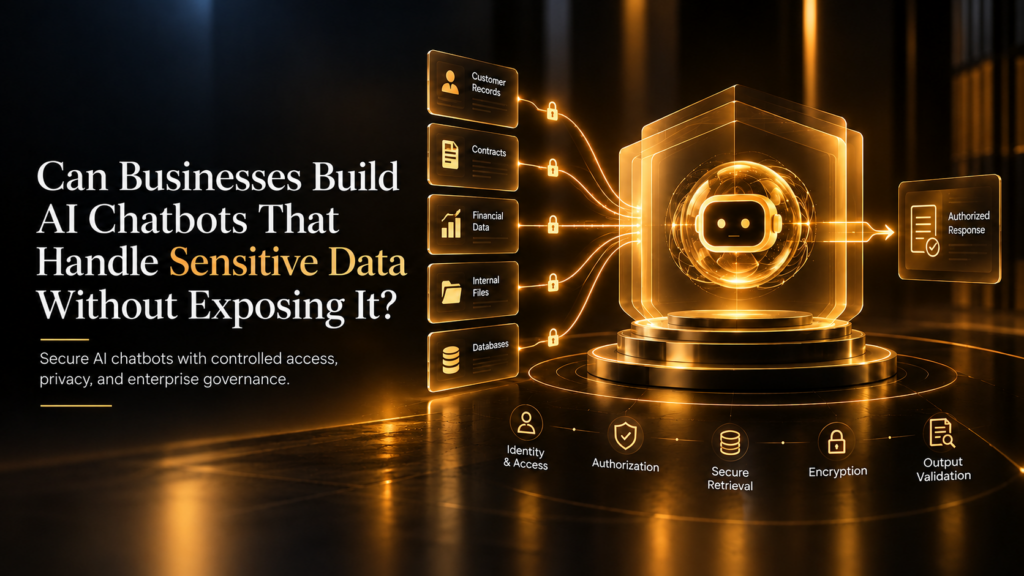
Businesses need to control what data the AI can access, which users can retrieve it, what information can be sent to a model, what the model can return, where data is stored, how long it is retained, and what actions the chatbot is allowed to perform.
This is where Secure AI Chatbots become important.
The objective is not to prevent AI from accessing useful information.
The objective is to give AI controlled access to the right information for the right user and the right purpose.
Why Sensitive Data Changes the AI Chatbot Problem
A traditional chatbot may answer questions using publicly available information.
For example:
“What are your business hours?”
The risk is relatively low.
An enterprise chatbot may receive a completely different question:
“Show me the outstanding invoices for our largest customer.”
Or:
“What salary was offered to the candidate we interviewed yesterday?”
Or:
“Summarize the confidential contract with this supplier.”
Now the chatbot is dealing with sensitive information.
The problem is no longer simply:
Can AI answer the question?
It becomes:
Should this user be allowed to receive the answer?
That distinction is fundamental to enterprise AI security.
A highly capable chatbot with unrestricted access can become a significant data exposure risk.
A properly designed chatbot can instead become a secure interface to enterprise information.
What Counts as Sensitive Data for an AI Chatbot?
Sensitive information differs between organizations and industries.
It can include:
Personal Information
- Names
- Addresses
- Phone numbers
- Email addresses
- Identification information
- Employee records
Financial Information
- Account information
- Invoices
- Payment details
- Financial reports
- Pricing agreements
Business Information
- Contracts
- Internal strategies
- Sales forecasts
- Customer lists
- Product roadmaps
- Pricing models
Customer Information
- Support history
- Orders
- Preferences
- Account information
- Customer communications
Technical Information
- API credentials
- System configurations
- Infrastructure information
- Internal architecture
- Security documentation
Regulated Information
Depending on the organization and jurisdiction, data may also fall under specific privacy, financial, healthcare, employment, or other regulatory requirements.
This means there is no universal definition of “safe chatbot data.”
Businesses need to classify their own information and determine how it should be handled.
The Biggest Risk Is Not Always the AI Model
When businesses discuss AI security, attention often goes directly to the language model.
But an enterprise chatbot is an entire system.
A simplified architecture might look like:
User
↓
Chat Interface
↓
Authentication
↓
AI Application
↓
Retrieval / Knowledge Layer
↓
Enterprise Data Sources
↓
AI Model
↓
Response
Every layer can introduce security risks.
For example:
- Weak authentication can expose the chatbot.
- Poor authorization can expose documents.
- Insecure retrieval can return information the user should not see.
- Excessive model access can expose unnecessary data.
- Poor logging can create new privacy risks.
- Uncontrolled plugins or tools can create additional attack surfaces.
Therefore, secure AI requires system-level security, not just a secure model.
Can AI Chatbots Use Sensitive Data Without Storing It?
Potentially, yes.
One important architectural principle is to separate:
Data access
from:
Data persistence
A chatbot may retrieve information from an authorized enterprise system to answer a question without permanently storing all of that information inside the chatbot itself.
For example:
User: “What is the status of Order 78452?”
The chatbot could:
- Authenticate the user.
- Verify access permissions.
- Query the order system.
- Retrieve the relevant information.
- Generate the response.
- Return only the necessary information.
The chatbot does not necessarily need a permanent copy of the entire customer database.
This approach can reduce unnecessary data exposure.
However, businesses still need to examine:
- Logs
- Conversation history
- Temporary storage
- Caching
- Monitoring systems
- Third-party services
- Model-provider policies
“Not permanently stored” does not automatically mean “never exposed.”
Data Minimization Is One of the Most Important Principles
A secure AI chatbot should generally receive only the information it needs to perform a task.
Consider a customer-support request:
“Where is my order?”
The chatbot may need:
- Customer identifier
- Order identifier
- Shipping status
It probably does not need:
- Complete customer profile
- Full payment history
- Internal sales notes
- Other customer orders
- Employee information
Providing unnecessary data increases the potential impact of a security incident.
This leads to a simple principle:
Give the AI the minimum information necessary to complete the task.
This is often called data minimization.
Authentication Comes Before Conversation
A chatbot should not assume that every user is equally trusted.
Before sensitive information is retrieved, the system should establish:
Who is the user?
Depending on the application, this could involve:
- Single sign-on
- Enterprise identity providers
- Multi-factor authentication
- Customer authentication
- Session validation
- Device or application authentication
For internal enterprise chatbots, identity can be especially important.
Consider two employees asking:
“Show me the latest sales forecast.”
A sales executive and a junior employee may have completely different access rights.
The AI should not decide access based solely on the wording of the question.
The identity and authorization system should determine what the user can access.
Authentication and Authorization Are Not the Same
This distinction is critical.
Authentication
Answers:
Who are you?
Authorization
Answers:
What are you allowed to access?
A user successfully logging into a chatbot does not automatically mean they should be able to retrieve every document available to the organization.
For example:
Employee A
→ Can access sales documents.
Employee B
→ Can access HR documents.
Finance User
→ Can access financial reports.
The chatbot should respect these existing permissions.
This means enterprise AI should ideally integrate with established identity and access-control systems rather than creating a completely separate permission model.
AI Should Respect Existing Data Permissions
One of the biggest mistakes businesses can make is creating an AI layer that bypasses existing permissions.
Imagine a company has a document repository containing:
- Public documents
- Department documents
- Executive documents
- Confidential contracts
An employee may only have access to certain folders.
If the AI chatbot retrieves everything and then decides what to show the employee, the system could create a serious security problem.
A safer model is:
User Identity
↓
Existing Permissions
↓
Authorized Retrieval
↓
AI Processing
↓
Response
The AI should retrieve only information the user is already authorized to access.
Retrieval-Augmented Generation Can Help Control Data Access
Many enterprise AI chatbots use a retrieval-based architecture commonly known as Retrieval-Augmented Generation (RAG).
Instead of giving the model access to an entire knowledge base, the system retrieves relevant information for a specific question.
For example:
User asks: “What is our refund policy for enterprise customers?”
The system can:
- Understand the query.
- Search authorized knowledge sources.
- Retrieve relevant policy documents.
- Pass the selected information to the model.
- Generate a grounded response.
The model does not necessarily need unrestricted access to every company document.
RAG therefore provides an architectural mechanism for controlling what context reaches the model.
But RAG is not automatically secure.
The retrieval layer itself needs:
- Access controls
- Permission-aware indexing
- Document classification
- Secure storage
- Proper filtering
- Auditability
Permission-Aware Retrieval Is Critical
Imagine an organization has two documents:
Document A
Public employee handbook
Document B
Confidential executive compensation plan
A chatbot should not retrieve Document B for an employee who does not have permission to access it.
This means security filtering needs to happen before or during retrieval, not merely after the AI generates an answer.
A useful architecture is:
User Identity
↓
Authorization Rules
↓
Permission-Aware Search
↓
Relevant Authorized Documents
↓
AI Model
↓
Response
This significantly reduces the chance of unauthorized information entering the AI context.
Can Businesses Prevent the AI From Revealing Sensitive Information?
They can reduce the risk substantially through multiple controls.
Possible controls include:
Input Filtering
Detect sensitive information entering the system.
Output Filtering
Inspect generated responses before they reach users.
Access Controls
Limit information based on user permissions.
Data Classification
Identify confidential, restricted, or public information.
Redaction
Remove sensitive fields when they are not necessary.
Tool Restrictions
Limit what actions the AI can perform.
Monitoring
Detect unusual access or usage patterns.
Human Approval
Require review for high-impact actions.
No single control should be considered sufficient on its own.
Security should be layered.
AI Can Use Redaction Before Processing Sensitive Data
Not every AI task requires personally identifiable information.
Suppose a business wants AI to summarize customer support conversations.
The model may not need:
- Full customer name
- Phone number
- Address
- Account number
The system could replace sensitive values with placeholders.
For example:
“John Smith from customer account 482921 reported a billing issue.”
could become:
“[CUSTOMER] from account [ID] reported a billing issue.”
The AI can still understand the issue without receiving unnecessary identifying information.
This approach can reduce the amount of sensitive information exposed to downstream systems.
Businesses Can Separate Sensitive Data From AI Reasoning
Another useful architectural principle is separating:
Identity
from:
Business context
For example, an AI system might need to understand:
“Customer purchased Product X three times and has an unresolved support case.”
But it may not need to know the customer’s full identity to perform the analysis.
Where possible, sensitive identifiers can be kept in controlled systems while the AI works with the minimum required business context.
This is particularly useful for analytics, summarization, classification, and pattern detection.
AI Chatbots Should Not Have Unlimited Tool Access
Modern AI agents can do more than answer questions.
They can potentially:
- Query databases
- Create tickets
- Update CRM records
- Issue refunds
- Modify orders
- Send emails
- Retrieve documents
- Trigger workflows
This makes tool permissions extremely important.
A chatbot that can read information is one thing.
A chatbot that can change information or execute transactions requires much stronger controls.
For example:
Read customer order
→ Lower-risk action
Change shipping address
→ Higher-risk action
Issue refund
→ High-impact action
Delete customer record
→ Highly sensitive action
Permissions should reflect the consequences of each action.
Human Approval Can Protect High-Impact Actions
Not every action should be completely autonomous.
Businesses can introduce approval workflows.
For example:
AI identifies a refund request.
↓
AI checks eligibility.
↓
AI prepares refund recommendation.
↓
Human approves.
↓
Refund is executed.
This creates a human-in-the-loop architecture.
The same approach can be applied to:
- Financial transactions
- Contract changes
- Account modifications
- Sensitive communications
- Employee decisions
- Data deletion
AI can perform the analysis while humans retain control over consequential actions.
Prompt Injection Is an Important Security Consideration
AI chatbots can also face attacks designed to manipulate their behavior.
For example, a malicious user might attempt to make the chatbot:
- Reveal system instructions
- Ignore security rules
- Expose confidential information
- Access unauthorized data
- Perform unintended actions
This is commonly discussed under the broader category of prompt injection.
The important lesson is that instructions contained in user input should not automatically override system-level security policies.
Security controls should exist outside the model itself.
For example:
User Prompt
↓
Policy Enforcement
↓
Authorization
↓
Tool Restrictions
↓
AI Reasoning
The model should not be the only security boundary.
AI Should Not Be Trusted to Decide Its Own Permissions
A common architectural mistake is asking the AI itself:
“Should I show this user the confidential document?”
The model may assist with reasoning, but access decisions should be enforced through deterministic security systems.
The principle should be:
Policy decides access.
AI uses authorized information.
Not:
AI decides what it is allowed to access.
This distinction becomes especially important in regulated and enterprise environments.
Secure AI Chatbots Need Strong Data Isolation
Businesses may use multiple data environments.
For example:
- Production
- Development
- Testing
- Customer-specific environments
- Internal environments
Sensitive production data should not automatically flow into development or testing environments.
Similarly, customer data from one organization should never become accessible to another customer.
This is particularly important for multi-tenant AI systems.
Strong isolation can involve:
- Tenant-aware access controls
- Separate data partitions
- Permission-aware retrieval
- Encryption
- Network isolation
- Application-level controls
The exact architecture depends on the organization’s requirements.
Encryption Protects Data in Transit and at Rest
Encryption is a foundational security control for enterprise AI systems.
Data may move between:
- User interface
- Application server
- Retrieval system
- Database
- AI model
- Enterprise applications
Businesses should consider encryption for data:
In transit
and
At rest
Sensitive credentials and secrets should also be managed using appropriate secret-management mechanisms rather than embedded directly in applications or prompts.
Encryption does not solve every AI security problem, but it is an important layer in a broader security architecture.
Logging Can Improve Security — But Logs Can Also Contain Sensitive Data
Organizations need visibility into how AI systems are being used.
Logs can help answer:
- Who accessed the chatbot?
- What systems were queried?
- Which tools were used?
- When did an unusual request occur?
- Which actions were performed?
But logging everything without considering privacy can create another problem.
Conversation logs may contain sensitive information.
Therefore businesses should carefully define:
- What is logged
- Why it is logged
- Who can access logs
- How long logs are retained
- Whether sensitive fields are masked
Security monitoring and privacy need to work together.
Can AI Chatbot Conversations Be Used for Model Training?
This depends on the architecture, AI provider, contract, configuration, and data-handling policies involved.
Businesses should not assume that conversational data is automatically suitable for model training.
Before sending sensitive information to an external AI service, organizations should understand:
- Data-use policies
- Retention policies
- Training policies
- Enterprise contractual terms
- Data location
- Security controls
- Administrative access
- Compliance requirements
For highly sensitive workloads, organizations may choose architectures that provide stronger control over where data is processed and retained.
The important principle is:
Know exactly what happens to data after it enters the AI system.
AI Data Governance Should Be Part of the Design
Security is not only a technical problem.
Organizations also need policies governing:
- What data AI can access
- Which use cases are permitted
- Who can deploy AI agents
- Which models are approved
- What information can be entered
- How long data is retained
- How incidents are handled
- How AI actions are audited
This is the role of AI data governance.
Without governance, individual teams may build disconnected AI solutions with inconsistent security practices.
A Secure AI Chatbot Architecture
A practical enterprise architecture might look like this:
User
↓
Identity & Authentication
↓
Authorization / Policy Engine
↓
AI Gateway
↓
Input Security & Data Classification
↓
Permission-Aware Retrieval
↓
Enterprise Data Sources
↓
AI Model
↓
Output Validation
↓
Tool / Action Controls
↓
User Response or Human Approval
↓
Audit & Monitoring
This layered architecture helps ensure that the AI model is not the only component responsible for security
Secure AI Chatbots vs Traditional Chatbots
| Capability | Traditional Chatbot | Secure Enterprise AI Chatbot |
|---|---|---|
| Basic Q&A | Yes | Yes |
| Internal knowledge | Limited | Yes |
| Identity integration | Sometimes | Core requirement |
| Permission-aware retrieval | Limited | Essential |
| Sensitive data handling | Basic | Designed explicitly |
| Data minimization | Limited | Built into architecture |
| Tool access | Limited | Controlled |
| Auditability | Basic | Enterprise-grade |
| Human approval | Limited | Available for high-risk actions |
| Data governance | Often minimal | Central requirement |
| Multi-system integration | Limited | Controlled and policy-driven |
The difference is not simply intelligence.
It is how safely intelligence is connected to enterprise information and actions.
Different Industries Have Different Sensitive Data Risks
Financial Services
AI systems may encounter:
- Financial records
- Account information
- Transaction data
- Customer identity information
Strong access control and governance are essential.
Healthcare
AI applications may process highly sensitive patient information.
Data handling, authorization, privacy, and regulatory requirements become especially important.
Retail and Ecommerce
AI systems may access:
- Customer profiles
- Orders
- Addresses
- Payment-related information
- Loyalty information
The chatbot should retrieve only what is necessary for the task.
Human Resources
HR chatbots may handle:
- Employee records
- Compensation information
- Performance information
- Recruitment data
Permission boundaries become particularly important.
Enterprise Technology
Internal AI assistants may access:
- Source documentation
- Architecture information
- Security procedures
- Credentials-related metadata
- Internal operational information
The chatbot should never become an unrestricted gateway to the organization’s entire technical environment.
A Practical Framework for Building Secure AI Chatbots
Businesses can approach secure AI chatbot development through seven layers.
1. Identify the Data
Determine what information the chatbot will access.
2. Classify the Data
Separate information into categories such as:
- Public
- Internal
- Confidential
- Restricted
3. Define User Permissions
Determine who can access each category.
4. Minimize Data Exposure
Provide the AI only with information required for the task.
5. Secure Retrieval
Ensure search and retrieval respect existing permissions.
6. Control AI Actions
Limit tools and require approval for high-impact actions.
7. Monitor and Improve
Continuously evaluate:
- Security
- Access
- Model behavior
- Data exposure
- User activity
- AI actions
This creates a security lifecycle rather than a one-time implementation.
What Businesses Should Test Before Launch
A secure AI chatbot should be tested against realistic failure scenarios.
Businesses should ask:
Can a user access another user’s information?
Can the AI retrieve documents outside the user’s permissions?
Can prompts manipulate the chatbot into bypassing rules?
Can sensitive information appear in logs?
Can the chatbot accidentally expose secrets?
Can users trigger unauthorized actions?
Can one tenant access another tenant’s data?
What happens when the AI is uncertain?
Can administrators audit sensitive activity?
Can access be revoked immediately?
These questions should be part of security testing before deployment.
AI Security Is a Continuous Process
A chatbot that is secure today may not remain secure forever.
Businesses continuously change:
- Data sources
- Users
- Permissions
- Models
- Integrations
- Tools
- Workflows
New vulnerabilities and attack techniques can also emerge.
Therefore, enterprise AI security needs continuous:
- Monitoring
- Testing
- Access reviews
- Model evaluation
- Data governance
- Incident response
- Policy updates
Security should evolve alongside the AI system.
The Future of Secure AI Chatbots
The future of enterprise chatbots will not simply be about making AI more intelligent.
It will be about making AI more context-aware, permission-aware, and policy-aware.
A future enterprise assistant could understand:
“I know this information exists, but this user is not authorized to access it.”
Or:
“I can retrieve this information, but executing the requested action requires human approval.”
That is a very different model of AI.
The chatbot becomes an intelligent interface operating inside a controlled security framework.
The future is not:
AI with access to everything.
It is:
AI with controlled access to what it needs.
How Moptra Can Help Businesses Build Secure AI Workflows
For enterprises adopting AI chatbots and agentic systems, security cannot be added after the chatbot is built.
It needs to be considered across:
Data → Identity → Retrieval → AI → Tools → Actions → Governance
Moptra works across AI automation, agentic AI, enterprise applications, commerce engineering, and intelligent workflows, helping businesses explore AI systems that connect enterprise information with practical business processes.
A secure enterprise AI workflow can follow a model such as:
User Authentication
↓
Permission Validation
↓
Secure Data Retrieval
↓
AI Reasoning
↓
Response Validation
↓
Controlled Action
↓
Audit
This approach helps businesses pursue the benefits of AI while maintaining appropriate control over sensitive information and business processes.
The objective is not to keep sensitive data completely away from AI.
It is to build an architecture where AI can use the right data, for the right purpose, under the right controls.
Conclusion
Businesses do not necessarily have to choose between using sensitive data with AI and protecting that data.
They can build AI chatbots that work with sensitive information when security, privacy, and governance are designed into the architecture from the beginning.
The key is not simply choosing a secure AI model.
Businesses need to control the entire path of information:
Who accesses the chatbot → What they are allowed to access → What data reaches the AI → What the AI can retrieve → What actions it can perform → What gets logged → Who can review it
Secure AI therefore depends on multiple layers working together.
Authentication establishes identity.
Authorization controls access.
Data minimization reduces unnecessary exposure.
Permission-aware retrieval limits the information entering the AI context.
Encryption protects information in transit and at rest.
Tool restrictions limit what the AI can do.
Human approval protects high-impact actions.
Monitoring and governance provide ongoing oversight.
The goal is not to build an AI chatbot that knows everything.
It is to build an AI chatbot that knows what it is allowed to know — and what it is allowed to do.
Frequently Asked Questions
Can AI chatbots safely handle sensitive data?
Yes. AI chatbots can be designed to handle sensitive information using authentication, authorization, data minimization, encryption, permission-aware retrieval, secure infrastructure, monitoring, and governance.
How can businesses prevent AI chatbots from exposing sensitive information?
Businesses can combine access controls, permission-aware retrieval, data minimization, input and output filtering, redaction, tool restrictions, monitoring, and human approval for high-risk actions.
Should AI have access to the entire company database?
Generally, no. AI systems should receive only the information necessary for the user’s task and should respect existing access permissions.
What is permission-aware retrieval?
Permission-aware retrieval ensures that an AI chatbot retrieves only documents and data that the authenticated user is authorized to access.
Is RAG secure by default?
No. Retrieval-Augmented Generation can support controlled enterprise knowledge access, but the retrieval layer still needs authentication, authorization, data isolation, secure indexing, and appropriate governance.
Can businesses prevent sensitive data from being stored by an AI chatbot?
Depending on the architecture and service being used, businesses can minimize or control persistent storage of sensitive information. However, they must also consider temporary storage, logs, caching, retention policies, and third-party processing.
Should sensitive information be redacted before reaching an AI model?
When the information is not necessary for the task, redaction or pseudonymization can reduce unnecessary exposure. The appropriate approach depends on the use case and security requirements.
Can AI chatbots execute sensitive business actions securely?
They can, but high-impact actions should have strong authorization controls. Some actions may also require human approval before execution.
What is the biggest security risk when connecting AI to enterprise data?
There is no single universal risk. Potential risks include unauthorized retrieval, excessive permissions, prompt injection, insecure integrations, sensitive information appearing in logs, weak tenant isolation, and inappropriate tool access.
Does encryption make an AI chatbot completely secure?
No. Encryption protects data in transit and at rest, but it does not address authorization, prompt injection, excessive permissions, unsafe AI actions, or other application-level risks.
What is the best approach to secure enterprise AI chatbots?
A layered approach is generally strongest: authenticate users, enforce authorization outside the model, minimize data exposure, use permission-aware retrieval, restrict tools and actions, protect data, monitor activity, and maintain ongoing AI governance.
Related Posts
Transforming Pharma Retail: Th...
The pharmaceutical retail landscape is evolving, and companies like Mercury Drug are embracing digital transformation to meet the ...
Revolutionizing eCommerce with...
In today’s fast-paced digital economy, data is the backbone of eCommerce success. At Moptra Infotech, we understand that the key...
Read this article on how you c...
Three key features in HCL Commerce v9.1 that can help you build a long lasting and interactive customer experience are as follows ...