

Introduction
Not every requirement in an RFP has the same impact on the final decision.
Some requirements are mandatory.
Some influence the technical evaluation.
Some determine commercial competitiveness.
Others may appear important because they occupy several pages but have relatively little influence on the final buying decision.
The challenge for sales and proposal teams is figuring out which requirements deserve the most attention.
A large RFP can contain hundreds or even thousands of questions, requirements, conditions, specifications, and evaluation criteria. Teams often respond to everything with the same level of effort, even though some requirements may have a much greater impact on the probability of winning.
This is where AI RFP Analysis can change the way teams approach proposal preparation.
AI can analyze an RFP as a connected document rather than simply extracting individual questions. It can identify mandatory requirements, detect repeated priorities, connect requirements with evaluation criteria, recognize potential scoring factors, identify areas of differentiation, and help prioritize where human expertise should be concentrated.
The goal is not simply to answer an RFP faster.
It is to answer it strategically.
Instead of asking:
“How do we answer every requirement?”
Teams can start asking:
“Which requirements could determine whether we win?”
Why RFP Requirements Do Not All Matter Equally
Consider a hypothetical RFP with 300 requirements.
A proposal team might assume that every requirement deserves approximately the same amount of attention.
But imagine the evaluation structure looks like this:
| Requirement Area | Number of Requirements | Potential Impact |
|---|---|---|
| Technical capabilities | 85 | High |
| Security & compliance | 45 | Very High |
| Implementation | 35 | High |
| Pricing | 20 | Very High |
| Reporting | 30 | Medium |
| General information | 55 | Low–Medium |
| Administrative requirements | 30 | Mandatory |
The number of questions does not necessarily correspond to their importance.
A single security requirement may be more important than 20 general information questions.
A single mandatory compliance requirement may even determine whether a proposal remains eligible for evaluation.
This creates a fundamental RFP problem:
Volume is not the same as importance.
AI can help teams distinguish between the two.
What Does RFP Requirement Prioritization Mean?
RFP requirement prioritization is the process of determining which requirements deserve the greatest attention, expertise, evidence, and response effort.
A requirement can receive a higher priority because it is:
- Mandatory
- Highly weighted
- Directly tied to evaluation criteria
- Difficult to satisfy
- Important to the buyer’s business objectives
- Relevant to a major pain point
- A potential differentiator
- A potential competitive weakness
- Connected to pricing
- Related to implementation risk
- Frequently emphasized throughout the RFP
The objective is not to ignore lower-priority requirements.
Every requirement still needs an appropriate response.
The objective is to allocate effort intelligently.
How AI RFP Analysis Can Identify High-Impact Requirements
AI can analyze the language and structure of an RFP to identify signals that indicate importance.
It can examine:
- Requirement wording
- Mandatory language
- Evaluation sections
- Scoring criteria
- Weightings
- Repeated terminology
- Section hierarchy
- Buyer priorities
- Technical specifications
- Compliance conditions
- Submission instructions
- Questions connected to business outcomes
It can then create a priority model.
For example:
Requirement
“The proposed solution must support integration with the organization’s existing ERP environment.”
AI could identify:
Category: Technical
Requirement Type: Mandatory
Business Impact: High
Potential Risk: High
Evidence Required: Integration architecture / customer examples
Response Priority: Critical
This provides more value than simply copying the requirement into a spreadsheet.
AI Can Detect Mandatory Requirements
One of the first things AI can identify is whether a requirement is mandatory.
RFP documents often use language such as:
- Must
- Shall
- Required
- Mandatory
- Will be rejected if
- Non-compliance
- Minimum requirement
- Eligibility criteria
These signals can be extracted automatically.
For example:
“The vendor must demonstrate compliance with the specified security framework.”
AI can classify this as:
Requirement Type: Mandatory
Priority: Critical
Potential Consequence: Non-compliance may affect eligibility or evaluation.
This is particularly important because a proposal can be highly persuasive and still fail if it misses a mandatory requirement.
AI Can Analyze Evaluation Criteria
The evaluation section of an RFP can provide some of the strongest clues about what matters.
Suppose an RFP says:
| Evaluation Area | Weight |
|---|---|
| Technical approach | 30% |
| Implementation methodology | 20% |
| Security | 20% |
| Commercial proposal | 15% |
| Experience | 10% |
| Presentation | 5% |
A proposal team now knows that technical approach, implementation, and security collectively account for a large portion of the evaluation.
AI can connect those evaluation criteria with individual requirements elsewhere in the RFP.
For example:
Evaluation Criterion: Technical Approach
↓
Related Requirements:
- Architecture
- Scalability
- Integration
- Performance
- APIs
- Data management
Instead of treating these requirements independently, AI can group them under the broader evaluation objective.
This creates a more strategic response.
AI Can Identify Repeated Buyer Priorities
Sometimes the buyer does not explicitly say:
“This is our most important priority.”
Instead, the priority appears repeatedly throughout the document.
Imagine an RFP mentions:
- Scalability in the executive summary
- Scalability in technical requirements
- Scalability in evaluation criteria
- Scalability in implementation requirements
The repetition itself is a signal.
AI can detect recurring concepts and terms across the entire document.
For example:
Recurring Priority: Security
Mentioned across:
- Executive requirements
- Technical specifications
- Compliance section
- Evaluation criteria
- Implementation requirements
AI can then flag security as a high-priority theme.
This is especially valuable in large RFPs where important signals may be distributed across different sections.
AI Can Connect Requirements That Appear Unrelated
RFP requirements often exist in different sections but influence the same business objective.
For example:
Requirement A
The platform must support real-time data synchronization.
Requirement B
The solution must provide accurate reporting.
Requirement C
The vendor must provide monitoring capabilities.
Individually, these look like separate technical requirements.
Together, they may indicate a broader buyer priority:
Reliable operational visibility.
AI can group related requirements into themes.
Possible themes include:
- Security
- Scalability
- Integration
- Automation
- Data quality
- User experience
- Cost optimization
- Operational efficiency
- Compliance
- Time to implementation
This helps teams understand the story behind the requirements.
AI Can Identify Requirements That Affect Multiple Evaluation Areas
Some requirements have a much larger impact because they influence multiple parts of the evaluation.
For example:
Implementation methodology
may affect:
- Technical feasibility
- Project risk
- Timeline
- Cost
- Resource requirements
- Customer confidence
AI can identify such cross-functional requirements and increase their priority.
This is different from simply counting how many times a topic appears.
The real question becomes:
“How many important decisions depend on this requirement?”
AI Can Identify High-Risk Requirements
Some requirements deserve attention because they may expose weaknesses in the proposed solution.
For example:
“The solution must integrate with three existing legacy systems.”
If the company has limited experience with those systems, the requirement could represent significant delivery risk.
AI can flag:
Potential Risk: High
Reason: Complex integration requirement with existing legacy systems.
Recommended Review: Technical architecture team.
Another example:
“The vendor must provide 24/7 support across multiple regions.”
AI can identify:
- Operational requirement
- Resource requirement
- Service-level commitment
- Potential cost impact
This allows teams to involve the right experts earlier.
AI Can Identify Requirements Where Evidence Is Critical
Some requirements cannot be answered effectively with generic statements.
For example:
“Describe your experience implementing similar solutions for organizations of comparable scale.”
A weak response might say:
“We have extensive experience.”
A stronger response needs evidence.
AI can identify requirements that require:
- Case studies
- Customer references
- Certifications
- Metrics
- Architecture diagrams
- Implementation examples
- Product documentation
- Security documentation
It can therefore create an evidence requirement map.
| Requirement | Priority | Evidence Needed |
|---|---|---|
| Security | Critical | Certifications / controls |
| Scalability | High | Architecture + case study |
| Integration | High | Technical examples |
| Implementation | High | Methodology + timeline |
| Customer experience | Medium | References / outcomes |
This can significantly improve response quality.
AI Can Identify Differentiation Opportunities
Not every important requirement is a risk.
Some are opportunities to stand out.
Suppose an RFP requires:
“The solution should provide AI-powered product recommendations.”
If many competitors can provide this capability, simply confirming compliance may not differentiate the proposal.
But perhaps your solution also provides:
- Real-time personalization
- Agentic recommendations
- Behavioral intelligence
- Advanced product discovery
- Automated experimentation
AI can help identify where the response should move from:
“Yes, we meet the requirement.”
to:
“Here is why our approach is stronger.”
This distinction is critical in competitive RFPs.
AI Can Detect Requirements Connected to Customer Pain
Requirements often originate from business problems.
For example:
“The solution must reduce manual product data management.”
The literal requirement is automation.
The underlying problem may be:
High operational workload and inconsistent product information.
AI can connect requirements to potential business outcomes such as:
- Reduced manual effort
- Faster operations
- Better data quality
- Lower costs
- Improved customer experience
Understanding the underlying problem can help teams write more compelling responses.
AI Can Identify Hidden Questions Inside Requirements
Some RFP requirements are not phrased as questions, but they contain questions the proposal needs to answer.
For example:
“The vendor should provide a scalable implementation model capable of supporting future business expansion.”
The hidden questions may include:
- How does the architecture scale?
- What happens when transaction volume increases?
- Can additional markets be added?
- Can new integrations be introduced?
- How does the implementation model adapt?
AI can transform broad statements into response considerations.
This helps teams avoid technically correct but strategically incomplete answers.
AI Can Compare Requirements With Your Capabilities
Once requirements have been prioritized, AI can compare them against the organization’s available information.
For example:
| Requirement | Capability Match | Evidence | Risk |
|---|---|---|---|
| API integration | Strong | Available | Low |
| Global support | Strong | Available | Low |
| Legacy ERP integration | Partial | Limited | High |
| Advanced analytics | Strong | Available | Low |
| Industry certification | Missing | Not found | Critical |
This produces a requirement readiness map.
The proposal team can then focus attention on gaps rather than spending excessive time reviewing areas where the organization already has strong evidence.
AI Can Use Past RFPs to Improve Requirement Prioritization
Previous proposals contain valuable institutional knowledge.
Suppose a company has responded to 500 RFPs.
Those proposals may contain information about:
- Frequently requested requirements
- Common objections
- Winning responses
- Lost opportunities
- Competitor mentions
- Evaluation criteria
- Successful evidence
- Common compliance issues
AI can compare a new RFP against historical proposals.
For example:
“This requirement is similar to requirements found in 47 previous RFPs.”
It could then identify:
- Previous response patterns
- Relevant case studies
- Past evidence
- Similar customers
- Common risks
- Successful positioning
This transforms past proposal work into reusable intelligence.
AI Can Prioritize Requirements Based on Multiple Signals
The strongest approach is not to use a single signal.
AI can combine multiple factors.
For example:
Requirement Priority Score
= Mandatory Status
- Evaluation Weight
- Buyer Priority
- Business Impact
- Competitive Importance
- Risk
- Evidence Requirement
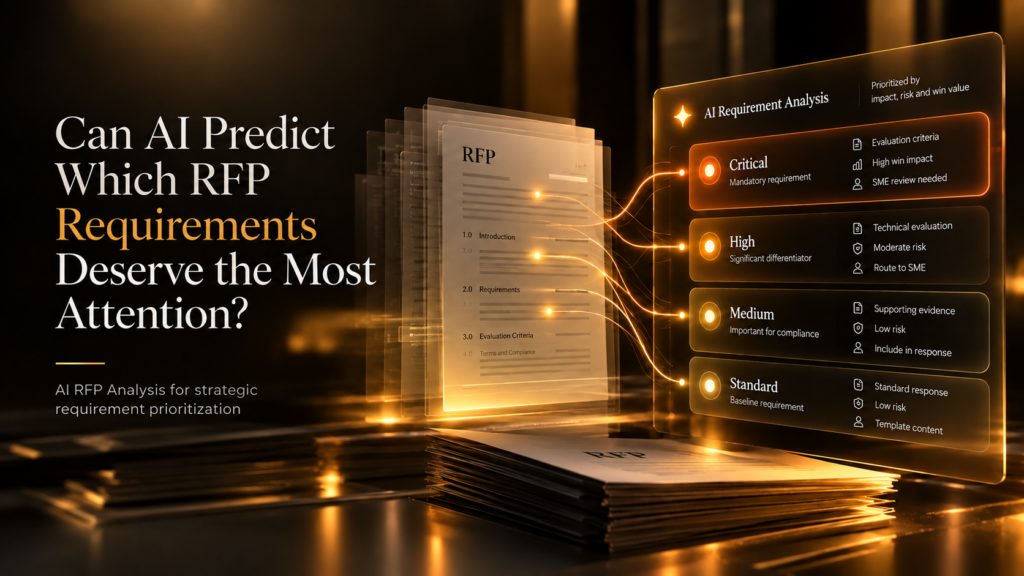
This can produce categories such as:
🔴 Critical
Requirements that could significantly affect eligibility, score, or deal outcome.
🟠 High
Requirements that strongly influence evaluation or differentiation.
🟡 Medium
Requirements that matter but are less likely to determine the outcome.
🟢 Standard
Requirements that require accurate compliance but limited strategic effort.
The exact scoring model should be customized to the organization’s RFP process.
A Practical AI RFP Requirement Priority Matrix
A useful output could look like this:
| Requirement | Mandatory | Evaluation Impact | Risk | Differentiation | Priority |
|---|---|---|---|---|---|
| Security compliance | Yes | Very High | High | Medium | Critical |
| Integration | Yes | High | High | High | Critical |
| Implementation approach | No | High | Medium | High | High |
| Reporting | No | Medium | Low | Medium | Medium |
| General company information | No | Low | Low | Low | Standard |
This gives proposal teams a much clearer picture of where to spend time.
AI RFP Analysis vs Manual Requirement Review
| Capability | Manual Review | AI RFP Analysis |
|---|---|---|
| Identify requirements | Yes | Yes |
| Detect mandatory language | Possible | Automated |
| Analyze evaluation criteria | Yes | Automated |
| Detect repeated priorities | Difficult | Scalable |
| Group related requirements | Manual | Automated |
| Identify potential risks | Expert-dependent | AI-assisted |
| Compare historical RFPs | Time-consuming | Fast |
| Identify evidence requirements | Manual | AI-assisted |
| Prioritize requirements | Subjective | Signal-based |
| Find differentiation opportunities | Manual | AI-assisted |
| Generate priority matrix | Manual | Automated |
AI does not eliminate the need for experienced proposal professionals.
Instead, it gives them a structured starting point.
Can AI Actually Predict Which Requirements Matter Most?
The answer is yes, but with an important qualification.
AI can estimate which requirements are likely to deserve greater attention by analyzing signals within the RFP and, where available, historical proposal and outcome data.
But prediction is not the same as certainty.
An RFP may contain:
- Ambiguous language
- Incomplete evaluation information
- Hidden stakeholder preferences
- Political or organizational factors
- Requirements that are intentionally vague
- Evaluation criteria that change during the process
AI therefore works best as a decision-support system.
It can say:
“These requirements appear to have the highest strategic importance.”
It should not claim:
“These are definitely the requirements the buyer will use to decide.”
Human expertise remains essential.
How Historical RFP Outcomes Can Make AI Predictions Better
AI becomes more useful when it can learn from historical outcomes.
Imagine a company has data from hundreds of previous proposals.
It can compare:
Requirements → Response Strategy → Evaluation → Outcome
Over time, patterns may emerge.
For example:
- Which requirements commonly caused proposal losses?
- Which evaluation criteria were most predictive?
- Which objections appeared in lost deals?
- Which evidence improved scores?
- Which requirements required executive involvement?
- Which competitors appeared in successful deals?
This allows AI to move from document analysis toward outcome-informed prioritization.
The organization effectively creates a feedback loop:
New RFP → AI Analysis → Prioritization → Response → Outcome → Learning
AI Can Route High-Priority Requirements to the Right Experts
Prioritization becomes even more useful when connected to workflow automation.
For example:
Security Requirement
→ Security team
Architecture Requirement
→ Solution architect
Pricing Requirement
→ Commercial team
Legal Requirement
→ Legal team
Product Requirement
→ Product team
Industry Requirement
→ Subject-matter expert
AI can identify both what matters and who should review it.
This reduces the risk of sending an entire RFP to every stakeholder and asking everyone to review everything.
AI Can Help Allocate Response Effort
Proposal teams operate under deadlines.
If an RFP must be completed in five days, spending equal effort on every requirement may not be the best strategy.
AI can help teams allocate effort.
For example:
Critical requirements
→ Senior expert review
→ Multiple evidence sources
→ Detailed response
→ Executive validation
High-priority requirements
→ SME review
→ Strong supporting evidence
Medium-priority requirements
→ Standard response
→ Existing content where appropriate
Standard requirements
→ Automated drafting + validation
This creates a more intelligent response strategy.
A Practical Workflow for AI-Powered RFP Requirement Prioritization
Step 1: Ingest the RFP
AI processes the complete RFP, including:
- Main document
- Appendices
- Attachments
- Evaluation criteria
- Submission instructions
Step 2: Extract Requirements
Each requirement is structured into a searchable format.
Step 3: Classify Requirements
AI identifies:
- Mandatory requirements
- Technical requirements
- Commercial requirements
- Compliance requirements
- Experience requirements
- Implementation requirements
Step 4: Analyze Importance Signals
AI examines:
- Evaluation weight
- Repetition
- Buyer priorities
- Risk
- Business impact
- Differentiation potential
Step 5: Compare With Internal Capabilities
The system identifies:
- Strong matches
- Partial matches
- Gaps
- Missing evidence
Step 6: Create Priority Scores
Requirements are categorized by strategic importance.
Step 7: Route to SMEs
High-priority requirements are assigned to the appropriate experts.
Step 8: Build the Response Strategy
The proposal team determines:
- Where to invest effort
- Which evidence to use
- Where to differentiate
- Which risks require mitigation
Step 9: Validate Before Submission
Critical requirements receive additional human review.
What Businesses Should Measure
Implementing AI RFP Analysis should not be measured only by how quickly an RFP is processed.
Businesses should also measure:
- Time spent analyzing RFPs
- Requirement identification accuracy
- Critical requirement coverage
- SME response time
- Evidence retrieval time
- Proposal completion time
- Response quality
- Compliance errors
- Win rate
- Proposal turnaround time
- Reuse of historical knowledge
The ultimate question is:
Does better requirement prioritization improve proposal quality and business outcomes?
Common Mistakes When Using AI for RFP Prioritization
Treating AI Scores as Absolute Truth
A priority score is an analytical signal, not a guaranteed prediction.
Ignoring Mandatory Requirements
A requirement with low apparent strategic value may still be mandatory.
Looking Only at Keyword Frequency
A requirement does not become important simply because a word appears many times.
Context matters.
Ignoring Historical Outcomes
Past RFP results can provide valuable information for improving prioritization.
Failing to Involve SMEs
AI can identify important requirements, but experts should validate technical, legal, security, and commercial implications.
Optimizing Only for Speed
Faster proposal creation is valuable, but accuracy, differentiation, compliance, and win probability matter more.
The Future of AI RFP Analysis Is Strategic Prioritization
The next generation of RFP automation will go beyond:
“Find all the questions.”
It will move toward:
“Understand what the buyer is really evaluating.”
AI systems will increasingly connect:
- Requirements
- Evaluation criteria
- Buyer priorities
- Historical RFPs
- Customer conversations
- Internal capabilities
- Evidence
- Competitor intelligence
- Deal outcomes
This creates a more intelligent proposal process.
Instead of treating an RFP as a giant checklist, businesses can treat it as a decision model.
And instead of responding to everything equally, teams can focus their best expertise on the requirements most likely to influence the outcome.
How Moptra Can Help With AI-Powered RFP Analysis
For organizations handling complex enterprise proposals, AI can become more than a document-processing tool.
Moptra’s work across AI automation, agentic AI, enterprise applications, and commerce engineering can support intelligent workflows that connect information analysis with business action.
An AI-powered RFP workflow can help organizations move through:
RFP Ingestion
↓
Requirement Extraction
↓
Requirement Prioritization
↓
Capability Matching
↓
Evidence Retrieval
↓
SME Routing
↓
Response Generation
↓
Human Validation
The objective is not simply to generate a faster proposal.
It is to help proposal teams understand where winning the requirement matters most.
For organizations exploring AI RFP Assistants, proposal automation, or intelligent sales workflows, requirement prioritization can become one of the most valuable capabilities in the RFP process.
Conclusion
A large RFP can contain hundreds of requirements.
But treating every requirement as equally important can waste time, overload subject-matter experts, and make it harder for proposal teams to focus on the factors that actually influence the buying decision.
AI RFP Analysis provides a way to approach the problem differently.
AI can analyze mandatory language, evaluation criteria, repeated priorities, business impact, risk, differentiation opportunities, evidence requirements, historical RFPs, and internal capabilities.
From these signals, it can help create a clearer picture of which requirements deserve the most attention.
The result is a smarter workflow:
Read the RFP → Understand the buyer → Identify important requirements → Prioritize → Match capabilities → Gather evidence → Respond strategically
AI cannot know with absolute certainty what a buyer will ultimately value.
But it can help proposal teams move from document volume to decision intelligence.
And that may be one of the biggest opportunities in modern RFP automation.
The future of RFP response is not simply about answering more requirements.
It is about knowing which requirements matter most — and responding to them better.
Frequently Asked Questions
Can AI predict which RFP requirements are most important?
AI can estimate requirement importance by analyzing signals such as mandatory language, evaluation criteria, weighting, repetition, business impact, risk, differentiation potential, and historical RFP outcomes. It should be treated as decision support rather than a guaranteed prediction.
What is AI RFP Analysis?
AI RFP Analysis uses artificial intelligence to extract, classify, interpret, and prioritize requirements within RFP documents. It can help teams identify important requirements, risks, evidence needs, and potential response strategies.
How does AI identify high-priority RFP requirements?
AI can analyze evaluation criteria, mandatory language, repeated themes, business objectives, requirement dependencies, risk, and historical proposal information to determine which requirements may deserve greater attention.
Can AI identify mandatory RFP requirements?
Yes. AI can detect language such as “must,” “shall,” “mandatory,” and “required” and classify associated requirements for additional review.
Can AI analyze RFP evaluation criteria?
Yes. AI can identify evaluation categories and weightings and connect them with relevant requirements elsewhere in the RFP.
Can AI identify RFP requirements that create business risk?
AI can flag requirements involving complex integrations, strict compliance, aggressive timelines, specialized capabilities, service commitments, or gaps between the requirement and available organizational capabilities.
Can AI compare an RFP with previous proposals?
Yes. Where historical proposal data is available and appropriately governed, AI can compare new requirements with previous RFPs to identify similar requirements, past responses, supporting evidence, and potential lessons.
Can AI determine which RFP requirements need SME review?
Yes. AI can categorize requirements and route them to relevant subject-matter experts, such as security, legal, technical architecture, product, finance, or implementation teams.
Does AI RFP Analysis replace proposal teams?
No. AI can accelerate analysis and provide prioritization signals, but proposal professionals and subject-matter experts remain important for validating requirements, developing strategy, ensuring accuracy, and making final decisions.
What is the biggest benefit of prioritizing RFP requirements with AI?
The biggest benefit is helping teams focus limited time and expertise on requirements that may have the greatest impact on eligibility, evaluation, differentiation, risk, and ultimately the probability of winning the RFP.
Related Posts
Why Choose Moptra Infotech for...
In today’s digital-first world, eCommerce is more than just an online storefront. It’s the backbone of successful businesses a...
Replace Multiple Marketing Too...
Introduction An Agentic AI Accelerator enables businesses to replace multiple marketing tools with one intelligent AI platform. I...
Leveraging Salesforce Commerce...
In today's digital landscape, B2B (business-to-business) transactions are rapidly moving online. Businesses are recognizing the ef...