

Introduction
The AI RFP Workflow is changing how businesses respond to enterprise sales opportunities. What once involved separate processes for proposal writing, security questionnaires, vendor assessments, and compliance documentation is increasingly becoming a connected workflow powered by artificial intelligence.
Imagine a software company pursuing a large enterprise customer. The sales team receives a request for proposal (RFP) containing hundreds of requirements. Shortly afterward, the customer’s security team sends a questionnaire asking about encryption, access controls, incident response, data retention, disaster recovery, and compliance certifications.
Traditionally, these requests might go to different teams.
Sales engineers handle the RFP. Security teams complete the questionnaire. Legal reviews contractual commitments. Compliance teams locate audit reports and policy documents. Everyone searches through previous submissions, internal knowledge bases, spreadsheets, and shared folders to find the right information.
The result? Repeated work, inconsistent answers, slow approvals, and unnecessary pressure on subject-matter experts.
But there is a fundamental connection between these requests: both RFPs and security questionnaires ask businesses to prove what they can deliver, how they operate, and why a buyer should trust them.
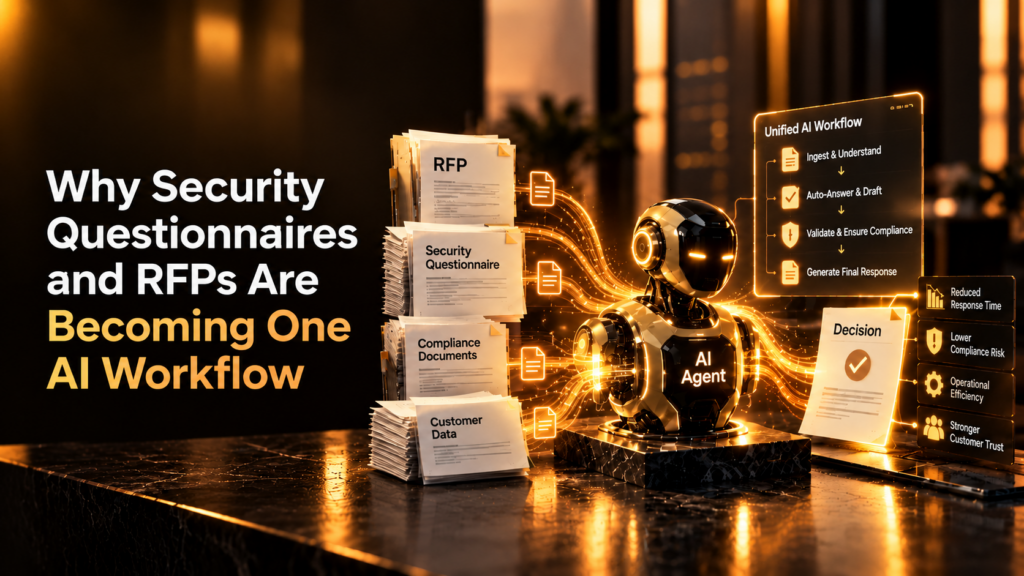
That shared requirement is driving a shift toward one AI-powered response workflow, where requirements, approved knowledge, evidence, answer generation, and human review work together.
The opportunity is not simply to automate more documents. It is to build a repeatable system for answering business questions accurately, consistently, and efficiently.
What Is an AI RFP Workflow?
An AI RFP Workflow is a connected process that uses artificial intelligence to interpret buyer requirements, retrieve relevant company information, draft responses, validate supporting evidence, and coordinate reviews before submission.
Instead of treating every RFP or security questionnaire as a separate project, the workflow uses shared knowledge and evidence wherever appropriate.
A unified workflow can support several types of requests:
- Requests for Proposals (RFPs): Detailed evaluations of a vendor’s solution, capabilities, implementation approach, pricing, and commercial fit.
- Requests for Information (RFIs): Preliminary requests used to understand vendor capabilities and available solutions.
- Security questionnaires: Structured assessments of a company’s security controls, privacy practices, and operational safeguards.
- Due diligence questionnaires (DDQs): Broader assessments covering risk, governance, business operations, and compliance.
- Technical assessments: Questions about integrations, architecture, infrastructure, performance, and support.
These documents may have different purposes, but they frequently depend on overlapping information.
For example, an RFP might ask how a software platform protects customer information. A security questionnaire might ask for details about encryption, access management, and incident response. Both responses may rely on the same approved security policies and technical documentation.
A unified AI workflow allows teams to reuse that knowledge without blindly copying identical answers into different contexts.
Why Security Questionnaires and RFPs Are Converging
The convergence is driven by a practical business problem: organizations are repeatedly asked to explain and demonstrate the same capabilities through different documents.
1. Enterprise Buyers Evaluate More Than Product Features
Enterprise procurement increasingly involves several stakeholders.
A business team may evaluate whether a solution meets its requirements. IT may examine architecture and integrations. Security teams may assess access controls and data protection. Legal and compliance teams may review contractual obligations and relevant certifications.
These reviews can happen in parallel or sequentially, depending on the buyer’s process.
This means winning a deal requires more than a persuasive proposal. Vendors must also provide credible answers about how their products and organizations operate.
The implication: Sales responses and security evidence need to be coordinated rather than managed as unrelated tasks.
2. The Same Company Information Is Requested Repeatedly
Consider the following questions:
- RFP: Describe your approach to protecting customer data.
- Security questionnaire: Is customer data encrypted at rest and in transit?
- Due diligence questionnaire: Explain your data protection governance.
- Technical assessment: Describe the security controls available within your platform.
Each question requires a different level of detail, but all may draw from a common set of approved policies, architecture documents, control descriptions, and product specifications.
Without a shared workflow, employees repeatedly search for the same evidence and rewrite similar answers.
An AI-powered response system can identify the overlap, retrieve relevant material, and adapt the response to each request.
3. Security Reviews Can Delay Commercial Progress
A sales team may complete a compelling proposal but still be unable to move forward until the buyer’s security review is finished.
If security teams must manually answer every questionnaire, the process can become a bottleneck—particularly when multiple opportunities require attention at the same time.
A unified workflow helps prepare routine responses earlier, route genuinely new questions to the right experts, and identify missing evidence before it becomes a last-minute issue.
It does not remove the need for security approval. It reduces avoidable administrative work around that approval.
4. AI Is Making Document-Level Automation Less Useful Than Workflow-Level Automation
Basic document automation focuses on filling in fields or generating paragraphs.
A more advanced AI RFP Workflow understands the relationship between a question, the relevant evidence, the required response format, and the person responsible for approving it.
This distinction matters because a completed spreadsheet is not necessarily a completed business process.
The real objective is to move from incoming requests to reviewed, defensible submissions with fewer unnecessary handoffs.
The Hidden Connection Between RFPs and Security Questionnaires
RFPs and security questionnaires differ in purpose, but they share several underlying workflow components.
| Workflow component | RFP requirement | Security questionnaire requirement |
|---|---|---|
| Requirement extraction | Identify product, service, and delivery requirements | Identify security and compliance questions |
| Knowledge retrieval | Find product information, case studies, and solution documentation | Find approved policies, audit evidence, and control descriptions |
| Answer generation | Create persuasive, requirement-specific responses | Create precise, evidence-supported security responses |
| Evidence management | Support capabilities, performance, and implementation claims | Support claims about security controls and certifications |
| Expert review | Validate technical feasibility and commercial commitments | Validate security, privacy, and compliance claims |
| Submission management | Meet buyer requirements and deadlines | Complete assessments and provide requested evidence |
The important distinction is that shared infrastructure does not mean identical response logic.
An RFP answer may need to explain business value, differentiation, and implementation outcomes. A security answer may need to state a specific control, explain its scope, and reference supporting evidence.
A successful unified workflow uses the same knowledge foundation while adapting the response to the question’s purpose.
How One AI Workflow Handles Both Processes
A practical unified system can be organized into six connected stages.
Stage 1: Ingest and Understand the Request
The workflow begins when a team uploads an RFP, questionnaire, spreadsheet, Word document, PDF, or supported portal export.
AI extracts the questions, identifies instructions, detects tables, and recognizes important requirements such as mandatory responses, word limits, requested attachments, and submission deadlines.
For example, an RFP may contain a requirement to explain disaster recovery capabilities, while a security questionnaire asks for the documented recovery time objective (RTO) and recovery point objective (RPO).
The system should recognize the relationship between these questions while preserving their individual requirements.
Stage 2: Classify Each Requirement
After extraction, each question is categorized according to its purpose.
Possible categories include:
- Product capabilities and functionality.
- Technical architecture and integrations.
- Security and access management.
- Privacy and data handling.
- Compliance and certifications.
- Implementation and support.
- Commercial and contractual commitments.
- Business continuity and disaster recovery.
Classification helps route each question to relevant evidence and reviewers.
It also prevents the system from treating every question as a generic text-generation task.
Stage 3: Retrieve Approved Evidence
The AI searches a controlled knowledge repository containing approved company information.
Depending on the organization, this may include:
- Previous approved RFP responses.
- Security policies and control descriptions.
- SOC 2 reports or other audit evidence, where applicable.
- ISO certification documentation, where applicable.
- Penetration test summaries and security documentation.
- Product specifications and architecture diagrams.
- Data processing agreements and privacy documentation.
- Implementation plans, case studies, and support policies.
The workflow should prioritize authoritative, current sources rather than simply choosing the most similar previous answer.
For example, a historical proposal might claim that a feature is available on every product tier. If the current product documentation restricts that feature to a specific plan, the current approved documentation should take precedence.
Stage 4: Generate Context-Aware Answers
Once the evidence is retrieved, the AI drafts an answer appropriate to the request.
Consider the topic of encryption.
An RFP might ask:
“Describe how your solution protects customer information.”
A security questionnaire might ask:
“Is customer data encrypted at rest?”
The first question may require a broader explanation of security architecture and customer data protection. The second requires a direct answer supported by the company’s actual control documentation.
The AI should adjust the level of detail and format while preserving the underlying facts.
It must not invent encryption methods, certifications, retention periods, or security controls to make a response sound complete.
Stage 5: Validate Evidence and Route Exceptions
The system checks whether the proposed answer is supported by the available evidence.
Questions that lack reliable support, contain conflicting source information, or require new commitments should be flagged for human review.
For example:
- A product capability is documented but its availability for the buyer’s requested configuration is unclear.
- A security policy exists, but its latest review date has passed.
- A questionnaire requests a certification that the company has not documented.
- A buyer asks for a recovery guarantee that has not been approved by the relevant team.
Instead of guessing, the system routes these questions to the appropriate subject-matter expert.
Stage 6: Review, Approve, and Submit
Finally, reviewers validate the drafted responses and supporting evidence.
Sales engineers review technical claims. Security teams verify security controls. Legal reviews contractual language. Sales leaders confirm positioning and commercial commitments.
Once approved, the workflow prepares the responses in the required format, preserving the original document structure wherever possible.
This creates a repeatable process that can be measured and improved over time.
Why a Shared Evidence Library Matters More Than a Shared Answer Library
One of the most important design decisions is what the AI should reuse.
A conventional response library stores previously written answers. This can be useful, but it may also preserve outdated claims, inconsistent language, and information that no longer applies.
A stronger approach combines reusable answers with the underlying evidence that supports them.
For example, an organization might maintain:
- An approved security policy.
- A current product architecture document.
- A documented access-control process.
- A record of relevant certifications.
- A product capability matrix.
- Previously approved responses linked to their source material.
When a new request arrives, the AI can retrieve the evidence and use earlier responses as additional context.
This creates a distinction between reusing wording and reusing verified knowledge.
What Happens When Two Sources Conflict?
Suppose a previous RFP says a feature is available, but the latest product documentation indicates that it is still in development.
A simple answer-reuse system might repeat the older statement.
A better workflow detects the conflict, prioritizes the appropriate authoritative source where the rules are clear, and flags unresolved discrepancies for review.
This is particularly important for security and compliance claims, where an unsupported statement can create reputational, contractual, or operational risk.
The long-term goal is to maintain a knowledge system in which answers, evidence, ownership, and review status remain connected.
The Role of Human Review in a Unified AI Workflow
Automation should reduce repetitive work without removing accountability.
Not every question requires the same level of human intervention. A previously approved product description may be suitable for automated drafting, while a new security commitment or contractual guarantee requires expert review.
A practical review model can use three categories.
| Category | Example | Recommended action |
|---|---|---|
| Low-risk, supported | Reusing an approved company overview | Generate a draft with source references |
| Supported but context-sensitive | Explaining a product capability for a specific deployment | Draft and request appropriate review |
| High-risk or unsupported | Confirming a new security guarantee or undocumented certification | Escalate to an authorized expert |
The system should distinguish between a high-confidence match to existing evidence and a genuinely verified business claim. Confidence scores alone do not prove that an answer is correct.
Human reviewers should be able to inspect the source, edit the answer, record approval, and identify missing knowledge.
Over time, approved corrections can improve the knowledge base—but changes to security facts and formal commitments should follow controlled approval processes rather than being accepted automatically.
Security and Governance Requirements for AI-Powered Response Workflows
Combining RFP and security questionnaire processing creates efficiency opportunities, but it also means the system may handle confidential business information and sensitive security documentation.
The workflow itself must therefore be designed with appropriate controls.
1. Role-Based Access
Not every employee should have access to every document.
A sales representative may be permitted to use an approved security summary but not download a confidential penetration testing report.
The system should enforce permissions when retrieving information, presenting citations, and exporting documents.
2. Evidence Freshness and Ownership
Important documents should have an identifiable owner, version, review date, and applicable scope where appropriate.
Expired or superseded evidence should be flagged rather than silently reused.
3. Confidentiality Controls
Security questionnaires may contain sensitive details about organizational controls, architecture, or vulnerabilities.
Organizations should determine which information can be shared with each buyer and ensure that the AI does not attach internal-only material to an external submission.
4. Audit Trails
The workflow should record meaningful actions, including evidence retrieval, significant answer changes, approvals, and submission versions.
These records help teams investigate discrepancies and understand how an answer was prepared.
5. Data Handling and AI Governance
Businesses should evaluate how the AI platform processes uploaded documents, stores information, manages access, and uses data under the applicable service terms.
Relevant risks and controls should be assessed using established governance approaches, such as the NIST Cybersecurity Framework, which organizes cybersecurity risk management around Govern, Identify, Protect, Detect, Respond, and Recover.
The correct controls depend on the organization’s environment, obligations, and risk profile.
Measuring the Business Value of a Unified AI Workflow
The value of an AI RFP Workflow should be measured through operational outcomes rather than the number of documents the AI can fill.
Organizations can track several useful metrics.
Response Cycle Time
Measure the time from receiving a request to submitting an approved response.
A reduction can indicate that retrieval, drafting, and coordination have become more efficient.
First-Draft Acceptance Rate
Track how often AI-generated answers require only minor edits versus substantial rewrites.
This helps identify whether the system understands the company’s knowledge and the buyer’s questions.
Evidence Coverage
Measure the proportion of important factual claims that have relevant, accessible supporting evidence.
High evidence coverage is especially important for security and compliance responses.
Expert Review Effort
Track the time security, legal, technical, and sales experts spend reviewing each submission.
The objective is to focus expert attention on complex or risky questions rather than eliminate necessary review.
Rework and Correction Rates
Monitor how often submitted drafts contain outdated information, inconsistent claims, unsupported statements, or formatting errors.
These measures reveal where the knowledge base and workflow need improvement.
Opportunity Progression
Where suitable data is available, assess whether faster, more consistent responses help the business meet deadlines, progress through buyer evaluations, and improve win rates.
Any business impact should be measured against a reasonable baseline rather than assumed to result from AI alone.
A Practical Roadmap for Implementing the Unified Workflow
Businesses do not need to automate every type of response at once. A phased approach makes it easier to validate quality and manage risk.
| Phase | Priority | Deliverable |
|---|---|---|
| 1. Assess | Map current RFP and security questionnaire processes | Workflow baseline and bottleneck analysis |
| 2. Organize | Identify approved answers, evidence, owners, and permissions | Governed knowledge repository |
| 3. Pilot | Select a recurring RFP or questionnaire category | Limited AI-assisted response workflow |
| 4. Validate | Test answer accuracy, citations, and exception handling | Quality and risk assessment |
| 5. Integrate | Connect review workflows and supported business systems | Coordinated response process |
| 6. Optimize | Monitor cycle time, rework, and evidence freshness | Continuous improvement plan |
A useful starting point is a category of questions that occurs frequently, has clear source documentation, and has an identifiable review owner.
Once the workflow demonstrates reliable results, the organization can expand to more complex requests and additional business functions.
What the Future Looks Like: From Document Automation to Response Intelligence
The next stage of AI-powered proposal management is likely to focus less on generating isolated answers and more on coordinating the full response lifecycle.
A connected system can help identify duplicate questions, recognize missing evidence, flag inconsistent claims, route exceptions to specialists, and maintain a history of approved responses.
It can also help teams understand which requirements repeatedly cause delays and which knowledge gaps deserve attention.
For example, if several buyers ask about the same data retention control and the organization repeatedly needs a security specialist to explain it, the pattern may reveal an opportunity to improve internal documentation or publish an approved external explanation.
The result is a feedback loop: each response process helps the organization improve its knowledge and readiness for the next request.
However, full automation should not be the default objective. Some requirements need judgment, negotiation, or explicit approval. The strongest workflow automates predictable work while preserving human control over consequential decisions.
How Moptra Can Help Businesses Build Smarter AI Workflows
Moptra works across enterprise engineering, AI automation, and business process integration—areas that can support organizations looking to modernize repetitive, knowledge-intensive workflows.
For businesses handling recurring RFPs, security questionnaires, and vendor assessments, the opportunity is to connect existing knowledge, automate routine processing, improve evidence traceability, and create clearer review paths for subject-matter experts.
A well-designed solution should fit the organization’s existing processes and information systems rather than introduce another isolated tool.
Moptra’s AI solution and work in AI agents for sales, HR, and operations provide starting points for exploring how intelligent automation can support business workflows.
The goal is not to let AI make unsupported promises on behalf of a company. It is to help teams produce accurate, consistent, evidence-backed responses with less repetitive work.
Conclusion
Security questionnaires and RFPs are becoming one AI workflow because they share the same underlying challenge: businesses must repeatedly explain their capabilities, demonstrate their controls, and provide trustworthy evidence to buyers.
Managing these requests separately creates unnecessary duplication. A unified workflow can connect requirement extraction, approved knowledge, evidence retrieval, context-aware drafting, validation, and expert review.
The key is to share the infrastructure without treating every question as identical. Sales proposals require persuasive, buyer-specific explanations, while security questionnaires demand precise, defensible statements about actual controls.
By combining reusable knowledge with current evidence, clear ownership, and appropriate human approval, organizations can reduce repetitive work while improving response consistency and visibility.
The future of RFP automation is not simply answering more questions with AI. It is building one reliable workflow that helps the right teams deliver the right answers, backed by the right evidence, at the right time.
Frequently Asked Questions
1. Why are security questionnaires and RFPs becoming one AI workflow?
Both processes require organizations to retrieve company information, answer buyer questions, provide supporting evidence, and obtain internal approvals. A unified AI workflow reduces duplicated work while allowing each response to retain its specific purpose and format.
2. What is the difference between RFP automation and security questionnaire automation?
RFP automation focuses on responding to requirements involving capabilities, solutions, implementation, commercial fit, and business value. Security questionnaire automation focuses on security controls, privacy, compliance, and risk. A unified platform can share knowledge and evidence while applying different response and review rules.
3. Can AI automatically answer security questionnaires?
AI can draft answers from approved documents and previously validated information. However, unsupported claims, conflicting evidence, new commitments, and sensitive security questions should be flagged for appropriate human review.
4. How does AI help speed up RFP responses?
AI can extract requirements, classify questions, retrieve relevant information, draft responses, identify missing evidence, and coordinate review assignments. These capabilities reduce manual searching and repetitive writing, although actual time savings depend on document quality, workflow design, and review requirements.
5. Why is an approved knowledge base important for AI RFP automation?
An approved knowledge base gives the AI a controlled foundation for drafting responses. It can help reduce inconsistent answers and outdated claims when documents have clear ownership, versioning, access controls, and review processes.
6. Can one AI workflow support RFPs, RFIs, DDQs, and security questionnaires?
Yes, a properly designed workflow can support these request types through shared ingestion, knowledge retrieval, evidence management, and review capabilities. It must still adapt to each document’s requirements, answer format, and risk level.
7. How can AI prevent inconsistent answers across proposals and questionnaires?
The system can retrieve answers from common approved sources, compare new responses with previous submissions, detect conflicting claims, and flag discrepancies for review. Current authoritative evidence should take precedence over blindly reusing historical wording.
8. What security risks should businesses consider when automating these workflows?
Organizations should consider unauthorized access to sensitive documents, disclosure of internal security information, outdated evidence, unsupported claims, inappropriate data retention, and insufficient audit trails. Appropriate access controls, evidence governance, and human approval are essential.
9. How should businesses measure the success of AI RFP workflow automation?
Useful measures include response cycle time, first-draft acceptance, evidence coverage, reviewer effort, correction rates, missed deadlines, and opportunity progression. These metrics should be compared with a baseline to determine whether the system delivers measurable improvements.
10. Will AI replace sales engineers and security teams in RFP responses?
AI can reduce repetitive document work, but it does not eliminate the need for technical judgment, security expertise, legal review, or commercial decision-making. Its strongest role is to prepare evidence-backed drafts and route complex or high-risk questions to the people qualified to approve them.
Related Posts
How to Scale Your Engineering ...
Introduction Every growing business reaches a point where its engineering team struggles to keep up with increasing product deman...
Harnessing predictive analytic...
AI is significantly enhancing customer experience in retail by providing personalized interactions and streamlining service proces...
Unlocking Expertise: Why Staff...
In today's rapidly evolving digital landscape, businesses are increasingly adopting powerful, specialized platforms to stay compet...