

Introduction
The AI Citation Problem is becoming an important challenge for businesses adopting artificial intelligence across their daily operations. Employees increasingly rely on AI assistants to summarize reports, interpret company policies, analyze customer conversations, and retrieve information from internal knowledge bases. But an important question remains: Can employees trust an AI-generated answer when they cannot see where the information came from?
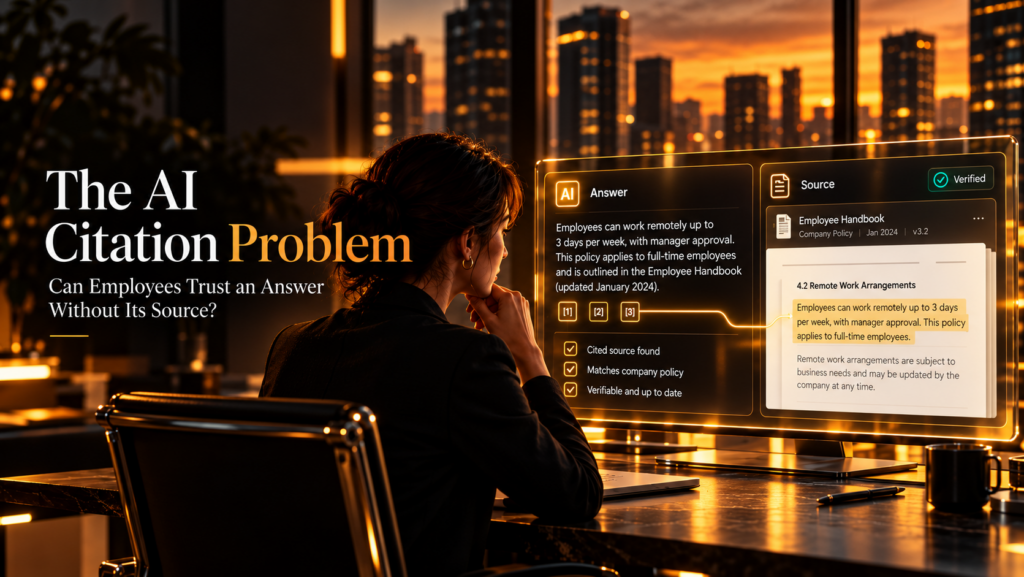
Imagine an employee asking an AI assistant about the company’s latest travel reimbursement policy. The assistant responds confidently, explaining the reimbursement limit, eligible expenses, and approval process. The answer looks professional and complete. However, it does not include a link to the policy document, the date it was updated, or the section supporting its claims.
The employee has two choices: trust the response or spend additional time searching for the original information.
This is where the AI Citation Problem begins. AI-generated answers can save time, but without accessible evidence, employees may struggle to distinguish verified information from outdated, incomplete, or incorrect statements.
For enterprises, the goal should not be to make AI sound more confident. It should be to make AI answers easier to verify.
As AI moves from experimentation into business-critical workflows, source attribution, evidence traceability, and responsible answer generation are becoming essential elements of trustworthy enterprise AI.
What Is the AI Citation Problem?
The AI Citation Problem occurs when an AI system provides information without sufficient, relevant, and verifiable sources to support its claims.
A response may be grammatically correct, logically structured, and persuasive while still containing factual errors. Without a source, users cannot easily determine whether the information comes from an approved company document, a public website, an outdated file, or the model’s generated interpretation.
Consider three common situations:
- No citation: The AI provides an answer without identifying its information source.
- Weak citation: The AI links to a general document or website that does not directly support the claim.
- Misleading citation: The AI includes a source, but the cited material does not substantiate the statement it is attached to.
All three can undermine employee trust.
A citation is useful only when it helps the user verify the answer. Simply displaying a link does not guarantee that the information is accurate.
Why AI Answers Need Verifiable Sources
Traditional search engines generally present links that users can inspect before deciding which information to trust. Generative AI changes this experience by combining information into a single, conversational response.
That convenience creates a new responsibility: users need a practical way to inspect the evidence behind the generated answer.
For example, an AI assistant might summarize a 40-page vendor agreement in seconds. If it identifies the contract’s renewal period, termination conditions, and payment obligations, employees should be able to navigate directly to the relevant clauses.
Without this capability, the summary becomes a starting point that requires manual verification rather than a dependable source of business information.
Why the AI Citation Problem Matters for Enterprises
In a business environment, an unsupported answer can influence more than an individual decision. It can affect customer relationships, operational processes, financial commitments, and compliance activities.
1. Employees May Act on Incorrect Information
Employees often use AI to obtain quick answers instead of searching through lengthy documents.
If an AI assistant incorrectly explains a leave policy, expense limit, or procurement rule, an employee might act on that information before discovering the error.
The risk increases when the answer appears authoritative and the employee has little time to verify it.
2. Outdated Information Can Become a Business Risk
Enterprise knowledge changes constantly. Policies are revised, product specifications evolve, contracts are renewed, and operational procedures are updated.
An AI assistant that retrieves an outdated document may provide an answer that was once correct but is no longer applicable.
Citations help employees inspect the document’s publication date, version, and context. However, organizations must also ensure that the retrieval system prioritizes current, authoritative sources.
3. Compliance and Auditability Become More Difficult
In regulated or process-heavy environments, organizations may need to explain why a particular decision was made and which information informed it.
An AI-generated answer without a traceable source makes this process more difficult.
Source references, document versions, timestamps, and interaction logs can help establish an audit trail. These controls do not automatically guarantee compliance, but they improve the ability to investigate and review AI-assisted decisions.
4. Employee Confidence Can Decline
When employees repeatedly encounter unsupported or inaccurate AI answers, they may stop using the system or spend so much time checking its responses that the productivity benefits disappear.
The opposite problem is equally concerning: employees may trust the system too much and accept incorrect answers without question.
A reliable enterprise AI strategy needs to avoid both extremes by making verification straightforward.
AI Answers vs. Evidence-Backed AI Answers
Not every AI response requires the same level of evidence. A brainstorming suggestion can be useful without formal citations, while an answer about a contract obligation or financial policy demands much stronger verification.
The distinction is between generating a plausible response and providing a response that employees can validate.
| Capability | AI answer without sources | Evidence-backed AI answer |
|---|---|---|
| Information visibility | Shows the generated response | Shows the response and supporting sources |
| Fact verification | Requires manual investigation | Provides direct verification paths |
| Document traceability | Often limited | Can link to relevant passages and versions |
| Outdated information | Difficult to identify | Easier to detect when metadata is available |
| Employee confidence | Depends heavily on trust in the AI | Can be based on inspectable evidence |
| Audit support | Limited source context | Better traceability when logging is implemented |
| Best suited for | Brainstorming and low-risk ideation | Research, knowledge retrieval, and business workflows |
Evidence-backed AI is not automatically correct. Its value lies in making the answer’s supporting evidence visible so employees can assess its reliability.
Why AI Systems Sometimes Produce Unsupported Answers
The AI Citation Problem is not caused by a single technical limitation. It can emerge from the way information is retrieved, interpreted, generated, and presented.
1. The AI Cannot Access the Right Information
An AI model may not have access to the company’s latest internal documents or relevant data sources.
If an employee asks about a newly introduced policy, the model might generate a response based on general patterns rather than the actual company policy.
The solution: Connect the AI system to approved, searchable knowledge sources and make its information boundaries clear.
2. Retrieval Finds the Wrong Document
Some enterprise AI systems use Retrieval-Augmented Generation (RAG) to retrieve relevant documents before generating an answer.
However, retrieval is not infallible. A search system might find a related document that contains similar terminology but does not answer the user’s specific question.
For example, an AI assistant asked about a refund policy might retrieve a customer support article instead of the current contractual refund terms.
The solution: Improve retrieval relevance, document classification, metadata filtering, and source prioritization.
3. The AI Misinterprets the Source
Even when the correct document is retrieved, the model may misinterpret its meaning.
A policy might contain an exception, a condition, or a restriction that changes how a rule applies. If the AI overlooks that detail, it can produce an answer that is only partially supported.
The solution: Require claim-level evidence checks, preserve relevant context, and test answers against source documents.
4. Citations Are Added Without Proper Validation
A system may generate an answer and attach references that appear relevant without confirming that the cited passages support the exact claims.
This creates a dangerous illusion of reliability.
The solution: Validate citations against the retrieved evidence and ensure that important claims have direct, meaningful support.
5. Conflicting Sources Are Not Resolved
An enterprise knowledge base may contain multiple documents with different dates, owners, and instructions.
If the AI treats all retrieved documents as equally authoritative, it may combine conflicting information into a single answer.
The solution: Establish source hierarchies, effective dates, document ownership, and clear rules for handling unresolved conflicts.
How Retrieval-Augmented Generation Helps Solve the AI Citation Problem
Retrieval-Augmented Generation, commonly known as RAG, combines information retrieval with generative AI. Instead of relying only on information learned during training, a RAG system retrieves relevant content from a connected knowledge source and uses that content to formulate an answer.
Google’s documentation describes grounding approaches that connect generative models to external information, including enterprise-specific data sources. These approaches can help provide more relevant, verifiable responses. See the Google Cloud documentation on grounding with search APIs.
A typical enterprise RAG workflow includes the following stages.
Step 1: Retrieve Relevant Information
When an employee asks a question, the system searches approved sources such as internal policies, product documentation, support articles, or project files.
Step 2: Identify the Best Evidence
The retrieval process ranks potential sources based on relevance and, where configured, factors such as document freshness, authority, and access permissions.
Step 3: Generate an Answer From the Retrieved Context
The AI uses the retrieved information to formulate a response. A well-designed system should avoid presenting unsupported assumptions as established facts.
Step 4: Attach Relevant Citations
The system provides references to the documents or passages used to support the answer.
Step 5: Validate the Evidence
Where appropriate, a grounding or verification component checks whether the generated claims are supported by the retrieved material. Google’s documentation on checking grounding describes evaluating how well a candidate answer is supported by reference facts.
RAG can improve access to relevant evidence, but it does not eliminate hallucinations, retrieval failures, or misinterpretation. Retrieval quality, citation validation, and source governance remain essential.
What Makes an AI Citation Trustworthy?
A trustworthy citation must do more than point to a document. It should help an employee understand exactly where a claim comes from and whether the supporting information is reliable.
1. Direct Evidence for the Claim
The citation should support the statement it accompanies.
If the AI states that employees can claim a particular travel allowance, the cited source should contain the relevant allowance rule—not simply a general travel policy.
2. Links to the Relevant Passage
Whenever technically feasible, citations should direct users to the specific paragraph, table, page, or section supporting the answer.
This reduces the time required to verify information and makes the AI experience more useful.
3. Clear Source Identity
Users should be able to identify the source document, its owner or publisher where relevant, and its date or version.
This is particularly important when several documents discuss the same subject.
4. Appropriate Source Authority
An approved company policy should generally take precedence over an informal discussion or an old presentation when the question concerns official company rules.
Organizations should define which sources are authoritative for different categories of questions.
5. Visible Uncertainty
If the available evidence is incomplete, ambiguous, or contradictory, the AI should communicate those limitations rather than presenting a guess as a confirmed fact.
A reliable assistant should be able to say, “I couldn’t verify this from the available sources.”
6. Respect for Access Permissions
Citations must not expose confidential information to employees who do not have permission to view it.
Enterprise AI systems should preserve source-level access controls when retrieving documents and presenting references. A citation feature must not become a shortcut around information security.
Can Citations Still Be Misleading?
Yes. Citations are necessary for many enterprise applications, but they are not a guarantee of correctness.
Consider the following examples:
- A genuine source with an incorrect interpretation: The document is real, but the AI misreads the relevant clause.
- A relevant document with outdated information: The citation points to a genuine policy that has since been replaced.
- A citation that supports only part of the answer: One statement is verified, but the remaining claims are not.
- A source that conflicts with another source: The cited document is relevant, but a newer authoritative document contradicts it.
- A source that is inaccessible to the employee: The reference exists, but the user cannot inspect it to verify the claim.
This is why organizations should measure citation quality rather than simply count the number of links in an AI response.
A useful principle is straightforward: A citation should make verification easier, not merely make an answer look credible.
How Businesses Can Build More Trustworthy AI Answers
Solving the AI Citation Problem requires a combination of technical design, content governance, evaluation, and employee education.
1. Establish an Authoritative Knowledge Base
Start by identifying which systems contain the information employees should rely on.
These might include:
- Approved policies and standard operating procedures.
- Product and service documentation.
- Current contracts and compliance guidelines.
- Internal knowledge articles and support documentation.
- Approved project and operational records.
Remove or clearly label duplicate, obsolete, and superseded documents wherever possible.
2. Improve Retrieval Quality
The system must retrieve the right evidence before it can produce a reliable answer.
Organizations should test retrieval across different question styles, including specific questions, ambiguous requests, questions involving exceptions, and requests for the latest policy.
Metadata such as document owner, effective date, business unit, and version can improve source selection.
3. Validate Claims Against Evidence
For high-impact applications, checking an entire answer as one block may be insufficient.
Break the response into meaningful claims and evaluate whether each claim is supported by one or more source passages.
Unsupported claims should be removed, qualified, or clearly identified as unverified.
4. Design Citations Into the User Experience
Citations should be easy to see, understand, and open.
Useful interface features include:
- Inline source links next to factual claims.
- Document names and version information.
- Passage previews or highlighted supporting text.
- Clear notices when sources are incomplete or conflicting.
- A simple way to report incorrect citations.
A well-designed interface reduces the effort employees need to spend checking an answer.
5. Give the AI Permission to Abstain
An AI system should not be forced to answer every question.
When it cannot find sufficient evidence, it should explain the limitation and suggest the next step, such as consulting an approved document owner or asking a more specific question.
This is particularly important for legal, financial, HR, security, and compliance-related workflows.
6. Monitor Citation Quality Over Time
AI systems should be evaluated after deployment, not only during development.
Track measures such as:
- Citation precision: How often cited passages genuinely support the associated claims.
- Claim coverage: The proportion of important factual claims supported by evidence.
- Source freshness: How often the system relies on current, valid documents.
- Retrieval relevance: How often the retrieved material is appropriate for the question.
- Abstention quality: Whether the system appropriately declines to make unsupported claims.
- Verification time: How long employees need to confirm an answer.
- Error severity: Whether unsupported claims create operational or business risks.
These metrics should be tested using representative business questions and reviewed against the needs of each workflow.
A Practical Framework for Implementing Evidence-Backed AI
Businesses can introduce stronger source attribution through a phased implementation plan.
| Phase | Key activity | Expected outcome |
|---|---|---|
| Phase 1: Audit | Identify AI use cases and existing knowledge sources | Clear understanding of information risks |
| Phase 2: Govern | Define authoritative sources, owners, versions, and permissions | More reliable knowledge foundations |
| Phase 3: Retrieve | Implement and evaluate search or RAG pipelines | Better evidence retrieval |
| Phase 4: Attribute | Connect claims to relevant source passages | More transparent answers |
| Phase 5: Verify | Test claim support, conflicts, and unsupported statements | Improved evidence quality |
| Phase 6: Monitor | Track errors, citation coverage, and employee feedback | Continuous improvement |
Organizations should prioritize workflows according to their risk. An AI assistant used for brainstorming social media ideas does not require the same verification process as one that summarizes a contract or provides information about employee benefits.
The appropriate level of control depends on the consequences of an incorrect answer.
How Employees Can Verify AI Answers Before Acting
Technology alone cannot eliminate every risk. Employees also need a simple process for reviewing AI-generated information.
Before acting on an important answer, employees should:
- Open the citation. Confirm that the source exists and is accessible.
- Check the relevant passage. Make sure the document directly supports the claim.
- Review the date and version. Verify that the source is still applicable.
- Look for exceptions. Read the surrounding context rather than relying on an isolated sentence.
- Compare authoritative sources. Investigate conflicts when multiple documents provide different instructions.
- Escalate high-impact uncertainty. Consult the appropriate subject-matter expert when evidence is incomplete or unclear.
Employees should be particularly careful with AI-generated statements involving money, contractual obligations, security, customer commitments, and regulatory requirements.
The goal is not to make employees distrust AI. It is to help them use AI efficiently while retaining appropriate judgment.
The Future of Enterprise AI Is Evidence-First
As AI assistants become more deeply integrated into business processes, the quality of their answers will matter—but so will the quality of the evidence behind those answers.
The next stage of enterprise AI adoption should move beyond conversational fluency toward evidence-first experiences. Employees should be able to understand not only what the AI recommends, but also which sources support that recommendation, what remains uncertain, and when human review is necessary.
This direction aligns with broader AI risk management practices. The National Institute of Standards and Technology (NIST) provides a framework for managing AI risks across the system lifecycle, including a dedicated profile for generative AI. These resources can help organizations develop structured approaches to trustworthy AI deployment.
Read the NIST AI Risk Management Framework and its Generative AI Profile.
The important distinction is that trust should not depend solely on how confidently an AI system speaks. It should be supported by accessible evidence, reliable retrieval, appropriate safeguards, and measurable performance.
How Moptra Helps Businesses Move Toward Trustworthy AI
At Moptra, enterprise AI and automation initiatives can be designed around business context, connected knowledge sources, and practical operational requirements.
For organizations exploring AI-powered business workflows, the focus should extend beyond generating fast responses. AI solutions should help employees access relevant information, reduce repetitive work, and make better-informed decisions while respecting organizational policies and data access requirements.
Through its work in AI automation, enterprise integration, and intelligent business solutions, Moptra can help businesses evaluate where evidence-backed AI fits into their processes and how to build more reliable AI-assisted workflows.
Explore Moptra’s AI solutions and learn more about AI agents for sales, HR, and operations.
The long-term opportunity is to make AI not just faster and more conversational, but also more transparent, verifiable, and useful to the people who depend on it.
Conclusion
The AI Citation Problem highlights an important challenge for businesses adopting generative AI: a convincing answer is not necessarily a verified answer.
Employees need more than polished responses. They need access to the evidence behind important claims, clear references to authoritative information, and transparency when the available sources are incomplete or contradictory.
By combining high-quality retrieval, claim-level source attribution, citation validation, effective knowledge governance, and employee education, organizations can make AI assistants more useful and easier to trust.
The future of enterprise AI will not be defined by how confidently a system answers every question. It will be defined by how reliably it supports the answers that matter.
The principle is simple: If employees are expected to act on an AI answer, they should have a practical way to verify the evidence behind it.
Frequently Asked Questions
1. What is the AI Citation Problem?
The AI Citation Problem occurs when an AI-generated answer lacks sufficient, relevant, or verifiable sources. Without supporting evidence, users may struggle to determine whether a response is accurate, current, and appropriate for their situation.
2. Why are citations important in enterprise AI?
Citations help employees verify factual claims, locate original documents, check information freshness, and investigate discrepancies. They also improve traceability when organizations review AI-assisted decisions.
3. Do citations guarantee that an AI answer is correct?
No. A citation may point to an outdated document, support only part of a claim, or be misinterpreted by the AI. Users and automated validation systems must still assess whether the evidence genuinely supports the response.
4. How does RAG help reduce AI hallucinations?
Retrieval-Augmented Generation retrieves relevant information from external or internal knowledge sources before generating an answer. It can improve factual grounding, but errors can still occur if retrieval is poor, sources are outdated, or the model misinterprets the evidence.
5. What is the difference between AI grounding and AI citation?
Grounding connects an AI response to supporting information, such as retrieved documents or verified data. Citation presents references that allow users to inspect that information. A well-designed system uses both, while recognizing that neither automatically guarantees correctness.
6. How can businesses measure AI citation quality?
Businesses can measure whether citations support the associated claims, how many important claims have evidence, whether sources are current, how relevant retrieved documents are, and how often employees encounter unsupported answers.
7. Should an AI assistant answer when it cannot find a reliable source?
For evidence-dependent business questions, the assistant should communicate that it could not verify the answer instead of presenting an unsupported claim as fact. Depending on the workflow, it can ask for clarification or direct the user to an appropriate expert.
8. Which enterprise processes benefit most from evidence-backed AI?
Processes involving internal policies, contracts, customer support, product documentation, HR guidance, compliance, procurement, and operational procedures can benefit substantially because employees need accurate, traceable information to act responsibly.
9. How can companies make AI answers more trustworthy?
Companies can establish authoritative knowledge sources, improve retrieval quality, validate citations against source passages, enforce access permissions, expose uncertainty, and continuously monitor answer quality and employee feedback.
10. What should businesses prioritize when implementing trustworthy AI?
Businesses should prioritize the reliability of their knowledge sources, the relevance of retrieved evidence, the verifiability of important claims, and the controls appropriate to each use case. Trust should be measured through performance and evidence—not assumed from the fluency of an AI response.
Related Posts
In today’s digital age, ...
With the increasing use of smartphones and the internet, more and more people are turning to online shopping for their needs. As a...
Composable Commerce in Action:...
The future of commerce is modular, intelligent, and lightning-fast. But what does that look like in practice? Let’s break down 5...
Why Winning an RFP Starts Befo...
Introduction The RFP Is Usually Won Before the Proposal Is Written Most teams think the RFP process begins when the document lan...