

Introduction
The RFP Is Usually Won Before the Proposal Is Written
Most teams think the RFP process begins when the document lands in their inbox.
It doesn’t.
By the time a sales or proposal team opens an RFP and starts writing responses, many of the factors that determine the outcome may already be in motion.
The buyer has defined its priorities. Competitors may already have relationships with stakeholders. Internal decision-makers may have formed preferences. The evaluation criteria may favor certain capabilities. And your own team may have already decided—sometimes without realizing it—whether the opportunity deserves serious investment.
This is why RFP strategy matters.
Winning an RFP isn’t simply about producing the most polished document. It is about understanding the opportunity, identifying what the buyer actually values, deciding whether the opportunity is worth pursuing, building a differentiated strategy, and only then writing the response.
A strong proposal is the output of strong decisions.
And those decisions happen before the first sentence is written.
What Happens Before the Writing Starts?
A typical RFP response may involve hours of reading, research, stakeholder interviews, solution development, pricing, compliance checks, content creation, reviews, and approvals.
But all of that activity can still produce a weak proposal if the strategic foundation is missing.
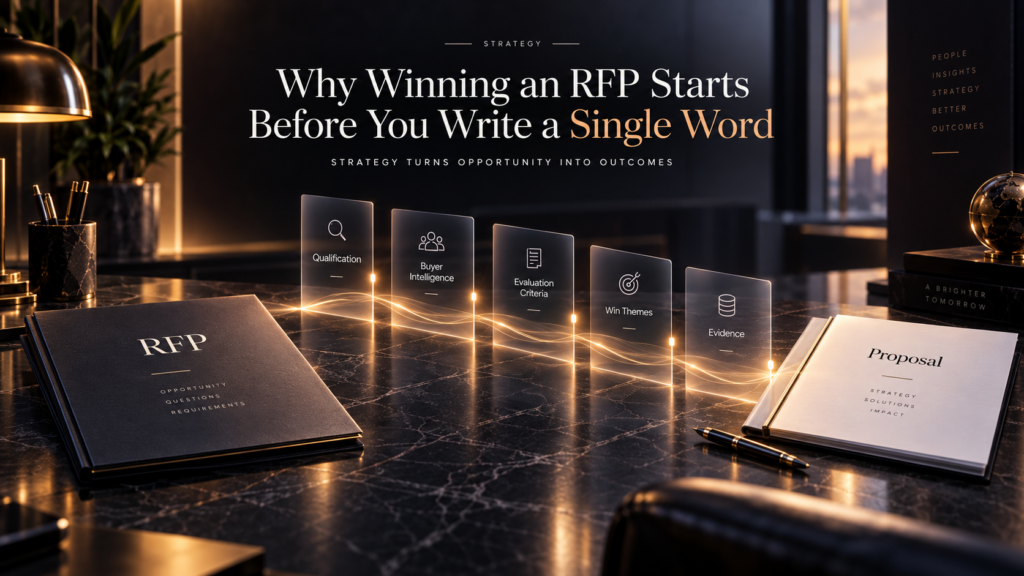
Before writing begins, your team should answer five fundamental questions:
- Should we pursue this opportunity?
- What does the buyer actually need?
- How will the buyer evaluate responses?
- Why should they choose us instead of competitors?
- What evidence can prove that we can deliver?
These questions turn an RFP from a document-completion exercise into a strategic sales opportunity.
1. First Decide: Should You Actually Bid?
One of the biggest mistakes organizations make is treating every RFP as an opportunity they must pursue.
They shouldn’t.
An RFP can look attractive because of its contract value, brand name, market potential, or strategic importance. But that doesn’t necessarily mean your company has a realistic path to winning.
A proper RFP qualification process evaluates the opportunity before resources are committed.
Questions to ask before bidding
Consider:
- Do we meet the mandatory requirements?
- Do we have the required certifications?
- Do we have relevant experience?
- Do we understand the buyer’s industry?
- Do we have relationships with important stakeholders?
- Can we meet the timeline?
- Is the budget realistic?
- Is the opportunity commercially attractive?
- Is there an incumbent supplier?
- Do we know who we are competing against?
- Can we demonstrate measurable outcomes?
- Do we have a credible differentiator?
The goal isn’t to eliminate every difficult opportunity.
The goal is to distinguish difficult-but-winnable from unlikely-to-win.
Bid/no-bid decisions protect your resources
Imagine two RFPs.
RFP A
- $2 million contract
- Strong customer fit
- Existing relationship
- Relevant case studies
- Clear differentiation
- Realistic delivery requirements
RFP B
- $3 million contract
- No existing relationship
- Limited industry experience
- Incumbent has a strong advantage
- Requirements don’t match your capabilities
- Price appears to be the primary evaluation factor
RFP B has a larger headline value.
RFP A may have the better chance of becoming revenue.
That’s why strategic qualification should happen before proposal writing.
2. Read the RFP Like a Buyer, Not a Writer
Once you’ve decided to pursue an opportunity, the next step isn’t drafting.
It’s RFP analysis.
A proposal team should read the RFP looking for more than questions that need answers.
Look for signals.
What does the buyer repeatedly emphasize?
If the RFP repeatedly mentions:
- speed
- scalability
- security
- integration
- cost reduction
- customer experience
- compliance
- operational efficiency
those aren’t simply requirements.
They are clues about what matters to the buyer.
For example, if a buyer mentions implementation risk throughout the document, responding with another paragraph about your company’s capabilities won’t necessarily help.
A stronger response might demonstrate:
- implementation methodology
- migration experience
- risk controls
- timeline
- governance model
- previous results
The difference is subtle but important.
Don’t just answer what the buyer asked. Understand why they asked it.
3. Separate Requirements From Buying Priorities
Not every requirement carries the same strategic weight.
An RFP might contain 150 questions.
That doesn’t mean all 150 questions are equally important.
Some are compliance requirements.
Some are technical requirements.
Some determine scoring.
Some reveal the buyer’s biggest concerns.
And some are simply administrative.
Your team needs to identify the difference.
Create an RFP priority map
A simple framework can categorize requirements into four groups:
| Category | What It Means | Response Strategy |
|---|---|---|
| Mandatory | Must-have requirement | Demonstrate compliance clearly |
| Scored | Directly impacts evaluation | Provide detailed evidence |
| Strategic | Reveals business priorities | Connect solution to outcomes |
| Administrative | Process or documentation | Answer accurately and efficiently |
This prevents proposal teams from spending equal effort everywhere.
The best proposals allocate effort according to business impact.
4. Find the Real Problem Behind the RFP
The RFP tells you what the buyer wants.
Your job is to understand what the buyer is actually trying to solve.
Consider a company asking for:
“A new customer service platform.”
That is the stated requirement.
But the underlying business problem might be:
- customer complaints are increasing
- support costs are rising
- agents spend too much time searching for information
- response times are hurting customer retention
- legacy systems don’t integrate
- service data is fragmented
Those problems create a much stronger foundation for a proposal.
Instead of saying:
“Our platform provides advanced customer service capabilities.”
You can position the solution around the business outcome:
“Our approach reduces the amount of time service teams spend searching across disconnected systems while creating a more consistent customer experience.”
The second response demonstrates understanding.
And buyers notice that difference.
5. Build a Buyer Intelligence Map
Before writing, identify who is involved in the decision.
The person who issued the RFP may not be the person who ultimately approves the contract.
An enterprise RFP can involve:
- procurement
- IT
- finance
- operations
- security
- legal
- business leadership
- executive sponsors
- end users
Each stakeholder may evaluate the same solution differently.
Different stakeholders ask different questions
CIO:
Can this integrate with our technology environment?
CFO:
What is the financial impact?
CISO:
How is our data protected?
Operations leader:
Will this actually improve productivity?
Procurement:
Are the commercial terms competitive?
End users:
Is it easy to use?
A strong proposal strategy anticipates these questions before they appear in the review process.
6. Identify the Evaluation Logic
Many teams respond to RFP questions individually.
Winning teams think about the evaluation as a system.
Ask:
How will the buyer decide who wins?
Look for:
- scoring criteria
- weighted categories
- mandatory requirements
- technical evaluations
- demonstrations
- interviews
- pricing models
- references
- implementation plans
If technical capability accounts for 30% of the score and implementation accounts for 25%, those areas deserve considerably more attention than a category worth 5%.
Build a scoring matrix
Before writing, map each requirement to:
Requirement → Score Weight → Buyer Concern → Our Evidence → Differentiator
This creates a strategic blueprint for the response.
It also makes internal reviews significantly easier.
7. Develop Your Win Themes Before Writing
A proposal shouldn’t simply contain good answers.
It should tell a consistent story.
That’s where win themes come in.
A win theme is a specific reason the buyer should select your organization.
For example:
Win Theme 1: Faster Implementation
“We reduce implementation complexity through a phased deployment model.”
Win Theme 2: Lower Operational Risk
“Our approach integrates with existing systems rather than requiring disruptive replacement.”
Win Theme 3: Measurable Business Outcomes
“We connect implementation milestones to measurable operational and commercial KPIs.”
Every major section of the proposal should reinforce these themes.
Without win themes, a proposal can become a collection of technically correct answers that fail to create a compelling reason to choose you.
8. Don’t Say You’re Different. Prove It.
“We are innovative.”
“We provide world-class service.”
“We have extensive experience.”
“We are customer-centric.”
These statements appear in countless proposals.
The problem isn’t that they’re necessarily false.
The problem is that they are difficult to evaluate.
A stronger proposal replaces claims with evidence.
Weak
“We provide exceptional implementation expertise.”
Stronger
“Our implementation methodology uses phased deployment, defined governance checkpoints, and measurable acceptance criteria to reduce implementation risk.”
Even stronger
“Our team has applied this approach across comparable enterprise environments, using phased deployment and governance checkpoints to reduce operational disruption.”
The principle is simple:
Claims create expectations. Evidence creates confidence.
9. Build an Evidence Library Before Writing
Your writers shouldn’t have to search for proof every time they answer a question.
Create an internal evidence library containing:
- customer case studies
- project outcomes
- performance metrics
- certifications
- technical capabilities
- implementation methodologies
- customer references
- testimonials
- product documentation
- security information
- industry expertise
Then map evidence to likely RFP requirements.
For example:
| Buyer Requirement | Available Evidence |
|---|---|
| Commerce modernization | Relevant client case study |
| AI automation | AI implementation example |
| Enterprise integration | Architecture documentation |
| Security | Security certifications |
| Scalability | Performance benchmarks |
| Implementation | Delivery methodology |
This dramatically reduces response friction.
10. Personalize the Proposal Around the Buyer
One of the easiest ways to make an RFP response feel generic is to talk too much about yourself.
The buyer doesn’t primarily want to know:
“Who are we?”
They want to know:
“How will you solve our problem?”
Compare these two openings.
Company-centric
“We are a leading technology company with extensive experience across cloud, AI, commerce, and enterprise transformation.”
Buyer-centric
“Your current environment combines multiple systems, increasing operational complexity and slowing the delivery of new customer experiences. Our approach is designed to simplify that environment while creating a foundation for scalable automation.”
The second version starts with the buyer.
That’s where the conversation should begin.
11. Use an RFP Response Architecture
Once the strategy is clear, create the response structure.
A useful architecture can look like this:
Executive Summary
Why the buyer should care.
Understanding of the Challenge
What you believe the buyer is trying to accomplish.
Proposed Solution
How you will address the problem.
Differentiation
Why your approach is different.
Proof
Evidence that you can deliver.
Implementation
How the solution will be deployed.
Risk Management
How you will reduce uncertainty.
Commercial Model
How the engagement creates value.
Next Steps
What happens after selection.
This creates a logical progression:
Problem → Understanding → Solution → Evidence → Confidence → Decision
12. AI Changes What Happens Before the Writing
The traditional RFP process requires teams to manually:
- search large documents
- identify requirements
- extract deadlines
- classify questions
- find previous answers
- search case studies
- identify missing information
- compare requirements
- coordinate contributors
This is where AI can significantly improve the process.
An AI RFP Assistant can help teams analyze large RFP documents, identify requirements, retrieve relevant knowledge, organize response tasks, and accelerate the preparation process.
Instead of starting with:
“Who can answer this question?”
teams can start with:
“What is the best strategy for winning this opportunity?”
That’s a major shift.
13. From RFP Automation to RFP Intelligence
RFP automation shouldn’t simply mean generating text faster.
That’s only one part of the opportunity.
The larger opportunity is RFP intelligence.
Imagine an AI system that can help identify:
- high-value opportunities
- missing requirements
- mandatory compliance items
- evaluation criteria
- likely buyer priorities
- relevant case studies
- historical responses
- competitive differentiators
- unanswered questions
- response risks
Now AI isn’t just helping writers.
It’s helping sales and proposal teams make better decisions.
The ideal workflow
RFP arrives
↓
AI analyzes the document
↓
Requirements are extracted
↓
Opportunity is qualified
↓
Buyer priorities are identified
↓
Win themes are developed
↓
Relevant evidence is retrieved
↓
Response strategy is created
↓
Writers draft targeted responses
↓
AI checks compliance and consistency
↓
Humans review and approve
This is much more powerful than simply asking AI to “write a proposal.”
14. Human Judgment Still Matters
AI can accelerate analysis.
It can retrieve information.
It can identify patterns.
It can draft content.
But winning an RFP still requires human judgment.
People need to determine:
- whether the opportunity is strategically attractive
- what the buyer really cares about
- which differentiators are credible
- what commitments the company can make
- how aggressive pricing should be
- what risks are acceptable
- which relationships need executive attention
The best model isn’t AI instead of people.
It’s:
AI for speed and intelligence + humans for judgment and accountability.
15. The Hidden Cost of Starting With Writing
Suppose a team spends 40 hours preparing an RFP response.
If the strategy is wrong, those 40 hours don’t become an investment.
They become sunk cost.
A team might spend days:
- answering low-value questions
- rewriting generic content
- searching for evidence
- correcting inconsistencies
- responding to requirements that weren’t properly understood
- creating content for an opportunity that should never have been pursued
The biggest efficiency gain may therefore happen before the first draft.
Good RFP strategy reduces wasted writing.
16. A Pre-Writing RFP Checklist
Before your team starts drafting, ask:
Opportunity
- Is this opportunity worth pursuing?
- Do we have a realistic path to winning?
- Is the commercial opportunity attractive?
Buyer
- Who are the key stakeholders?
- What business problem are they solving?
- What outcomes matter most?
Competition
- Who are the likely competitors?
- Is there an incumbent?
- Where can we differentiate?
Requirements
- What are the mandatory requirements?
- What criteria are scored?
- Which areas carry the highest weight?
Strategy
- What are our win themes?
- What proof supports each theme?
- What objections might the buyer have?
Execution
- Who owns each response?
- What information is missing?
- What are the internal review deadlines?
If these questions cannot be answered, the proposal probably isn’t ready to be written.
17. What Winning RFP Teams Do Differently
The difference between average and high-performing RFP teams isn’t necessarily writing ability.
It’s process maturity.
| Traditional Approach | Strategic Approach |
|---|---|
| Start writing immediately | Qualify first |
| Answer every question equally | Prioritize high-impact requirements |
| Focus on company capabilities | Focus on buyer outcomes |
| Use generic content | Use evidence-backed personalization |
| Search manually for information | Use structured knowledge retrieval |
| Treat AI as a writing tool | Use AI across the RFP workflow |
| Review grammar first | Review strategy first |
| Measure effort | Measure win potential and outcomes |
The strategic approach creates a fundamentally different process.
18. The Future of RFPs Is Pre-Writing Intelligence
As AI becomes embedded into sales and proposal operations, the competitive advantage will move upstream.
Organizations won’t win simply because they can generate a 100-page proposal in minutes.
Everyone will eventually have access to faster content generation.
The differentiator will be what happens before generation.
Which opportunities do you pursue?
What buyer signals do you identify?
Which evidence do you use?
What are the risks do you recognize?
What differentiators do you build?
What strategy do you create?
AI can make the writing faster.
But intelligence makes the writing matter.
How Moptra Can Help Transform the RFP Process
For organizations handling complex enterprise RFPs, the challenge isn’t simply writing faster.
It is turning fragmented information into a repeatable response process.
Moptra’s AI capabilities can help organizations move toward intelligent, AI-assisted workflows that support document analysis, knowledge retrieval, workflow automation, and enterprise decision-making.
The broader goal is to move from:
Manual RFP Response → Automated RFP Response → Intelligent RFP Strategy
That shift can help sales and proposal teams spend less time searching, copying, and coordinating—and more time deciding how to win.
Explore more about AI-driven business automation through Moptra’s Moptra AI and its work in AI agents for sales, HR, and operations.
You can also explore the broader Agentic AI for modern businesses.
Conclusion
The biggest mistake in an RFP isn’t always writing a bad answer.
Sometimes it’s writing before knowing what the answer should accomplish.
A winning RFP response starts with qualification.
Then comes buyer research.
requirement analysis.
stakeholder understanding.
competitive positioning.
evidence.
And only after those decisions are made should the writing begin.
Because the real question isn’t:
“How quickly can we complete this RFP?”
It’s:
“What do we need to understand before we write anything that gives us a reason to win?”
The best proposal teams understand one simple truth:
The proposal is the final expression of the strategy—not the strategy itself.
Frequently Asked Questions
1. Why should RFP strategy come before writing?
Because writing without a strategy can result in generic answers, wasted effort, weak differentiation, and missed buyer priorities. Strategy establishes what the proposal needs to accomplish before content is created.
2. What is RFP qualification?
RFP qualification is the process of evaluating whether an opportunity is worth pursuing based on factors such as customer fit, requirements, competition, relationships, resources, commercial value, and probability of winning.
3. What should you analyze before responding to an RFP?
Teams should analyze requirements, evaluation criteria, buyer priorities, stakeholders, competition, timelines, risks, commercial considerations, and available evidence.
4. How can AI help with RFP responses?
AI can help extract requirements, analyze documents, retrieve relevant information, identify gaps, organize response tasks, generate drafts, check compliance, and accelerate knowledge retrieval.
5. Can AI replace an RFP proposal team?
AI can automate and accelerate many repetitive activities, but human judgment remains important for qualification, positioning, pricing, commitments, risk decisions, and final approval.
6. What is a win theme in an RFP response?
A win theme is a clear, evidence-backed reason why the buyer should choose your organization. Strong win themes connect your capabilities directly to the buyer’s priorities and desired outcomes.
7. How can companies improve their RFP win rate?
Start by improving bid/no-bid qualification, buyer research, requirement analysis, competitive positioning, evidence management, personalization, and review processes. AI can further improve speed and consistency across these activities.
Related Posts
Multi-Platform Content Generat...
How AI Helps Businesses Create Content for Every Channel Faster Your customers don't interact with your business in just one plac...
The future of Ecommerce : How ...
E-commerce has grown exponentially in recent years, and with that growth has come a need for businesses to keep up with the latest...
How AI Is Eliminating Repetiti...
Introduction AI is eliminating repetitive business processes and changing the way modern organizations operate. Every day, employ...