

Introduction
AI Chatbot Agents are changing the role of conversational AI in business. Traditional chatbots were primarily designed to answer frequently asked questions, guide users through predefined flows, and redirect complex issues to human representatives. Today’s AI-powered agents are moving beyond conversation.
They can understand intent, retrieve information, interact with business systems, execute tasks, and escalate situations when human judgment is required.
That creates a fundamental shift:
From “Here is the answer.”
to:
“I’ve taken care of it.”
The difference may sound small, but it represents a major change in how businesses design customer service, sales, commerce, and operational workflows.
From Chatbots That Answer to Agents That Act
Traditional chatbots were largely built around predefined questions and responses.
A customer might ask:
“Where is my order?”
The chatbot checks a predefined flow and provides an order-status link.
An AI chatbot agent can go further.
It can:
- Identify the customer.
- Retrieve the relevant order.
- Check the latest shipping information.
- Explain the delay.
- Offer available options.
- Update the request.
- Escalate the issue if necessary.
The conversation becomes an interface for completing work, not just retrieving information.
Salesforce describes this distinction similarly: traditional chatbots primarily answer questions, while AI agents can access backend systems and complete multi-step processes.
What Are AI Chatbot Agents?
AI chatbot agents combine conversational AI with agentic capabilities.
They can understand natural-language requests and use connected tools, enterprise data, and workflows to accomplish a goal.
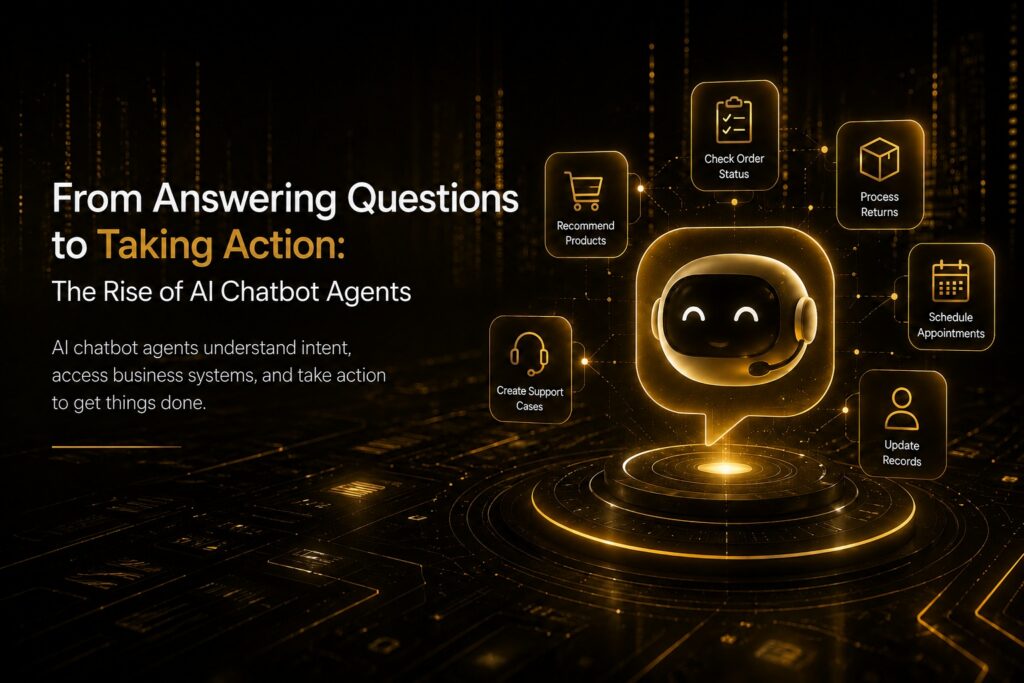
Depending on their permissions, an agent may be able to:
- Retrieve customer information
- Check order status
- Update records
- Schedule appointments
- Process eligible requests
- Recommend products
- Create support cases
- Retrieve knowledge
- Trigger workflows
- Escalate complex issues
The important distinction is action.
A conventional chatbot provides information.
An AI chatbot agent can use information to perform an approved action.
Why the Shift From Answers to Actions Matters
Customers don’t necessarily want to learn how a business works.
They want their problem solved.
Consider these two experiences.
Traditional Chatbot
Customer: “I want to return my shoes.”
Chatbot: “Here’s our return policy.”
The customer still has work to do.
AI Chatbot Agent
Customer: “I want to return my shoes.”
Agent: “I’ve found your order. The shoes are eligible for return. Would you like me to arrange the return?”
The second interaction reduces friction because the system moves from information delivery to task completion.
This is the fundamental promise of agentic customer service.
AI Chatbot Agents Can Understand Customer Intent
The first step toward taking action is understanding what the customer actually wants.
A customer may say:
“My package was supposed to arrive yesterday and I need it tomorrow.”
This isn’t simply an order-status question.
The underlying intent may involve:
- Delivery delay
- Urgency
- Order identification
- Available delivery options
- Potential compensation
An intelligent agent can analyze the context and determine which systems and actions are relevant.
This makes conversational interfaces more useful than rigid menus and scripted flows.
The Technology Behind Action-Oriented Chatbots
AI chatbot agents typically combine several capabilities.
Natural Language Understanding
The system needs to understand conversational requests, context, and intent.
Enterprise Knowledge
Agents need access to reliable information such as:
- FAQs
- Product documentation
- Policies
- Customer history
- Service information
Tool and System Access
An agent needs controlled access to the systems required to complete tasks.
These might include:
- CRM
- ERP
- Commerce platforms
- Order management
- Ticketing systems
- Scheduling platforms
Workflow Orchestration
Complex requests may require multiple actions across different systems.
Guardrails and Permissions
Agents need clear boundaries defining what they can and cannot do.
Together, these capabilities transform a chatbot from a conversational interface into an intelligent business interface.
What Can AI Chatbot Agents Actually Do?
The possibilities extend far beyond answering FAQs.
Customer Service
Agents can help:
- Check orders
- Update customer information
- Start eligible returns
- Create support cases
- Schedule appointments
- Provide troubleshooting assistance
- Escalate complex issues
Modern customer service agents are increasingly designed to retrieve information and take specified actions through connected backend systems.
Sales
AI chatbot agents can support sales teams by:
- Qualifying leads
- Answering product questions
- Recommending products
- Capturing customer requirements
- Scheduling meetings
- Updating CRM records
- Supporting follow-ups
Instead of acting as a static website assistant, the agent becomes part of the sales workflow.
E-Commerce
Commerce is another area where action-oriented AI can have a significant impact.
An AI agent could help a customer:
- Describe what they need.
- Discover relevant products.
- Compare alternatives.
- Check availability.
- Review delivery options.
- Add a product to the cart.
- Continue toward checkout.
Recent commerce developments show the shift toward agents that can connect customer conversations with product catalogs, inventory, orders, and commerce workflows.
Employee Support
The same model can be applied internally.
Employees could ask:
“I need access to the analytics dashboard.”
Instead of receiving instructions, an AI agent could:
- Verify the employee’s identity.
- Check access policies.
- Submit the request.
- Route approval.
- Track the request.
- Notify the employee.
This turns an internal chatbot into an operational assistant.
AI Chatbot Agents vs Traditional Chatbots
| Capability | Traditional Chatbot | AI Chatbot Agent |
|---|---|---|
| FAQ responses | Yes | Yes |
| Natural conversation | Limited to advanced | Yes |
| Context understanding | Basic | Advanced |
| Customer history | Limited | Can be connected |
| Enterprise data access | Limited | Controlled access |
| System actions | Limited | Yes |
| Multi-step workflows | Rare | Yes |
| Product recommendations | Basic | Context-aware |
| Task completion | Limited | Core capability |
| Human escalation | Yes | Yes, with context |
| Personalization | Basic | Advanced |
The difference isn’t that traditional chatbots suddenly become useless.
They remain effective for predictable, low-risk questions.
AI chatbot agents become valuable when customers need context, reasoning, and action.
The Biggest Business Benefit: Lower Customer Effort
Customer experience isn’t simply about providing more information.
It’s about reducing the effort required to get something done.
AI chatbot agents can reduce friction by eliminating steps such as:
- Searching through help articles
- Filling out repetitive forms
- Repeating information
- Switching between applications
- Waiting for basic requests
- Navigating complex menus
IBM notes that customers increasingly expect conversational systems to maintain context, handle ambiguity, and continue understanding a conversation rather than forcing users through rigid flows.
The more tasks an agent can safely complete, the less effort the customer needs to invest.
AI Agents Can Work Across Multiple Systems
The real value of action-oriented AI often comes from integration.
Imagine a customer asks:
“Can you change my delivery address and tell me when the package will arrive?”
The agent may need to interact with:
CRM → Order Management → Inventory → Shipping
A single conversational request can trigger multiple backend actions.
This is why enterprise integration is so important to the future of AI agents.
The chatbot interface is only the visible layer.
The real intelligence sits behind it.
Personalization Becomes More Actionable
Traditional personalization often means:
“Here are products you may like.”
Agentic personalization can go further.
For example:
“Based on your previous purchase, this replacement filter should fit your device. It’s currently available and eligible for your subscription discount. Would you like me to add it to your next order?”
The system combines:
- Customer history
- Product information
- Inventory
- Pricing
- Business rules
- Current intent
The result is personalization that can lead directly to an action.
AI Chatbot Agents Can Support Proactive Service
Traditional chatbots wait for customers to ask questions.
Agentic systems can eventually support more proactive workflows.
For example, if a business detects:
- A delayed shipment
- An expiring subscription
- A failed payment
- A service appointment
- A product recall
An AI agent could initiate an appropriate communication and guide the customer through the next step.
The objective is to move from:
Reactive support
to:
Proactive resolution
Salesforce’s 2026 customer-service research describes this broader shift toward AI agents that resolve issues, complete transactions, and support proactive customer interactions.
Human Agents Still Matter
The rise of AI chatbot agents doesn’t mean human representatives disappear.
Some situations require:
- Empathy
- Negotiation
- Strategic judgment
- Complex problem-solving
- Exception handling
- Sensitive communication
The better model is AI + human collaboration.
AI can handle:
- Routine requests
- Information retrieval
- Repetitive tasks
- Initial troubleshooting
- Workflow coordination
Humans can focus on:
- Complex cases
- Escalations
- Relationship management
- High-value decisions
- Situations requiring judgment
When an AI agent escalates an issue, it should transfer the relevant context rather than forcing the customer to start over.
Security and Governance Become More Important
The ability to take action also introduces additional responsibility.
A chatbot that only answers questions has limited ability to affect a business system.
An agent that can update records, issue refunds, change orders, or trigger workflows has much greater operational impact.
Organizations therefore need:
- Identity verification
- Role-based permissions
- Least-privilege access
- Approval thresholds
- Audit trails
- Data protection
- Monitoring
- Human escalation
- Clear agent policies
The principle should be simple:
An AI agent should only be able to perform actions it is explicitly authorized to perform.
How Businesses Should Start With AI Chatbot Agents
Organizations don’t need to automate every customer interaction immediately.
A practical approach is to start with well-defined, high-volume use cases.
Step 1: Identify Repetitive Requests
Find questions and tasks that occur frequently.
Step 2: Separate Answers From Actions
Determine which requests only require information and which require a system action.
Step 3: Connect Trusted Knowledge
Give the agent access to approved business information.
Step 4: Connect the Required Systems
Integrate only the applications necessary for the selected workflows.
Step 5: Define Permissions
Specify exactly what the agent can do automatically.
Step 6: Add Human Escalation
Create clear rules for when a human must take over.
Step 7: Measure Results
Track:
- Resolution time
- Customer satisfaction
- First-contact resolution
- Escalation rate
- Automation rate
- Customer effort
- Cost per interaction
This turns AI experimentation into a measurable business initiative.
How Moptra Can Help Businesses Move From Chatbots to Agents
At Moptra, we help businesses move beyond basic conversational AI toward intelligent, action-oriented workflows.
Our capabilities can include:
- AI Chatbot Agents
- Agentic AI
- AI Customer Support
- AI Knowledge Assistants
- AI Workflow Automation
- Intelligent Product Discovery
- Customer Intent Analysis
- Enterprise Application Integration
- Commerce AI
- Human-in-the-loop workflows
The goal is not simply to build a chatbot that sounds intelligent.
It’s to create an AI-powered interface that can understand customer needs, access trusted information, coordinate workflows, and take appropriate action.
The Future of AI Chatbot Agents
The next generation of conversational AI will increasingly be defined by what happens after the answer.
A customer won’t simply ask:
“What is your return policy?”
They may say:
“I want to return this product.”
An agent won’t simply explain the policy.
It may check eligibility, create the return request, arrange the next step, and confirm completion.
That is the fundamental evolution:
Chat → Understand → Decide → Act → Confirm
As businesses connect AI agents with more enterprise systems, conversational interfaces could become one of the primary ways customers and employees interact with business processes.
Conclusion
The chatbot era isn’t ending.
It’s evolving.
Traditional chatbots introduced businesses to conversational self-service. AI chatbot agents are taking the next step by connecting conversation with knowledge, systems, workflows, and actions.
The real value of an AI agent isn’t that it can produce a convincing answer.
It’s that it can understand what the customer is trying to accomplish and, within clearly defined permissions, help accomplish it.
That changes the role of conversational AI from:
“Ask me a question.”
to:
“Tell me what you need, and I’ll help get it done.”
For businesses, this can mean lower customer effort, faster resolution, more efficient operations, and more personalized experiences.
The future of customer service won’t be defined by AI replacing humans.
It will be defined by AI agents handling the work they are best suited for while humans focus on the decisions and interactions where human judgment matters most.
Frequently Asked Questions
What are AI chatbot agents?
AI chatbot agents are conversational AI systems that can understand user requests, retrieve information, interact with connected business systems, and perform authorized actions instead of simply providing answers.
How are AI chatbot agents different from traditional chatbots?
Traditional chatbots primarily provide predefined or AI-generated answers. AI chatbot agents can understand context, access enterprise systems, coordinate multi-step workflows, and take authorized actions.
What can an AI chatbot agent do?
Depending on its permissions and integrations, an agent can check orders, create support cases, schedule appointments, recommend products, update records, process eligible requests, and trigger workflows.
Can AI chatbot agents replace customer service employees?
They can automate many routine interactions, but they are not a complete replacement for human service teams. Humans remain important for complex, sensitive, high-value, and judgment-intensive situations.
Are AI chatbot agents secure?
They can be designed securely using authentication, role-based permissions, least-privilege access, audit logs, data protection, monitoring, and human approval for higher-risk actions.
How does Agentic AI improve chatbots?
Agentic AI gives conversational systems the ability to reason about goals, use tools, coordinate workflows, and take authorized actions. This moves the experience from answering questions toward completing tasks.
How can Moptra help businesses implement AI chatbot agents?
Moptra can help businesses design AI-powered chatbot and agentic workflows that combine conversational AI, enterprise knowledge, workflow automation, intelligent search, system integrations, and human oversight.
Related Posts
AI-Powered Customer Support Ch...
Introduction Customers expect instant responses, regardless of the time or day. An AI-Powered Customer Support Chatbot enables bu...
Do you know that 43% of the us...
Adobe Commerce, powered by #AdobeSensei, is a cutting-edge e-commerce platform that offers a range of innovative features to help...
Some of the trends that are ex...
Mobile commerce: More and more people are using their phones to shop online, and this trend is expected to continue in the coming ...