

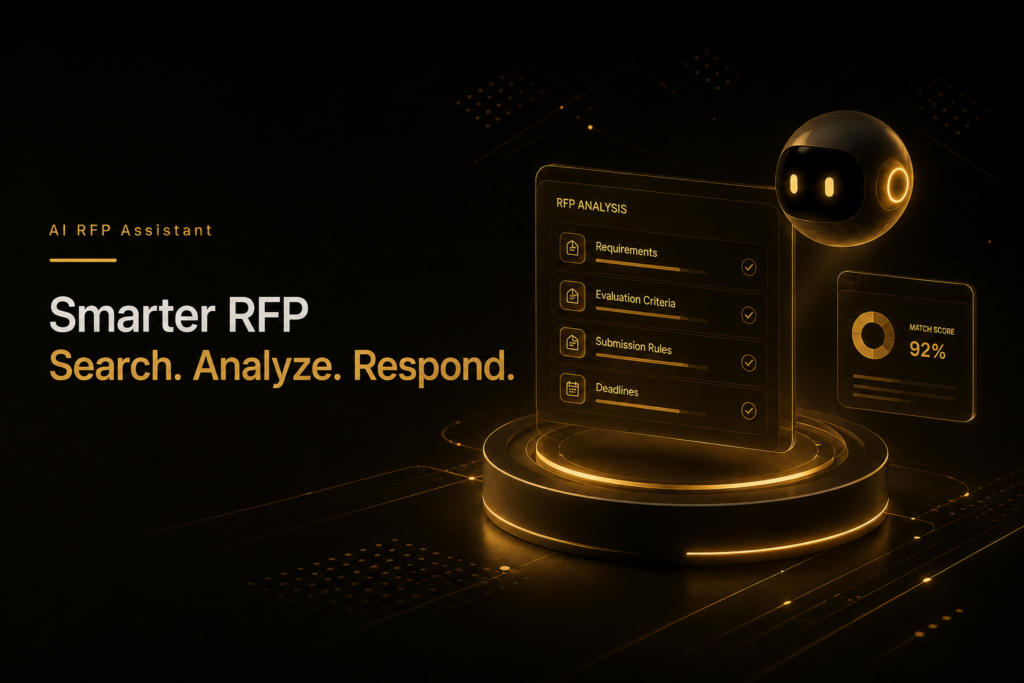
Introduction
An AI RFP Assistant can transform one of the most time-consuming processes in B2B sales: finding, analyzing, and responding to Requests for Proposals (RFPs). Sales and proposal teams often spend hours searching for relevant opportunities, reviewing lengthy documents, finding requirements, collecting information, and creating responses.
The challenge isn’t simply writing the response.
Teams need to determine whether an RFP is worth pursuing, understand what the buyer actually requires, identify gaps, find accurate information, coordinate subject-matter experts, and submit a compliant proposal before the deadline.
AI can bring these activities into a connected workflow.
Instead of treating every RFP as a manual document-processing exercise, an AI RFP Assistant can help teams discover opportunities, understand requirements, retrieve relevant knowledge, draft responses, identify missing information, and accelerate the review process.
The result is a faster and more intelligent approach to proposal management.
Why Traditional RFP Management Is So Time-Consuming
RFPs can contain hundreds of pages of requirements, questions, technical specifications, contractual conditions, evaluation criteria, and submission instructions.
A typical response process may involve:
- Finding relevant RFP opportunities
- Downloading documents
- Reviewing requirements
- Identifying deadlines
- Assigning questions to teams
- Searching previous proposals
- Finding product information
- Drafting responses
- Reviewing compliance
- Getting approvals
- Formatting the final proposal
- Submitting before the deadline
When these steps are handled manually, even a strong sales team can struggle to respond quickly.
The result can be:
- Missed opportunities
- Slow response cycles
- Repetitive work
- Inconsistent answers
- Knowledge silos
- Last-minute approvals
- Higher proposal costs
This is where AI-powered RFP automation becomes valuable.
What Is an AI RFP Assistant?
An AI RFP Assistant is an AI-powered system designed to support the end-to-end RFP response lifecycle.
Depending on its configuration, it can help teams:
- Discover relevant RFP opportunities
- Extract requirements
- Summarize documents
- Identify deadlines
- Analyze evaluation criteria
- Match requirements with capabilities
- Search internal knowledge
- Generate response drafts
- Identify unanswered questions
- Coordinate reviews
- Improve response consistency
Instead of using AI simply as a writing tool, organizations can use it as an intelligent assistant throughout the RFP workflow.
How an AI RFP Assistant Works
An effective AI RFP workflow can be divided into several stages.
1. Find Relevant RFP Opportunities
The first challenge is finding opportunities that are actually worth pursuing.
AI can help organizations analyze RFP sources and identify opportunities based on criteria such as:
- Industry
- Geography
- Solution requirements
- Contract value
- Customer type
- Technology requirements
- Submission deadlines
This helps sales teams focus their attention on opportunities that align with their capabilities.
2. Analyze RFP Documents
Once an RFP is identified, AI can process lengthy documents and extract important information.
It can help identify:
- Scope of work
- Requirements
- Evaluation criteria
- Submission rules
- Important dates
- Mandatory certifications
- Technical requirements
- Commercial requirements
Instead of manually reading every page before understanding the opportunity, teams can start with an AI-generated overview.
3. Summarize What Actually Matters
RFP documents often contain large amounts of information.
An AI RFP Assistant can turn complex documents into structured summaries.
For example:
Opportunity Summary
- Buyer
- Project
- Deadline
- Contract duration
- Estimated requirements
Technical Requirements
- Required platforms
- Integrations
- Security requirements
- Technical capabilities
Commercial Requirements
- Pricing structure
- Contract terms
- Payment conditions
Submission Requirements
- Required documents
- File formats
- Submission method
- Deadline
This allows teams to quickly understand the opportunity before investing significant response effort.
AI Can Score RFP Opportunities
Not every RFP deserves the same level of investment.
One of the most valuable capabilities of an AI RFP Assistant is helping teams evaluate opportunities before committing resources.
AI can analyze factors such as:
- Capability fit
- Customer requirements
- Previous experience
- Competition
- Contract size
- Deadline
- Resource availability
- Technical complexity
The system can then help teams classify opportunities as:
High Priority
Strong alignment and attractive opportunity.
Medium Priority
Potentially valuable but requires further assessment.
Low Priority
Limited alignment or high response effort.
The final bid/no-bid decision should remain with the appropriate sales or leadership team.
AI Finds Answers Hidden Across Enterprise Knowledge
One of the biggest challenges in RFP responses is finding accurate information.
The answer to one RFP question may already exist somewhere inside the organization:
- Previous proposals
- Case studies
- Product documentation
- Security documents
- Sales presentations
- Technical specifications
- Company policies
- Customer references
The problem is knowing where to find it.
An AI RFP Assistant connected to an enterprise knowledge base can retrieve relevant information and use it to support response creation.
This turns organizational knowledge into a reusable sales asset.
AI RFP Response Generation
Once requirements are understood, AI can help create initial response drafts.
For example, if an RFP asks:
“Describe your experience implementing enterprise commerce platforms.”
The AI can retrieve approved information about:
- Relevant services
- Previous projects
- Industry experience
- Technology capabilities
- Case studies
It can then generate a structured draft for the proposal team to review.
The important point is that AI should assist with the response, not blindly invent one.
Responses should be grounded in verified company information.
AI Helps Maintain Response Consistency
Large RFP responses often involve multiple contributors.
Sales may answer commercial questions.
Engineering may answer technical questions.
Security teams may handle compliance requirements.
Legal teams may review contractual sections.
Without a centralized process, responses can become inconsistent.
AI can help teams maintain consistency across:
- Terminology
- Product descriptions
- Company information
- Technical capabilities
- Customer references
- Messaging
This is especially useful for organizations responding to large enterprise RFPs.
AI Identifies Gaps Before Submission
A proposal can fail even when the solution itself is strong.
Why?
Because the response may miss a mandatory requirement.
AI can review draft responses and identify:
- Unanswered questions
- Missing attachments
- Incomplete sections
- Unsupported claims
- Conflicting information
- Requirement mismatches
This provides another quality-control layer before final submission.
AI RFP Assistant vs Traditional RFP Process
| Traditional RFP Process | AI RFP Assistant |
|---|---|
| Manual opportunity discovery | AI-assisted opportunity discovery |
| Manual document review | Automated document analysis |
| Spreadsheet-based tracking | Intelligent workflow |
| Manual knowledge search | AI-powered knowledge retrieval |
| Manual drafting | AI-assisted response generation |
| Manual gap identification | Automated response checks |
| Repetitive research | Reusable enterprise knowledge |
| Multiple disconnected tools | Connected RFP workflow |
AI doesn’t eliminate the need for proposal professionals.
It removes much of the repetitive work surrounding them.
Benefits of an AI RFP Assistant
Faster RFP Analysis
Teams can understand lengthy RFP documents more quickly.
Reduced Response Time
AI accelerates research, drafting, and review.
Better Knowledge Reuse
Previous proposals and enterprise knowledge become easier to access.
Improved Response Quality
AI can identify missing information and inconsistencies.
Higher Team Productivity
Proposal teams spend less time searching and formatting.
Better Opportunity Prioritization
AI helps teams focus resources on the most relevant opportunities.
Greater Scalability
Organizations can manage more RFPs without increasing manual effort at the same rate.
A Practical AI RFP Workflow
A modern RFP process can look like this:
Step 1: Discover
AI identifies relevant RFP opportunities.
Step 2: Analyze
AI extracts requirements, deadlines, evaluation criteria, and submission instructions.
Step 3: Qualify
Sales teams evaluate whether the opportunity is worth pursuing.
Step 4: Retrieve
AI searches approved enterprise knowledge for relevant information.
Step 5: Draft
AI generates initial responses based on verified information.
Step 6: Review
Subject-matter experts validate technical and business responses.
Step 7: Validate
AI checks for missing requirements, inconsistencies, and unanswered questions.
Step 8: Submit
The final proposal goes through the organization’s approval and submission process.
This creates a connected workflow instead of a collection of disconnected manual tasks.
Where Agentic AI Takes RFP Automation Further
Traditional AI can help answer questions.
Agentic AI can coordinate the workflow around those questions.
For example, an Agentic AI system could:
- Detect a new RFP.
- Extract its requirements.
- Identify relevant internal experts.
- Retrieve supporting information.
- Generate draft responses.
- Route sections to reviewers.
- Identify unresolved questions.
- Track completion.
- Escalate overdue tasks.
- Prepare the final response package.
This shifts RFP management from AI-assisted writing toward AI-powered workflow orchestration.
The Role of Human Review
AI should not operate without appropriate oversight.
Human experts remain essential for:
- Strategic decisions
- Bid/no-bid decisions
- Technical validation
- Pricing
- Legal review
- Contract interpretation
- Customer-specific commitments
- Final proposal approval
The ideal model is:
AI handles repetitive intelligence work.
Humans handle judgment and accountability.
Security and Governance for AI RFP Systems
RFPs can contain commercially sensitive information.
An AI RFP solution therefore needs appropriate security controls.
Organizations should consider:
- Role-based access
- Authentication
- Data encryption
- Document permissions
- Audit trails
- Knowledge-base access controls
- Human approval
- Data retention policies
AI should only retrieve information that the user is authorized to access.
This is especially important when RFP workflows involve confidential customer, pricing, legal, or technical information.
How Moptra Can Help Build an AI RFP Workflow
At Moptra, we help businesses explore AI-powered workflows that connect enterprise knowledge, intelligent automation, and Agentic AI.
An AI RFP solution can combine capabilities such as:
- RFP discovery
- Document analysis
- Requirement extraction
- AI Knowledge Assistants
- Enterprise search
- Response generation
- Workflow automation
- Approval routing
- Gap analysis
- Agentic workflow orchestration
The goal is to help sales and proposal teams move from manually processing documents to managing an intelligent, connected RFP workflow.
Moptra’s broader Agentic AI approach focuses on connecting AI agents with business knowledge, workflows, and enterprise systems to support goal-oriented business processes.
Best Practices for Implementing an AI RFP Assistant
Start With a Specific RFP Workflow
Don’t try to automate everything immediately.
Begin with a measurable use case such as:
RFP document analysis → requirement extraction → response drafting.
Use Trusted Enterprise Knowledge
AI-generated responses should be grounded in approved:
- Product information
- Case studies
- Technical documentation
- Company capabilities
- Security information
- Previous proposals
Keep Humans in the Loop
AI-generated answers should be reviewed before being submitted to customers.
Track Performance
Measure:
- RFP processing time
- Response preparation time
- Number of RFPs handled
- Review time
- Missing requirements
- Response accuracy
- Win rate
This helps demonstrate whether the AI workflow is creating measurable value.
The Future of RFP Management
RFP management is moving toward intelligent, automated workflows.
Future systems will increasingly be capable of understanding opportunities, analyzing requirements, retrieving organizational knowledge, coordinating teams, and assisting with proposal creation.
The biggest shift won’t be AI writing better proposals.
It will be AI helping businesses manage the entire RFP lifecycle.
That means sales teams can spend less time searching through documents and more time developing winning strategies, understanding buyers, and building stronger proposals.
Conclusion
RFP management has traditionally been a document-heavy, time-consuming process involving research, collaboration, drafting, review, and repetitive information retrieval.
An AI RFP Assistant can change that.
By helping teams discover opportunities, analyze requirements, retrieve trusted knowledge, generate response drafts, identify gaps, and coordinate workflows, AI can dramatically reduce the manual effort involved in proposal management.
The real opportunity, however, goes beyond generating proposal text.
With Agentic AI and workflow automation, organizations can create an intelligent RFP ecosystem that connects opportunity discovery, enterprise knowledge, response creation, collaboration, review, and submission.
The future of RFP management isn’t simply about writing proposals faster.
It’s about turning the entire RFP process into an intelligent business workflow.
Frequently Asked Questions
What is an AI RFP Assistant?
An AI RFP Assistant is an AI-powered system that helps businesses discover, analyze, qualify, and respond to Requests for Proposals by automating research, document analysis, knowledge retrieval, drafting, and workflow activities.
How can AI help with RFP responses?
AI can extract requirements, summarize documents, find relevant company information, generate initial response drafts, identify missing answers, and help teams review proposals before submission.
Can an AI RFP Assistant find RFP opportunities?
Yes. Depending on its integrations and configuration, an AI RFP Assistant can help identify relevant RFP opportunities based on criteria such as industry, geography, requirements, deadlines, and business fit.
Can AI write an entire RFP response?
AI can generate substantial portions of an RFP response, but human review remains important. Technical, legal, pricing, contractual, and customer-specific claims should be validated before submission.
Is AI RFP automation useful for enterprise sales teams?
Yes. Enterprise sales teams often manage complex RFPs containing large volumes of information. AI can reduce research and administrative work while making organizational knowledge easier to reuse.
How does Agentic AI improve RFP management?
Agentic AI can coordinate multiple steps in the RFP lifecycle, such as analyzing documents, retrieving information, assigning tasks, generating drafts, tracking reviews, identifying gaps, and escalating unresolved work.
How can Moptra help with AI RFP automation?
Moptra can help businesses design AI-powered RFP workflows that combine enterprise knowledge, AI agents, document analysis, workflow automation, intelligent search, and human approval processes to make RFP management faster and more scalable.
Related Posts
Agentic AI for Modern Business...
Introduction Agentic AI for Modern Businesses is transforming how organizations operate in 2026. Unlike traditio...
Three key takeaways from speci...
1.Strategy first, technology second Technology is only a facilitator. The fundamental elements, such as knowing what your strateg...
AI-Powered Customer Support Ch...
Introduction Customers expect instant responses, regardless of the time or day. An AI-Powered Customer Support Chatbot enables bu...