

Introduction
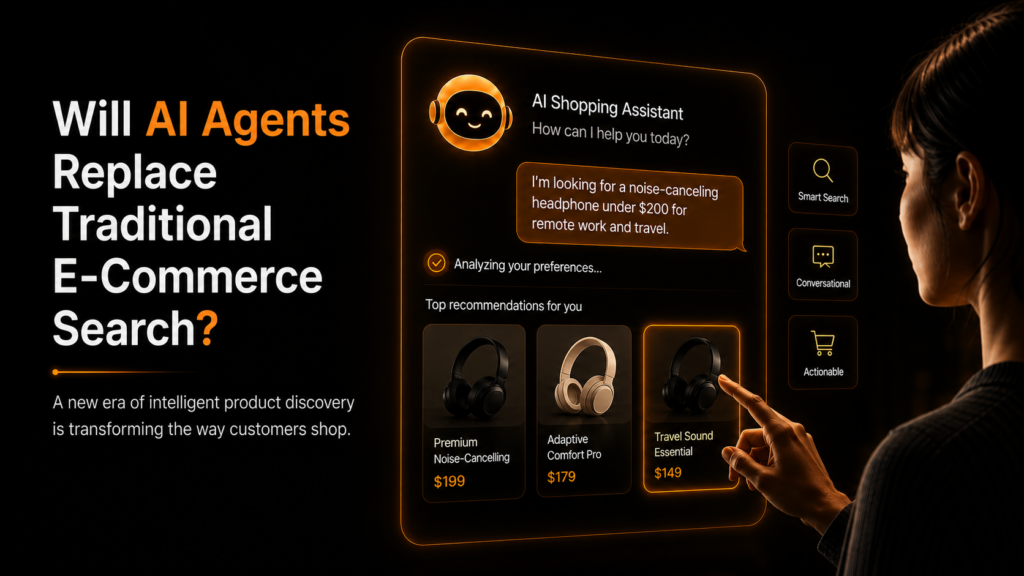
Will AI Agents Replace Traditional E-commerce Search? It’s a question many retailers, brands, and e-commerce leaders are asking as artificial intelligence continues to reshape digital shopping. For years, customers have relied on keyword-based search bars to find products. However, modern shoppers expect more than a list of results—they want personalized recommendations, conversational assistance, and instant answers.
AI agents are introducing a new way to discover products by understanding customer intent, learning preferences, and guiding purchasing decisions. While traditional search isn’t disappearing overnight, AI agents are rapidly becoming a core part of the next generation of e-commerce experiences.
How Traditional E-commerce Search Works
Most online stores rely on keyword matching.
A customer searches for:
- “Blue office chair”
- “Running shoes”
- “Wireless headphones”
The platform returns products that match those keywords.
Although search technology has improved over the years with filters, synonyms, and autocomplete, it still depends heavily on customers knowing exactly what to search for.
Common limitations include:
- Keyword dependency
- Irrelevant search results
- Limited personalization
- Poor understanding of customer intent
- Difficulty handling conversational queries
These challenges often lead to abandoned searches and missed sales opportunities.
What Are AI Agents?
AI agents are intelligent digital assistants capable of understanding context, reasoning through customer requests, and completing tasks autonomously.
Instead of simply matching keywords, AI agents can:
- Understand natural language
- Learn customer preferences
- Recommend products
- Compare alternatives
- Answer product questions
- Guide purchasing decisions
- Complete multi-step shopping tasks
This creates a shopping experience that feels more like talking to an expert than using a search engine.
AI Agents vs Traditional Search
| Traditional Search | AI Agents |
|---|---|
| Keyword-based | Intent-based understanding |
| Static search results | Personalized recommendations |
| Customer searches alone | AI guides the shopping journey |
| Limited context | Remembers conversation context |
| Manual filtering | Intelligent product suggestions |
| One-time interaction | Continuous conversational assistance |
The biggest difference is that AI agents actively help customers find the right product instead of simply displaying search results.
Why AI Agents Are Changing Product Discovery
Modern customers increasingly use conversational queries instead of short keywords.
Instead of searching:
“Office chair”
They ask:
“I work from home eight hours a day. Which ergonomic chair is best for my back under $500?”
Traditional search struggles with these requests.
AI agents understand:
- Budget
- Product category
- Customer intent
- Usage scenario
- Personal preferences
This enables much more accurate recommendations.
Benefits of AI Agents for E-commerce
Businesses adopting AI-powered shopping assistants can achieve several advantages.
Better Customer Experience
Customers receive relevant recommendations faster.
Higher Conversion Rates
Personalized recommendations increase purchase confidence.
Reduced Cart Abandonment
AI agents answer questions before customers leave.
Improved Product Discovery
Customers discover products they might never find through traditional search.
Increased Average Order Value
AI agents intelligently recommend complementary products.
24/7 Shopping Assistance
Customers receive guidance anytime without human intervention.
Will Traditional Search Disappear?
Probably not.
Traditional search remains valuable for customers who know exactly what they want.
For example:
- SKU searches
- Exact product names
- Brand-specific searches
- Repeat purchases
However, AI agents will increasingly work alongside traditional search to create a hybrid shopping experience.
Many leading retailers are already combining:
- Search
- AI recommendations
- Conversational assistants
- Personalized merchandising
- Predictive analytics
The future isn’t about replacing search entirely—it’s about making search smarter.
Industries That Will Benefit Most
AI-powered product discovery can significantly improve customer experiences in industries such as:
- Retail
- Fashion
- Electronics
- Furniture
- Home Décor
- Beauty
- Automotive Parts
- Healthcare
- Industrial Supplies
- B2B Commerce
Each industry can leverage AI agents to simplify complex buying decisions.
The Role of AI Agents in B2B Commerce
B2B purchasing is often more complex than consumer shopping.
Business buyers need:
- Contract pricing
- Technical specifications
- Product compatibility
- Bulk ordering
- Inventory availability
- Quote generation
AI agents can understand these requirements and guide buyers through the purchasing process while reducing the workload on sales teams.
How Moptra Helps Businesses Embrace Agentic Commerce
At Moptra, we help organizations move beyond traditional search by implementing intelligent commerce solutions powered by AI.
Our expertise includes:
- AI-powered product discovery
- Conversational shopping assistants
- AI chatbot integration
- Commerce platform modernization
- Enterprise search optimization
- Personalized customer experiences
- Workflow automation
- Agentic AI solutions
Our goal is to help businesses deliver faster, smarter, and more engaging shopping experiences.
The Future of E-commerce Search
The next generation of digital commerce will be built around intelligent conversations rather than simple keyword matching.
Future AI agents will:
- Understand customer intent in real time
- Predict shopping needs
- Offer proactive recommendations
- Compare products intelligently
- Automate purchasing workflows
- Integrate with enterprise systems
- Learn continuously from customer interactions
Businesses that adopt these technologies early will be better positioned to deliver personalized and frictionless shopping experiences.
Conclusion
So, will AI agents replace traditional e-commerce search? Not entirely—but they are redefining how customers discover, evaluate, and purchase products.
Traditional search will continue to play an important role for straightforward queries, while AI agents will enhance shopping through conversational assistance, personalization, and intelligent recommendations. Together, these technologies create a more seamless and engaging customer journey.
For businesses, the opportunity is clear: embracing AI-powered product discovery today can improve customer satisfaction, increase conversions, and build a future-ready commerce experience. Companies that invest in agentic commerce now will be well-positioned to lead the next era of digital retail.
Frequently Asked Questions
Will AI agents completely replace e-commerce search?
Not in the near future. AI agents are expected to complement traditional search by providing conversational assistance, personalized recommendations, and intent-based product discovery.
What is the difference between AI agents and traditional search?
Traditional search relies on keywords, while AI agents understand natural language, customer intent, and preferences to deliver more relevant recommendations and guidance.
Which businesses benefit most from AI agents?
Retailers, manufacturers, B2B companies, home décor brands, electronics stores, fashion brands, and enterprise e-commerce businesses can all benefit from AI-powered shopping assistants.
How can Moptra help businesses adopt AI-powered commerce?
Moptra helps businesses implement AI-driven product discovery, conversational shopping assistants, commerce platform modernization, workflow automation, and agentic AI solutions to create intelligent shopping experiences.
Related Posts
Here are some ways in which Ch...
With the availability of ChatGPT-4, app developers can leverage this technology in several ways to enhance their app's functionali...
Why HCL Commerce is Shaping th...
in the dynamic landscape of B2B eCommerce, enterprise buyers are demanding the same speed, personalization, and experience they r...
Join the Moptra Infotech Famil...
Introduction: At Moptra Infotech, we believe in creating a positive and inclusive work environment where our employees can thrive....