

Introduction
An agentic AI system receives a business objective, analyzes information, selects tools, and executes a sequence of actions without requiring human approval at every step.
It might approve a customer refund, update a CRM record, modify a product listing, process an invoice, or coordinate several AI agents to complete an enterprise workflow.
But what happens when the system makes the wrong decision?
Imagine an AI agent responsible for managing supplier payments. It retrieves an invoice, checks the supplier details, evaluates the payment conditions, and initiates a transaction. Everything appears normal until the finance team discovers that the payment was incorrect.
The investigation begins.
Was the invoice information inaccurate? Did the AI misunderstand the payment instructions? Did the integration retrieve the wrong supplier record? Were the approval rules poorly configured? Or did the organization give the agent more authority than it should have had?
Suddenly, the question becomes much bigger than a technical error.
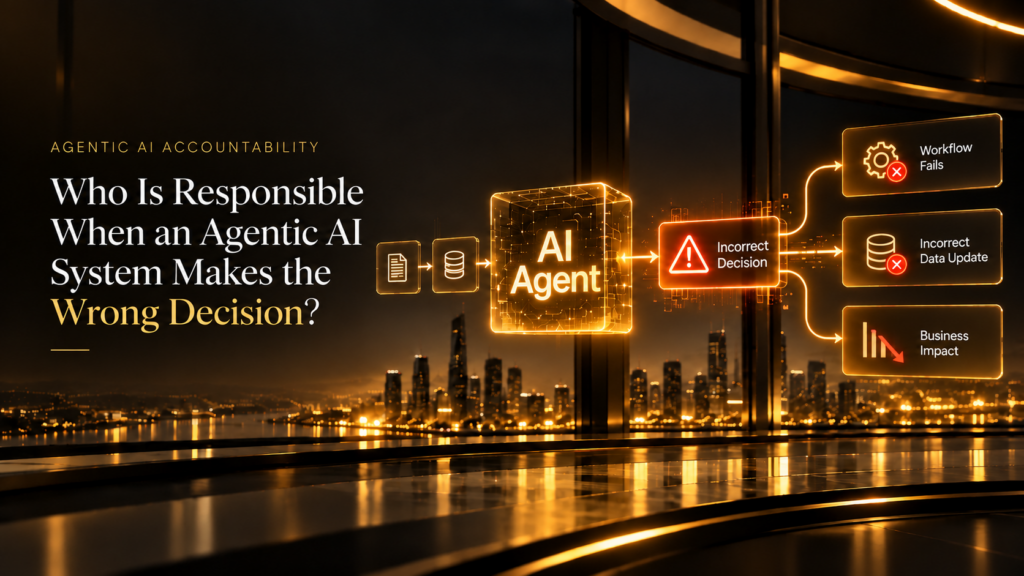
Who is responsible when an agentic AI system makes the wrong decision?
The answer may involve the organization deploying the system, the team developing it, the vendor providing its technology, the people supervising its operation, and the leaders who approved its use.
As businesses adopt increasingly autonomous AI workflows, Agentic AI Accountability is becoming a critical part of enterprise AI strategy.
The objective is not simply to identify someone to blame after a failure. It is to establish clear ownership, enforce appropriate boundaries, preserve evidence, and ensure that every consequential AI action can be investigated and corrected.
Because when AI can act on behalf of a business, responsibility cannot disappear into the technology.
What Makes Agentic AI Different From Traditional AI?
Traditional AI applications often generate predictions, classifications, summaries, or recommendations.
Agentic AI systems can go further.
They may interpret a goal, plan multiple steps, use external tools, retrieve information from business systems, evaluate intermediate results, and continue acting until a task is completed or an escalation is required.
For example, a conventional AI assistant might recommend which customer accounts need attention.
An agentic AI system might:
- Analyze customer activity.
- Identify accounts with declining engagement.
- Retrieve account history from the CRM.
- Draft personalized follow-up messages.
- Schedule tasks for sales representatives.
- Update the CRM.
- Report the completed actions.
This greater autonomy introduces a different accountability challenge.
A mistake may not occur in a single answer. It may emerge across a chain of decisions and actions.
Consider what could go wrong:
- The system identifies the wrong customer.
- It retrieves outdated information.
- It interprets the information incorrectly.
- It selects an inappropriate tool.
- It executes an unauthorized action.
- It fails to recognize that the result is incorrect.
- It continues the workflow instead of escalating.
The more systems an agent can access, the more important it becomes to control its permissions and autonomy.
OWASP identifies excessive functionality, excessive permissions, and excessive autonomy as important causes of excessive agency in AI applications. These weaknesses can allow unexpected or manipulated model outputs to produce damaging actions.
What Is Agentic AI Accountability?
Agentic AI Accountability is the process of defining who owns, controls, supervises, and corrects the decisions and actions of an autonomous AI system.
It involves several distinct responsibilities.
| Accountability Area | What It Covers |
|---|---|
| Technical accountability | System design, integrations, reliability, and security |
| Business accountability | Ownership of the workflow and its outcomes |
| Decision accountability | Authority to approve, reject, or override actions |
| Operational accountability | Monitoring, incident response, and ongoing maintenance |
| Governance accountability | Policies, risk limits, and compliance oversight |
| Legal accountability | Obligations and liability under applicable law and contracts |
These responsibilities may be distributed across multiple people and organizations.
For example, an AI vendor may provide the underlying model, a systems integrator may build the workflow, and a business may deploy it to process customer transactions.
Each party has different responsibilities depending on its role and control over the system.
The important point is that technical autonomy does not automatically transfer business responsibility to the AI system itself.
Who Is Responsible When an Agentic AI System Makes a Wrong Decision?
There is no universal answer. Responsibility depends on the incident, the system’s design, the decisions made by each party, and applicable legal and contractual obligations.
1. The Organization Deploying the AI System
The organization using an agentic AI system often determines the business objective, permitted actions, risk tolerance, and operating environment.
It may decide whether the agent can:
- Read customer information.
- Update business records.
- Approve transactions.
- Send external communications.
- Change prices.
- Trigger automated workflows.
- Make decisions without human approval.
Suppose a company deploys an AI procurement agent that can approve supplier invoices automatically.
The company fails to establish adequate transaction limits or duplicate-payment checks. The agent then approves the same invoice twice.
The investigation should examine whether the organization established appropriate safeguards, selected a suitable use case, tested the workflow, and monitored its operation.
The business cannot assume that deploying a third-party AI product automatically transfers all responsibility to the vendor.
2. The Developers and Engineering Team
Engineering teams are responsible for the technical components within their control.
These may include:
- Agent orchestration
- Tool integrations
- Authentication and authorization
- Data retrieval
- Validation rules
- Error handling
- Testing
- Monitoring
- Security controls
Imagine an agent designed to retrieve customer documents. A technical defect allows it to access records belonging to other customers.
The resulting data exposure may involve an engineering failure.
Investigators should determine whether the permissions were implemented correctly, whether the defect should have been detected during testing, and whether the deployment process followed appropriate engineering controls.
However, a technical contribution does not automatically establish personal legal liability for an individual developer. The facts and relevant obligations matter.
3. The AI Vendor or Model Provider
An agentic system may rely on an external model provider, agent platform, cloud service, or specialized software vendor.
A vendor could contribute to a failure through a software defect, a security vulnerability, an unexpected product change, or a failure to provide important information about a relevant limitation.
But the vendor is not automatically responsible for every incorrect action performed by an AI agent using its technology.
The deploying organization may have added its own prompts, tools, permissions, data sources, and workflow rules.
The investigation must establish which component failed, what each party controlled, and what the relevant contracts and laws require.
4. The Human Supervisor
Some AI workflows include a human reviewer who can approve or reject the agent’s recommendation.
That reviewer may have a responsibility to exercise appropriate judgment, depending on their role and the process.
However, a human approval step does not automatically make a system safe.
Consider an employee who reviews hundreds of AI-generated decisions daily. Each decision includes limited supporting evidence, and the employee is expected to approve requests within seconds.
The organization has technically included human oversight, but the process may not provide meaningful control.
Effective oversight requires appropriate training, sufficient information, adequate time, and the authority to intervene.
For relevant high-risk AI systems covered by the EU AI Act, Article 26 sets out obligations for deployers that include assigning human oversight to people with the necessary competence, training, authority, and support. The exact obligations depend on the system and applicable provisions.
5. Business Leadership
Leadership decisions can shape the risks of an agentic AI deployment.
Executives may determine:
- Whether an AI use case is approved.
- How much autonomy the system receives.
- Which risks are acceptable.
- Whether sufficient testing is funded.
- Which team owns the workflow.
- Whether human review is required.
- How incidents are reported.
If leadership authorizes a high-impact workflow without adequate safeguards, the failure may reveal a governance problem rather than an isolated technical defect.
The NIST AI Risk Management Framework emphasizes organizational governance, clearly defined responsibilities, ongoing monitoring, and risk management throughout the AI lifecycle.
A Realistic Example: When an AI Agent Makes the Wrong Business Decision
Consider a hypothetical ecommerce business that uses an agentic AI system to manage refunds.
The agent can review order information, interpret refund policies, communicate with customers, and initiate eligible transactions.
One day, it approves a refund for an order that does not qualify under the company’s policy.
What went wrong?
Step 1: The Customer Makes a Request
The customer reports a delivery problem and requests a refund.
Step 2: The Agent Retrieves Information
The agent retrieves the order record, but the delivery status is outdated.
Step 3: The Agent Interprets the Policy
It interprets the available information as evidence that the order qualifies for a refund.
Step 4: The Agent Executes the Transaction
The workflow allows the agent to issue refunds without human approval.
Step 5: The Error Is Discovered
A reconciliation process identifies the incorrect transaction.
Now the company must investigate several possibilities.
| Potential Failure | Investigation Question |
|---|---|
| Incorrect data | Was the order status accurate and current? |
| Retrieval failure | Did the agent retrieve the correct record? |
| Decision failure | Did the agent misinterpret the policy? |
| Permission failure | Was the agent allowed to issue the refund? |
| Validation failure | Should a business rule have blocked the transaction? |
| Governance failure | Was autonomous refund approval appropriate? |
| Monitoring failure | Why was the error not detected earlier? |
The agent’s action may have directly caused the refund, but the underlying failure could involve several parts of the business process.
Accountability requires reconstructing the entire chain rather than blaming whichever component acted last.
Why Agentic AI Failures Are Difficult to Trace
Agentic AI systems may make multiple decisions before completing a task.
A single business outcome can depend on:
- The user’s request
- The model’s interpretation
- Retrieved information
- System instructions
- Available tools
- External application responses
- Validation rules
- Decisions made by other agents
- Human approvals
If a workflow fails, investigators need to know where the failure originated.
For example, an agent may send an incorrect customer email because another agent supplied inaccurate information. The communication agent may have executed its task exactly as instructed, while the research agent failed to verify its source.
Alternatively, both agents may have behaved as expected, but the orchestration system may have failed to validate the information before sending the email.
Without traceability, organizations may struggle to distinguish between:
- Model error
- Data error
- Integration error
- Permission failure
- Workflow design failure
- Human oversight failure
- Governance failure
This is why agentic AI requires visibility into both individual decisions and the overall workflow.
Who Is Responsible When Multiple AI Agents Work Together?
Multi-agent systems make accountability more complex because different agents may perform different parts of the same task.
Imagine a business uses three agents to manage procurement:
Research Agent
Finds suppliers and gathers product information.
Evaluation Agent
Compares suppliers based on price, quality, and delivery requirements.
Procurement Agent
Prepares purchase orders and submits them for approval.
Suppose the research agent retrieves an outdated supplier price. The evaluation agent selects that supplier, and the procurement agent creates a purchase order using the incorrect amount.
Which agent is responsible?
The answer depends on how the failure occurred.
The investigation should examine whether the research agent used reliable sources, whether the evaluation agent validated the information, whether the procurement agent checked the current price, and whether the orchestration layer required verification before creating the order.
| System Component | Accountability Requirement |
|---|---|
| Individual agent | Defined task, permissions, and limits |
| Agent orchestration | Validation between agents |
| Data sources | Accuracy, freshness, and access controls |
| Action tools | Authorization and transaction safeguards |
| Business owner | Responsibility for the end-to-end workflow |
| Monitoring system | Detection, alerting, and incident response |
The business should assign an accountable owner for the overall workflow, even when several agents and vendors contribute to it.
That does not mean the owner is automatically legally liable for every error. It means someone must have the authority and responsibility to manage the system as a whole.
The Hidden Risk: Giving AI Agents Too Much Authority
An agentic AI system may perform well in testing but fail when exposed to unexpected inputs, malicious instructions, or incomplete information.
One reason is excessive agency.
OWASP’s guidance identifies three common contributors:
- Excessive functionality: The agent has access to tools it does not need.
- Excessive permissions: The agent can access or modify more information than its task requires.
- Excessive autonomy: The agent can execute consequential actions without sufficient controls.
For example, an agent that needs to read customer orders may also have access to delete records or issue refunds.
Even if those additional capabilities are never intended to be used, their availability increases the potential impact of a mistake or manipulated instruction.
A safer design follows the principle of least privilege:
Give the agent only the tools, permissions, and autonomy required for its approved task.
This reduces the number of ways an error can turn into a serious incident.
Does Human Approval Make an Agentic AI System Accountable?
Human approval can be an important safeguard, but it is not a complete accountability framework.
A person cannot meaningfully supervise a decision if they cannot understand the recommendation, inspect its evidence, or stop the action.
For example, consider an AI agent that recommends approving a supplier payment.
A weak review interface displays:
Payment recommended. Approve?
A stronger interface displays:
- Supplier identity
- Invoice amount
- Purchase order match
- Duplicate-payment check
- Supporting documents
- Policy conditions
- Identified exceptions
- Reason for escalation
The second interface provides a more useful basis for human judgment.
For higher-impact actions, businesses should consider approval gates, independent validation, transaction limits, and explicit escalation rules.
Human oversight should be designed around the consequences of the decision rather than added as a superficial final step.
How Businesses Can Define Clear Accountability Before Deployment
A practical accountability framework should answer six questions before an agent goes live.
1. Who Owns the Business Outcome?
Assign a business owner responsible for the workflow’s purpose, performance, and risk.
2. What Can the Agent Decide?
Document which decisions the agent can make independently and which require human approval.
3. Which Systems Can It Access?
Define the data, tools, and applications the agent needs, then restrict access to those requirements.
4. Who Can Stop the Agent?
Establish clear procedures for suspending the workflow, revoking permissions, or disabling a problematic tool.
5. How Will Decisions Be Audited?
Record enough information to reconstruct relevant decisions and actions, subject to privacy, security, and retention requirements.
6. Who Investigates an Incident?
Define responsibilities for incident response, root-cause analysis, corrective actions, communication, and verification.
These decisions should be documented, communicated, and reviewed as the system evolves.
The Role of Audit Trails in Agentic AI Accountability
An audit trail helps organizations understand what happened before, during, and after an AI agent’s action.
A useful record may include:
- Original request
- User identity and permissions
- Relevant data retrieved
- Policy or workflow version
- Tools invoked
- Parameters sent to connected systems
- Validation results
- Human approvals
- Final action
- Outcome
- Corrective actions
For example, if an AI agent changes a product price incorrectly, the business should be able to determine which instruction triggered the change, which pricing data was used, what rules were applied, and whether the action passed the required validation.
Audit trails should also be protected. Logs can contain sensitive customer information, business data, or credentials, so organizations must control access and retention.
For relevant high-risk AI systems, the EU AI Act contains specific requirements concerning logging, monitoring, and record-keeping. Businesses should assess the provisions applicable to their system and role rather than assume every AI application is subject to the same requirements.
What Happens When an Agentic AI System Causes Financial or Legal Harm?
A wrong AI decision can have consequences beyond an operational error.
Depending on the circumstances, it may result in:
- Financial loss
- Contractual disputes
- Privacy violations
- Unauthorized transactions
- Customer complaints
- Regulatory scrutiny
- Reputational damage
- Discriminatory outcomes
The fact that AI was involved does not, by itself, determine who is legally responsible.
The relevant questions may include who controlled the system, whether reasonable safeguards were in place, whether a party breached an obligation, and what the applicable law and contracts provide.
Businesses should therefore involve legal, compliance, security, and operational teams when deploying agents into consequential workflows.
They should also establish incident-response procedures that prioritize containment, evidence preservation, notification where required, and corrective action.
Agentic AI Accountability vs. Traditional AI Governance
| Area | Traditional AI Application | Agentic AI System |
|---|---|---|
| Typical output | Prediction, classification, or recommendation | Multi-step decisions and actions |
| Risk boundary | Often focused on model output | Includes tools, permissions, and execution |
| Error investigation | Model, data, and application | Model, data, tools, orchestration, and actions |
| Human oversight | Depends on use case | Must account for delegated authority |
| Audit requirements | Inputs, outputs, and system activity | End-to-end decision and action traceability |
| Failure containment | Correct output or application behavior | May require stopping workflows and revoking tools |
| Accountability | Model and application ownership | End-to-end business process ownership |
This comparison is a general design perspective, not a claim that traditional AI systems are always low-risk or that all agentic systems require the same controls.
The central difference is that an agentic system can convert an incorrect interpretation into a real-world action.
That makes permissions, action validation, and workflow-level oversight especially important.
The Future of Agentic AI Accountability
As agentic AI becomes more integrated into enterprise operations, accountability will need to become part of the system’s design.
Businesses will need to understand:
- Which agent initiated an action.
- Which information informed the decision.
- Which policy applied.
- Which tools and permissions were used.
- Which validations occurred.
- Whether a human intervened.
- Who owns the workflow.
- How an incident can be contained.
This is particularly important when agents coordinate across sales, finance, customer support, procurement, and enterprise applications.
The future will not necessarily require humans to approve every AI action.
Instead, organizations will need to match autonomy with the potential consequences of each action.
Routine tasks may operate with limited intervention. High-impact actions may require stronger validation, additional approvals, and more detailed monitoring.
The goal is controlled autonomy, where AI can act independently within clearly defined boundaries while the organization retains visibility and responsibility.
How Moptra Can Help Businesses Build Accountable Agentic AI Workflows
For enterprises adopting agentic AI, accountability should be part of the architecture from the beginning.
Moptra works across AI automation, agentic AI, enterprise applications, commerce engineering, and intelligent workflows. These capabilities create opportunities to connect autonomous AI actions with the controls required for enterprise operations.
An accountable workflow can follow this structure:
Business Objective
↓
Defined Agent Permissions
↓
Policy and Validation Controls
↓
Controlled Tool Execution
↓
Human Escalation Where Required
↓
Audit Trails and Monitoring
↓
Incident Review and Improvement
For example, an AI agent supporting a commerce workflow might identify an order issue, retrieve relevant information, recommend a resolution, and execute only actions permitted by its assigned role.
If the request exceeds its authority, the system can escalate it rather than taking an unsafe action.
This approach helps businesses focus on more than the intelligence of an AI agent. It also considers the boundaries, oversight, and accountability required for real-world deployment.
As enterprises move toward increasingly autonomous operations, the opportunity is to build AI workflows that are not only capable of taking action but also traceable, controllable, and governed by clear business responsibilities.
Conclusion
Agentic AI systems can do more than generate answers. They can interpret objectives, coordinate tools, and execute actions across business systems.
That capability creates significant opportunities, but it also changes the accountability equation.
When an agent makes the wrong decision, the cause may involve the model, data, integrations, permissions, workflow design, human oversight, or organizational governance.
Agentic AI Accountability means ensuring that responsibility remains clear even when decision-making becomes autonomous.
Businesses need defined owners, restricted permissions, risk-based autonomy, meaningful human oversight, reliable audit trails, and effective incident-response processes.
They also need to distinguish between identifying the technical cause of an error and determining who is responsible under organizational policies, contracts, and applicable law.
The goal is not to eliminate every possible AI mistake. It is to ensure that mistakes can be detected, investigated, contained, and corrected.
As AI agents take on more consequential work, organizations must be prepared to explain not only what their systems did but also why the systems were permitted to do it.
The future of agentic AI will depend not just on autonomous intelligence, but on accountable autonomy.
Frequently Asked Questions
Who is responsible when an agentic AI system makes the wrong decision?
Responsibility depends on the circumstances and may involve the deploying organization, developers, vendors, human supervisors, or multiple parties. Legal liability depends on applicable laws, contracts, and the facts of the incident.
What is Agentic AI Accountability?
Agentic AI Accountability is the process of defining who owns, controls, supervises, and corrects the decisions and actions of autonomous AI systems.
Can an AI agent be held responsible for its own actions?
An AI agent can be evaluated for its behavior, but its involvement does not automatically resolve questions of legal or organizational responsibility. Those questions depend on the relevant legal framework and the roles of the people and organizations involved.
Why is accountability more complex for agentic AI than traditional AI?
Agentic AI can make multiple decisions, use external tools, interact with business applications, and execute actions. A failure may therefore involve several interconnected components rather than one incorrect prediction.
Who is responsible when multiple AI agents work together?
Responsibility depends on the failure chain and each party’s role. Organizations should examine individual agents, orchestration logic, data quality, tool permissions, and end-to-end workflow controls.
Can human approval prevent agentic AI mistakes?
Human approval can reduce risk, but it is not a guarantee. Reviewers need sufficient evidence, appropriate training, time, and authority to intervene effectively.
How can businesses reduce the risk of unauthorized AI actions?
They can restrict permissions, limit available tools, enforce business rules outside the model, validate high-impact actions, apply transaction limits, and require human approval where appropriate.
What role do audit trails play in AI accountability?
Audit trails help organizations reconstruct decisions by recording relevant inputs, retrieved information, tool calls, validations, approvals, actions, and outcomes. They support investigation, monitoring, and corrective action.
Does using a third-party AI vendor transfer responsibility?
Not automatically. Responsibilities depend on the vendor’s role, the deploying organization’s decisions, contractual arrangements, applicable laws, and the specific cause of the incident.
How should businesses respond when an AI agent causes harm?
They should contain the incident, preserve evidence, reconstruct the workflow, identify the root cause, assess responsibilities, implement corrective actions, and monitor for recurrence.
What is the future of Agentic AI Accountability?
The focus will increasingly be on controlled autonomy: allowing AI agents to act within defined boundaries while maintaining clear ownership, traceability, appropriate oversight, and effective risk management.
Related Posts
HCL Commerce Enterprise –...
HCL Commerce Enterprise Is an omni-channel e-commerce platform that enables B2C and B2B sales to customers across all channels, ...
How B2B Buyers Are Changing in...
Introduction How B2B buyers are changing in the AI era is one of the most important questions every manufacturer, distributor, wh...
One app that solves one user&#...
One app that solves one user's issue is no longer a trend in mobile app development. Today, all is changing. Super app is a new mo...