

Introduction
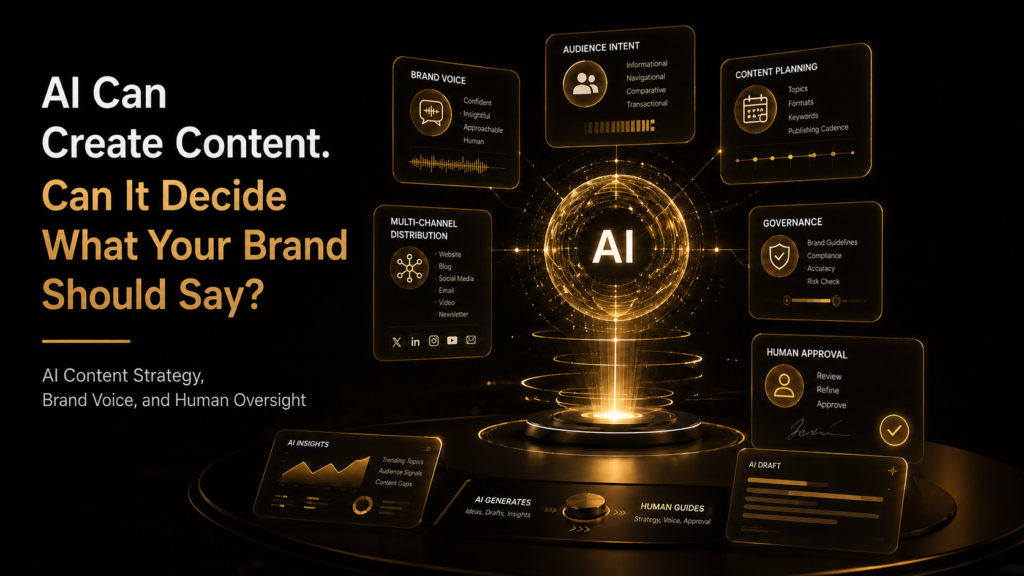
AI Content Strategy is changing how businesses plan, create, and distribute marketing content. AI can write blog posts, social media captions, emails, product descriptions, ad copy, and video scripts in seconds. But creating content is only one part of building a strong brand.
The bigger question is:
Can AI decide what your brand should actually say?
AI can analyze customer behavior, market trends, search intent, campaign performance, and existing content. It can identify topics, suggest messaging, personalize communication, and predict which content may perform better.
But deciding what a brand should stand for, what it should communicate, and how it should respond to important situations requires something more than data.
It requires strategy, context, creativity, judgment, and human understanding.
That is why the future of marketing isn’t about letting AI control the brand. It’s about combining AI intelligence with human strategy to create better, faster, and more consistent marketing.
AI Can Create Content Faster Than Ever
Content production has traditionally involved multiple steps:
- Research the topic.
- Develop the idea.
- Write the first draft.
- Edit the content.
- Check brand guidelines.
- Create visuals.
- Get internal approval.
- Publish.
- Analyze performance.
AI can accelerate many of these activities.
Marketing teams can use AI to create:
- Blog articles
- LinkedIn posts
- Instagram captions
- Email campaigns
- Product descriptions
- Landing page copy
- Advertisement variations
- Video scripts
- FAQs
- Content calendars
This creates a major productivity advantage.
But producing more content doesn’t automatically mean building a stronger brand.
A business could publish hundreds of AI-generated posts and still struggle to answer one important question:
What do we actually want our audience to remember about us?
Content Creation Is Not Brand Strategy
Content creation answers:
“What should we publish?”
Brand strategy asks:
“Why should we publish it, and what should it make people think about our brand?”
These are very different questions.
A strong brand strategy considers:
- Who is our audience?
- What problems do they have?
- What do we want to be known for?
- What makes us different?
- What does our brand believe?
- What topics should we own?
- What should we avoid?
- What tone should we use?
- What action should our content encourage?
AI can support these decisions, but businesses shouldn’t expect AI to independently define their identity.
What AI Can Do for Content Strategy
Modern AI can become a powerful strategic assistant for marketing teams.
AI Can Identify Content Opportunities
AI can analyze:
- Search queries
- Customer questions
- Website behavior
- Campaign performance
- Competitor content
- Social engagement
- Market trends
This helps marketers identify subjects their audiences actually care about.
Instead of randomly generating ten blog ideas, a marketing team can use AI to identify recurring customer questions and develop content around those needs.
AI Can Understand Customer Intent
Not every visitor has the same reason for interacting with a brand.
One person might be researching.
Another might be comparing solutions.
Another could already be ready to buy.
AI can analyze customer signals and help marketers understand where audiences are in the buying journey.
This allows businesses to create content that is more relevant to the customer’s actual needs.
AI Can Recommend Content Formats
A single idea doesn’t have to remain a single piece of content.
AI can help marketers decide whether an idea should become:
- A LinkedIn post
- An Instagram carousel
- A blog
- An email
- A short video
- A landing page
- A case study
- A sales presentation
This makes content planning more efficient, especially for businesses managing multiple channels.
What AI Should Not Decide Alone
AI can provide recommendations, but certain brand decisions should remain under human control.
Brand Positioning
AI can analyze competitors and market trends.
But your business must decide:
“What do we want to be known for?”
That’s a strategic decision.
Brand Values
A company’s values aren’t simply patterns in a dataset.
They influence:
- Communication
- Customer relationships
- Company culture
- Public statements
- Marketing campaigns
- Business decisions
Human leadership should define these principles.
Sensitive Communication
AI shouldn’t independently control messaging involving:
- Crisis communication
- Legal matters
- Customer complaints
- Reputation issues
- Major company announcements
- Sensitive social topics
- Regulatory communication
These situations require human judgment and appropriate approval.
Final Brand Voice
AI can learn and reproduce a brand voice.
But businesses should define the voice first.
For example:
We sound:
- Clear
- Confident
- Helpful
- Practical
- Intelligent
- Approachable
We don’t sound:
- Generic
- Overly corporate
- Aggressive
- Excessively promotional
- Filled with unnecessary jargon
Once these rules are established, AI can help maintain consistency.
Why AI-Generated Content Can Become Generic
One of the biggest problems with uncontrolled AI content is sameness.
Ask several AI tools:
“Write a professional LinkedIn post about AI.”
You may get several variations of the same predictable structure.
The content might be grammatically correct.
It might even be useful.
But it may not sound like your company.
This happens because AI doesn’t automatically know your:
- Point of view
- Customer knowledge
- Industry experience
- Brand personality
- Unique stories
- Business expertise
- Differentiators
That’s why a strong AI Content Strategy needs brand-specific context.
Build Your Brand Voice Before Using AI at Scale
Before asking AI to produce hundreds of pieces of content, define your communication framework.
Define Your Tone
Decide whether your brand should sound:
- Educational
- Conversational
- Authoritative
- Friendly
- Bold
- Technical
- Inspirational
Define Your Messaging
Identify your core messages.
For example:
- What problem do you solve?
- Who do you solve it for?
- What makes your solution different?
- What proof supports your claims?
- What outcomes do customers achieve?
Define Your Content Pillars
Instead of publishing random topics, create a few strategic content categories.
For example:
Thought Leadership
Industry insights, opinions, trends, and analysis.
Educational Content
Guides, explainers, tutorials, and practical advice.
Product Content
Features, use cases, solutions, and demonstrations.
Customer Proof
Case studies, results, experiences, and success stories.
This gives AI a strategic framework to work within.
AI Can Help Protect Brand Consistency
AI doesn’t have to weaken brand consistency.
When connected to approved business information, AI can actually make content governance easier.
A controlled AI content system can use:
- Brand guidelines
- Approved terminology
- Product documentation
- Customer personas
- Previous campaigns
- Messaging frameworks
- Case studies
- Company knowledge
- Legal requirements
Instead of asking AI to invent the brand, businesses provide the information AI needs to represent the brand accurately.
This is where AI becomes much more valuable than a simple content generator.
AI Knowledge Assistants Can Improve Content Accuracy
Marketing teams often spend significant time searching for reliable information.
Before creating content, they may need to check:
- Product documentation
- Service information
- Brand guidelines
- FAQs
- Case studies
- Pricing information
- Internal policies
An AI Knowledge Assistant can provide access to approved business information, helping marketers find relevant information faster.
This can reduce research time while improving consistency.
Moptra’s approach to AI-powered content workflows focuses on using business-specific knowledge to support content generation and multi-platform content operations.
From One Idea to Every Platform
The biggest opportunity isn’t simply generating content faster.
It’s turning one strong strategic idea into multiple useful experiences.
Imagine a company launches a new AI solution.
The core message is approved by the marketing team.
AI can then transform that message into:
- LinkedIn thought leadership
- Instagram carousel content
- Blog content
- Email campaigns
- Website copy
- Short-form video scripts
- Sales enablement content
- Customer FAQs
The strategy stays consistent.
The execution changes according to the platform.
This is one of the most practical applications of AI in modern marketing.
Moptra also uses AI-powered workflows to help businesses adapt content across multiple platforms while maintaining consistency and reducing repetitive production work.
AI Content Strategy vs. AI Content Generation
These concepts are often confused.
| AI Content Generation | AI Content Strategy |
|---|---|
| Creates content | Defines content direction |
| Generates drafts | Identifies opportunities |
| Rewrites copy | Understands audience needs |
| Produces variations | Prioritizes topics |
| Automates execution | Supports strategic decisions |
| Focuses on speed | Focuses on business impact |
AI content generation helps businesses produce.
AI Content Strategy helps businesses determine what to produce and why.
The strongest marketing teams need both.
The Human + AI Marketing Model
The most effective model isn’t:
Human vs. AI
It’s:
Human Strategy + AI Intelligence + Human Approval
A practical workflow looks like this:
Step 1: Understand the Audience
AI analyzes customer behavior, questions, engagement, and search intent.
Step 2: Identify Opportunities
AI recommends topics, formats, and messaging opportunities.
Step 3: Define the Strategic Message
Marketing leaders decide what the brand should communicate.
Step 4: Generate Content
AI creates drafts and variations based on approved messaging.
Step 5: Validate the Content
AI checks information, terminology, consistency, and brand guidelines.
Step 6: Human Review
Marketing teams review and approve the final content.
Step 7: Publish and Analyze
AI helps monitor performance and identify opportunities for improvement.
This model gives businesses the speed of AI without giving up strategic control.
How AI Helps Marketing Teams Make Better Decisions
AI can analyze information that would take marketing teams significant time to review manually.
It can help answer questions such as:
- Which topics generate the most engagement?
- Which audiences respond to specific messages?
- Which content formats perform best?
- Which creatives drive conversions?
- What questions are customers asking?
- Which campaigns are losing momentum?
- Which content should be repurposed?
- What should the team test next?
This changes AI from a simple writing assistant into a marketing intelligence layer.
Brand-Safe AI Requires Governance
As AI becomes more deeply integrated into marketing, governance becomes increasingly important.
Businesses should establish clear rules for:
- Approved AI tools
- Data handling
- Brand guidelines
- Human approval
- Sensitive content
- Customer information
- AI-generated claims
- Content review
Organizations can also use established AI risk-management guidance to structure governance. For example, NIST’s AI Risk Management Framework provides a voluntary framework for managing AI risks and promoting trustworthy AI systems.
How Moptra Helps Businesses Build Better AI Content Workflows
At Moptra, we help businesses move beyond basic AI content generation toward connected marketing workflows.
Our capabilities include:
- AI Content Generation
- AI Knowledge Assistants
- Brand-Safe AI Content
- AI Content Calendars
- Multi-Platform Content Generation
- AI-Powered Creative Testing
- AI Marketing Automation
- Workflow Automation
- Customer Intent Analysis
- Agentic AI Solutions
Moptra’s AI solutions are designed to help businesses automate repetitive marketing activities while keeping teams involved in strategic and creative decisions.
Best Practices for AI Content Strategy
Define the Brand First
Don’t ask AI to discover your identity. Give it a clear identity to work with.
Create a Trusted Knowledge Base
Ground AI outputs in approved business information.
Give AI Context
Instead of:
“Write a LinkedIn post.”
Try:
“Write a LinkedIn post for B2B technology leaders using our approved brand voice, focusing on the business impact of Agentic AI.”
The difference is context.
Keep Humans in the Approval Loop
AI should accelerate content creation, not eliminate strategic oversight.
Measure Content Performance
Track:
- Engagement
- Click-through rates
- Leads
- Conversions
- Content-assisted revenue
- Audience growth
Use those insights to continuously improve your content approach.
The Future of AI and Brand Strategy
AI will increasingly become part of the strategic marketing workflow.
Future AI systems will analyze:
- Customer behavior
- Search trends
- Competitor positioning
- Campaign performance
- Market signals
- Content engagement
They will recommend what businesses should discuss, which audiences to prioritize, and which channels may be most effective.
But there’s an important distinction.
AI can tell you:
“This message is likely to perform well.”
It shouldn’t independently decide:
“This is what your company should stand for.”
That decision belongs to the people responsible for the brand.
Conclusion
AI can create content faster than most marketing teams ever could.
It can generate ideas, write drafts, personalize messaging, repurpose campaigns, analyze performance, and automate distribution.
But creating content and deciding what a brand should say are two different responsibilities.
The strongest businesses won’t give AI complete control over their brand. Instead, they will combine human strategy, AI intelligence, and thoughtful governance.
But humans should continue to define the brand’s purpose, values, positioning, and point of view.
The future of marketing isn’t about using AI to say more.
It’s about using AI to help brands say the right things, to the right people, at the right time.
A strong AI Content Strategy makes that possible by combining the scale of AI with the judgment and creativity of people.
Frequently Asked Questions
What is AI Content Strategy?
AI Content Strategy is the use of artificial intelligence to support content planning, audience analysis, topic discovery, content creation, personalization, optimization, and distribution while keeping business and brand objectives at the center.
Can AI decide what a brand should say?
AI can analyze data and recommend topics, messages, and content opportunities. However, important decisions about brand positioning, values, sensitive communication, and overall direction should remain under human strategic control.
Can AI maintain a consistent brand voice?
Yes. AI can maintain consistency when it receives clear brand guidelines, approved terminology, examples, business knowledge, and appropriate content controls.
How can businesses prevent AI content from becoming generic?
Businesses should provide AI with detailed brand guidelines, audience information, unique business knowledge, customer insights, and examples of the desired communication style. Human review should also remain part of the workflow.
What is the difference between AI content generation and AI Content Strategy?
AI content generation focuses on producing content, while AI Content Strategy focuses on deciding what content should be created, why it matters, who should receive it, and how it supports business objectives.
How can Moptra help businesses with AI marketing?
Moptra helps businesses implement AI-powered content generation, Knowledge Assistants, multi-platform content workflows, creative testing, marketing automation, and Agentic AI solutions to scale marketing while maintaining brand consistency and strategic control.
Related Posts
Beyond Monoliths: How Composab...
In the fast-evolving world of digital commerce, agility, scalability, and intelligence are no longer luxuries—they're necessitie...
Unleash Your Potential: Career...
Are you passionate about SAP Commerce and HCL Commerce? Looking for a company that values your skills and fosters your professiona...
AI-Powered Chatbot...
Introduction Every business receives the same questions repeatedly. Customers often want to know: What services do you of...