

Introduction
Digital customer expectations are changing. People no longer want to navigate complicated websites, search through multiple pages, or wait for support teams to resolve simple requests. They expect businesses to understand their needs, provide relevant recommendations, and help them complete tasks quickly.
This shift is bringing Action-Oriented AI into the spotlight.
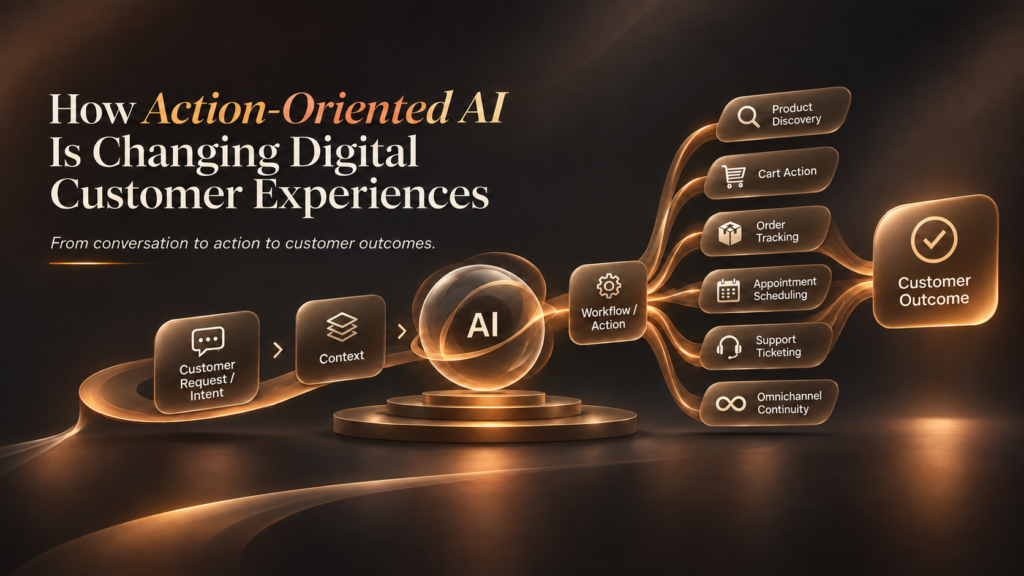
Traditional AI-powered experiences primarily focus on answering questions, recommending products, and generating information. Action-oriented AI takes the next step: it can understand a customer’s intent, determine what needs to happen, and execute supported actions through connected systems.
Imagine a customer asking an online shopping assistant to find a suitable laptop, compare available options, apply an eligible discount, and add the selected product to their cart. Instead of simply providing suggestions, an action-oriented AI assistant can coordinate these steps within the customer journey, subject to permissions and approval requirements.
This changes the role of AI from a digital information provider into an active participant in customer experiences.
For businesses, the opportunity is significant: fewer repetitive interactions, faster service delivery, more relevant engagement, and smoother customer journeys.
What Is Action-Oriented AI?
Action-oriented AI refers to AI systems designed not only to understand and respond to user requests but also to take meaningful actions toward completing them.
It combines capabilities such as:
- Natural language understanding
- Contextual reasoning
- Intent recognition
- Workflow orchestration
- Tool and API integrations
- Personalization
- Continuous feedback and monitoring
Rather than stopping after generating a response, the system identifies the next appropriate step and performs it using authorized tools and connected applications.
Traditional AI vs. Action-Oriented AI
| Traditional AI | Action-Oriented AI |
|---|---|
| Answers customer questions | Resolves customer requests |
| Provides product recommendations | Helps execute product-related tasks |
| Generates information | Initiates supported workflows |
| Responds to individual prompts | Coordinates multiple steps |
| Often requires manual follow-up | Can complete authorized actions |
| Primarily information-focused | Outcome-focused |
For example, a traditional chatbot might explain how to update a delivery address. An action-oriented assistant could authenticate the customer, check whether the order is eligible for an address change, submit the update, and confirm the result.
The difference is simple: one explains what to do, while the other helps get it done.
Why Digital Customer Experiences Are Moving Toward Action-Oriented AI
Customer experience is no longer defined only by how quickly a business responds. It is increasingly measured by how effectively it solves customer problems.
Several factors are driving this transition.
1. Customers Expect Immediate Resolution
Customers increasingly expect digital services to be available whenever they need them. Waiting for an email response or navigating multiple support pages can create unnecessary friction.
Action-oriented AI helps businesses automate eligible requests, including:
- Checking order status
- Updating account information
- Booking or rescheduling appointments
- Creating support tickets
- Initiating eligible return requests
- Finding relevant products
Instead of sending customers through several steps, an AI assistant can coordinate the required workflow.
2. Personalization Must Lead to Meaningful Actions
Traditional personalization often focuses on displaying recommended products or customized content.
Action-oriented AI makes personalization more practical by connecting customer context with the next appropriate action.
For example, an e-commerce assistant could:
- Understand a customer’s product preferences.
- Review available inventory.
- Identify products matching their requirements.
- Compare relevant options.
- Help the customer add a selected product to their cart.
This creates a more useful experience because personalization becomes part of the transaction journey rather than just a marketing feature.
3. Businesses Need More Efficient Customer Support
Customer support teams spend considerable time handling repetitive requests.
Action-oriented AI can manage suitable routine workflows while escalating complex or sensitive cases to human employees.
Examples include password reset assistance, order tracking, appointment scheduling, and basic account-related requests.
This allows support teams to dedicate more attention to situations that require human judgment, empathy, or specialized knowledge.
4. Customers Expect Consistent Experiences Across Channels
Customers may interact with a business through a website, mobile application, email, WhatsApp, or social media.
When these channels operate independently, customers often need to repeat information.
Connected AI systems can use authorized customer context and integrated business systems to maintain continuity across supported channels.
The result is a more consistent experience with fewer repeated steps.
How Action-Oriented AI Works in a Digital Customer Journey
Action-oriented AI typically operates through a sequence of connected capabilities.
Step 1: Understand Customer Intent
The AI interprets what the customer wants to achieve.
For example:
“I ordered a pair of shoes last week, but I received the wrong size. Can you help me exchange them?”
The system identifies the underlying intent: an exchange request.
Step 2: Understand Context
The AI gathers relevant information from authorized sources, such as:
- Customer account details
- Order history
- Product information
- Return and exchange policies
- Previous support interactions
This context helps the system determine the appropriate next step.
Step 3: Identify the Required Actions
The system breaks the request into smaller tasks.
For an exchange request, these could include:
- Verify the customer.
- Retrieve the relevant order.
- Check the product’s exchange eligibility.
- Review available replacement sizes.
- Confirm the customer’s preferred option.
Step 4: Execute Through Connected Systems
The AI uses authorized tools, APIs, or business workflows to perform supported operations.
For example, it may create an exchange request in an order management system or generate a support ticket.
Actions involving financial transactions, sensitive account changes, or irreversible decisions should follow appropriate authorization and approval controls.
Step 5: Confirm the Outcome
The customer receives a clear update explaining what happened.
For example:
“Your exchange request has been created. The replacement size is currently available, and your request is awaiting confirmation.”
The AI should report only actions that the connected system has successfully completed.
7 Ways Action-Oriented AI Is Transforming Customer Experiences
1. From Chatbots to Intelligent AI Assistants
Traditional chatbots are commonly designed around predefined questions, scripted conversations, and limited workflows.
Action-oriented AI assistants can handle more complex requests by interpreting customer intent and coordinating multiple actions.
For example, a travel customer could ask:
“Find me a hotel near the conference venue for two nights and show me options within my budget.”
An integrated AI assistant could identify the destination, retrieve available hotels, compare relevant options, and guide the customer toward booking.
The customer receives help throughout the journey instead of simply receiving a list of links.
2. Smarter E-Commerce Shopping Experiences
E-commerce businesses can use action-oriented AI to make shopping more convenient.
Instead of manually searching through product categories and filters, customers can describe what they need in natural language.
An AI shopping assistant can:
- Understand product requirements.
- Search relevant product catalogs.
- Compare product specifications.
- Check available inventory.
- Recommend suitable alternatives.
- Add selected items to a cart with customer authorization.
This reduces friction between product discovery and purchase.
3. Proactive Customer Support
Traditional support systems usually wait for customers to report a problem.
Action-oriented AI can also support proactive service when businesses provide relevant event data and establish appropriate rules.
For example, if an order is delayed, an integrated AI workflow could identify affected customers, retrieve the latest delivery status, prepare a notification, and send an approved update.
This helps customers receive useful information before they need to contact support.
4. Faster Appointment Scheduling and Management
Healthcare providers, financial service companies, educational institutions, and service businesses often manage large volumes of appointments.
AI assistants can help customers:
- Find available time slots.
- Schedule appointments.
- Reschedule existing bookings.
- Send reminders.
- Provide preparation instructions.
- Create follow-up requests.
When connected to scheduling systems, these tasks can be handled through a conversational interface.
For sensitive services, appropriate identity verification and human oversight remain essential.
5. Personalized Recommendations That Lead to Action
Recommendations become more valuable when customers can act on them immediately.
Consider a customer browsing an online fashion store.
An AI assistant could understand their preferred style, identify matching products, check available sizes, and help build an outfit.
Rather than displaying unrelated suggestions, the assistant guides the customer toward a relevant outcome.
6. Automated Post-Purchase Experiences
Customer experience does not end after checkout.
Action-oriented AI can support the post-purchase journey through:
- Order tracking
- Delivery updates
- Product setup assistance
- Warranty information
- Return and exchange workflows
- Feedback collection
- Support ticket creation
This creates opportunities for businesses to maintain meaningful customer engagement after the transaction.
7. Seamless Omnichannel Interactions
A customer might begin a conversation on a website and continue it through WhatsApp or a mobile application.
With suitable integrations and permission controls, action-oriented AI can help preserve relevant conversation context and continue supported workflows across channels.
For example, a customer who previously requested a product recommendation should not have to explain the same requirements again when continuing the interaction through another connected channel.
Action-Oriented AI vs. Traditional Customer Experience Automation
Although both approaches can improve efficiency, they serve different purposes.
| Comparison Area | Traditional Automation | Action-Oriented AI |
|---|---|---|
| Workflow | Mostly predefined rules | Can coordinate context-dependent steps |
| Customer interaction | Menu-based or scripted | Natural language and contextual interaction |
| Decision-making | Rule-based conditions | AI-assisted reasoning within defined boundaries |
| Personalization | Based on predefined segments | Can adapt to individual context |
| Task execution | Fixed automated processes | Dynamic orchestration of supported tools |
| Handling complexity | Limited to configured scenarios | Can manage more varied requests with appropriate controls |
| Human involvement | Required for exceptions | Escalation based on risk and complexity |
Traditional automation remains valuable for predictable, repetitive tasks. Action-oriented AI adds flexibility when customer requests involve multiple steps, changing context, or different systems.
Businesses do not necessarily need to replace existing automation. They can connect AI capabilities to established workflows where they provide measurable value.
Real-World Industry Applications of Action-Oriented AI
Action-oriented AI can improve customer interactions across several industries.
| Industry | Customer Challenge | Potential AI-Driven Action |
|---|---|---|
| Retail and E-Commerce | Difficult product discovery | Search, compare, and add products to cart |
| Banking | Repetitive account requests | Retrieve information and initiate eligible service workflows |
| Healthcare | Appointment management | Find available slots and schedule appointments |
| Travel and Hospitality | Complex booking journeys | Compare options and assist with reservations |
| Telecommunications | Repeated support requests | Run account checks and create service tickets |
| Education | Student service queries | Retrieve information and initiate administrative requests |
| Real Estate | Slow lead follow-up | Qualify enquiries and schedule property visits |
| Insurance | Lengthy service processes | Collect required information and initiate claims workflows |
The value comes from connecting customer intent with the systems and processes required to resolve it.
What Makes an Action-Oriented AI System Effective?
Implementing an AI assistant is not enough. Businesses need an architecture that enables the system to understand requests, access relevant information, execute actions, and communicate outcomes reliably.
1. Strong Contextual Understanding
The system should understand what customers mean, not just recognize individual keywords.
For example, “I need to change my order” could refer to changing the delivery address, product quantity, size, or delivery date.
The assistant should clarify ambiguous requests before taking action.
2. Integration With Business Systems
Action-oriented AI becomes useful when connected to the systems that support customer operations.
Common integrations include:
- CRM platforms
- E-commerce platforms
- ERP systems
- Order management systems
- Inventory management software
- Customer support platforms
- Payment and scheduling services
Integrations should use controlled permissions and secure authentication.
3. Workflow Orchestration
A customer request may require multiple systems to work together.
For example, processing a return could involve checking order eligibility, validating the return policy, creating a return authorization, and updating the support record.
Workflow orchestration helps coordinate these steps in the correct sequence.
4. Human-in-the-Loop Controls
Not every action should be completed autonomously.
Businesses should define which activities can happen automatically, which require customer confirmation, and which must be reviewed by an employee.
This is particularly important for financial transactions, sensitive customer information, account access, and high-impact decisions.
5. Continuous Monitoring and Improvement
AI-driven customer experiences should be monitored to identify errors, improve response quality, and understand customer satisfaction.
Businesses should evaluate both the quality of AI responses and the actual success of completed actions.
Measuring the Business Impact of Action-Oriented AI
To understand whether an action-oriented AI implementation is delivering value, businesses need measurable performance indicators.
| KPI | What It Measures | Why It Matters |
|---|---|---|
| Task Completion Rate | Percentage of requests successfully completed | Measures actual outcomes |
| First Contact Resolution | Issues resolved without additional support interactions | Indicates service effectiveness |
| Average Resolution Time | Time required to complete customer requests | Measures operational speed |
| Escalation Rate | Requests transferred to human agents | Identifies automation limitations |
| Customer Satisfaction (CSAT) | Customer feedback after interactions | Measures experience quality |
| Conversion Rate | Percentage of users completing desired actions | Evaluates commercial impact |
| Repeat Contact Rate | Customers returning for the same unresolved issue | Helps identify incomplete resolutions |
| Action Failure Rate | Percentage of attempted actions that fail | Measures workflow reliability |
For example, an e-commerce company might discover that customers frequently abandon product searches because they cannot identify suitable alternatives.
An action-oriented AI assistant could help customers compare products and check availability.
The business could then measure whether product discovery improves, whether more customers add items to their carts, and whether the assistant completes requests accurately.
The goal should not simply be to increase the number of AI conversations. It should be to improve the number of customer problems successfully resolved.
Challenges Businesses Must Address Before Adopting Action-Oriented AI
Despite its potential, action-oriented AI introduces important implementation challenges.
Data Privacy and Security
AI systems may interact with customer accounts, transaction details, and personal information.
Businesses must establish secure access controls, data protection policies, authentication mechanisms, and audit trails.
Integration Complexity
Many organizations operate with disconnected applications and legacy systems.
Connecting AI assistants to these environments requires careful API planning, integration testing, and workflow design.
Incorrect or Unauthorized Actions
An AI system may misunderstand customer intent or attempt an action that is not appropriate.
Businesses should implement:
- Permission-based access
- Customer confirmation for consequential actions
- Approval workflows
- Transaction validation
- Action logging
- Rollback or recovery mechanisms where supported
Lack of Transparency
Customers should know when they are interacting with AI and understand what actions the system is taking.
Clear confirmations and explanations help establish trust.
Over-Automation
Automating every interaction is not necessarily a good customer experience.
Sensitive complaints, complex disputes, and emotionally difficult situations may require human support.
The most effective approach combines AI efficiency with human judgment.
How Businesses Can Get Started With Action-Oriented AI
A successful implementation should begin with a clear business problem rather than simply adopting AI because it is a growing technology trend.
Step 1: Identify High-Friction Customer Journeys
Find the interactions that involve repetitive questions, multiple manual steps, or unnecessary waiting.
Examples include order tracking, appointment scheduling, product discovery, and support ticket creation.
Step 2: Prioritize Suitable Use Cases
Evaluate potential workflows based on customer impact, implementation complexity, business value, and operational risk.
Start with tasks that are frequent, well-defined, and relatively low-risk.
Step 3: Map the Required Systems
Identify the platforms and data sources needed to complete each workflow.
Determine whether the AI assistant needs access to CRM, ERP, e-commerce, inventory, or customer support systems.
Step 4: Define Action Permissions
Establish clear boundaries for what the AI can read, recommend, initiate, or complete.
Include approval requirements for sensitive or irreversible actions.
Step 5: Build and Test the Workflow
Develop the assistant, connect the required tools, and test real-world customer scenarios.
Test both successful and unsuccessful outcomes, including ambiguous requests, unavailable services, integration failures, and permission restrictions.
Step 6: Measure Results and Expand
Track task completion, resolution time, customer satisfaction, escalation rates, and action failures.
Use these insights to improve the experience and gradually introduce additional workflows.
The Future: From AI Conversations to AI-Driven Customer Outcomes
The next phase of digital customer experience will not be defined only by smarter chatbots or more personalized recommendations.
It will be shaped by AI systems that can understand customer goals and coordinate the actions needed to achieve them.
As agentic AI capabilities mature, businesses will increasingly explore assistants that can work across connected applications, manage multi-step workflows, and adapt to changing customer requirements.
This does not mean every customer interaction will become fully autonomous. Instead, businesses will develop more intelligent combinations of AI assistance, workflow automation, and human decision-making.
The competitive advantage will come from reducing friction while maintaining reliability, security, and customer trust.
How Moptra Supports AI-Driven Business Experiences
Building effective AI-powered customer experiences requires more than a conversational interface. It requires the right combination of AI capabilities, business logic, system integrations, and workflow automation.
Moptra works across AI, automation, and enterprise technology to help businesses explore and implement intelligent digital solutions.
Through its AI and automation initiatives, businesses can explore opportunities such as:
- Intelligent AI Assistants: Create conversational experiences that help customers access information and complete supported tasks.
- Agentic Workflow Automation: Connect AI capabilities with business processes to coordinate multi-step operations.
- Enterprise System Integration: Connect customer-facing experiences with relevant business applications and data sources.
- Customer Journey Optimization: Identify opportunities to reduce manual effort and improve digital interactions.
Conclusion
Action-oriented AI is changing digital customer experiences by moving beyond information delivery toward meaningful task execution.
Customers increasingly expect businesses to understand their requirements, provide relevant assistance, and help them complete tasks without unnecessary friction.
From personalized shopping and proactive customer support to appointment scheduling and omnichannel service, action-oriented AI creates opportunities to make digital interactions more useful and efficient.
However, successful adoption depends on more than AI intelligence. Secure integrations, reliable workflows, clear permissions, human oversight, and continuous measurement are equally important.
Businesses that focus on solving real customer problems rather than simply automating conversations will be better positioned to create valuable digital experiences.
The future of customer experience is not just about AI that can answer. It is about AI that can help customers get things done.
Frequently Asked Questions
1. What is action-oriented AI?
Action-oriented AI refers to AI systems that can understand user requests, identify appropriate next steps, and execute authorized actions through connected tools and business applications.
2. How is action-oriented AI different from traditional chatbots?
Traditional chatbots primarily provide information or follow predefined conversation flows. Action-oriented AI can coordinate multi-step workflows and perform supported tasks through integrations with business systems.
3. How does action-oriented AI improve customer experience?
It can reduce repetitive steps, accelerate service requests, provide personalized assistance, and help customers complete tasks through conversational interactions.
4. Can action-oriented AI complete customer transactions?
Yes, when the system is integrated with the required platforms and has the appropriate permissions. Sensitive or consequential transactions may require customer confirmation or human approval.
5. What industries can benefit from action-oriented AI?
Retail, banking, healthcare, telecommunications, travel, hospitality, education, insurance, and real estate can all explore relevant use cases.
6. Is action-oriented AI the same as agentic AI?
The concepts overlap. Action-oriented AI describes systems designed to take actions toward user goals, while agentic AI generally emphasizes the ability to plan, reason, use tools, and coordinate multiple steps with varying degrees of autonomy.
7. Does action-oriented AI replace human customer support agents?
Not necessarily. It can automate suitable repetitive tasks and support employees, while human agents remain important for complex, sensitive, and high-impact situations.
8. What technologies are required to implement action-oriented AI?
Common requirements include AI models, APIs, workflow orchestration, CRM and ERP integrations, customer data systems, authentication, permission controls, and monitoring capabilities.
9. How can businesses measure the success of action-oriented AI?
Businesses can track task completion rates, resolution times, customer satisfaction, first contact resolution, escalation rates, conversion rates, and action failure rates.
10. What is the future of action-oriented AI in digital customer experience?
The future is likely to involve more context-aware AI assistants that coordinate tasks across connected platforms, provide personalized support, and work alongside human employees to deliver better customer outcomes.
Related Posts
Agentic AI for Modern Business...
Introduction Agentic AI for Modern Businesses is transforming how organizations operate in 2026. Unlike traditio...
How AI Agents Handle Complex C...
Introduction AI Agents are changing how businesses handle customer conversations. Traditional chatbots were designed primarily t...
Beyond Development: How Moptra...
At Moptra, we pride ourselves not only on our technical prowess but also on our deep commitment to creating exceptional user inter...