

Introduction
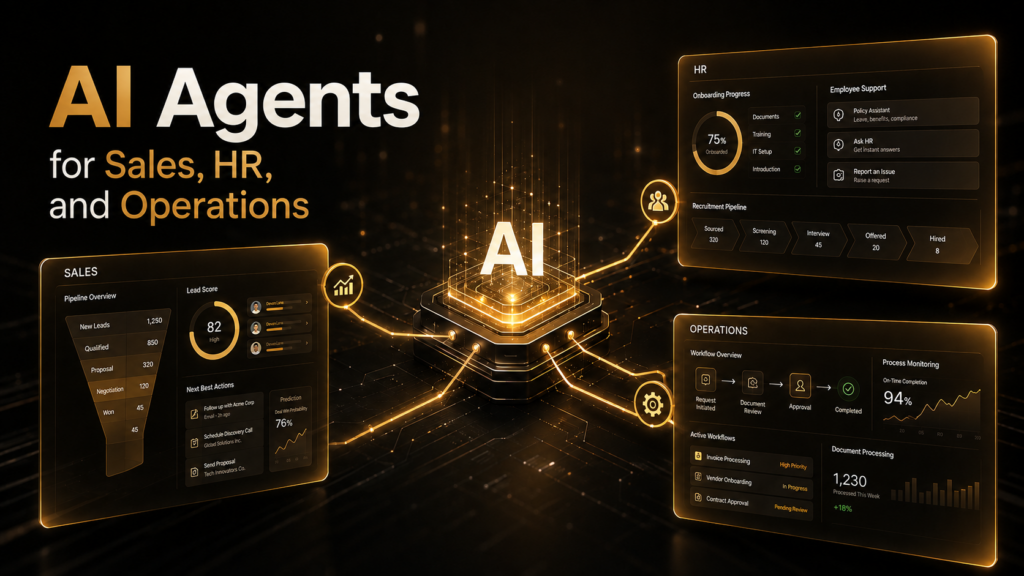
AI agents for sales, HR, and operations are changing how businesses handle everyday work. Instead of using AI only to generate text or answer questions, organizations can now deploy intelligent agents that understand business context, interact with enterprise systems, and help complete multi-step workflows.
Sales teams can use AI agents to qualify leads and manage follow-ups. HR teams can automate employee support and onboarding. Operations teams can use agents to monitor processes, coordinate workflows, and identify issues.
The result is a more connected organization where employees spend less time on repetitive tasks and more time on strategic work.
At Moptra, we help businesses explore Agentic AI and intelligent workflow automation to improve productivity, customer experiences, and operational efficiency.
What Are AI Agents?
AI agents are software systems designed to understand goals, analyze information, make decisions, and take actions with limited human intervention.
Unlike traditional automation, which generally follows predefined rules, AI agents can respond to changing situations and use information from connected systems to determine the next appropriate action.
An AI agent may:
- Understand a request
- Retrieve relevant information
- Analyze data
- Make a recommendation
- Trigger a workflow
- Update business systems
- Escalate complex tasks to a human
This makes AI agents particularly useful for business processes that involve multiple steps.
Why Businesses Are Adopting AI Agents
Modern organizations deal with large volumes of repetitive work.
Employees regularly spend time on:
- Data entry
- Email communication
- Lead qualification
- Document processing
- Employee questions
- Reporting
- Approvals
- Customer inquiries
- System updates
AI agents can handle parts of these workflows while keeping employees involved where human judgment is important.
This creates opportunities to improve:
- Productivity
- Response times
- Operational efficiency
- Customer experience
- Employee experience
- Scalability
AI Agents for Sales
Sales teams spend a significant amount of time researching prospects, updating CRMs, writing follow-ups, and managing leads.
AI agents can help automate many of these activities.
AI Lead Qualification
An AI sales agent can evaluate incoming leads based on information such as:
- Company size
- Industry
- Customer requirements
- Previous interactions
- Engagement signals
- Buying intent
The agent can then prioritize leads that are more likely to convert.
Automated Sales Follow-Ups
Following up consistently is critical for sales teams.
AI agents can help:
- Draft personalized emails
- Schedule follow-ups
- Summarize previous conversations
- Remind sales representatives about opportunities
- Update CRM records
Sales professionals can spend more time having meaningful conversations instead of manually managing every follow-up.
AI-Powered Sales Research
Before contacting a prospect, sales representatives often need to research the company and understand its challenges.
An AI agent can gather relevant information and create a concise account brief covering:
- Company information
- Industry
- Potential business challenges
- Previous interactions
- Relevant products or services
This helps sales teams prepare more effectively.
AI Agents for Sales Forecasting
AI can analyze historical sales data, pipeline activity, customer behavior, and opportunity information to help identify trends.
Sales leaders can use these insights to:
- Identify pipeline risks
- Prioritize opportunities
- Improve forecasting
- Allocate resources
- Identify potential revenue gaps
AI Agents for HR
HR teams manage employee questions, documentation, onboarding, recruitment, and internal processes.
AI agents can reduce administrative workloads while making employee support more accessible.
AI Employee Assistants
Employees often ask HR repetitive questions about:
- Leave policies
- Benefits
- Company policies
- Payroll processes
- Working hours
- Internal procedures
An AI HR assistant can provide instant answers using approved company information.
AI-Powered Employee Onboarding
Onboarding involves multiple steps across HR, IT, finance, and management.
An AI agent can help coordinate:
- Employee documentation
- Account creation requests
- Policy information
- Training schedules
- Equipment requests
- Manager notifications
This creates a smoother onboarding experience while reducing manual coordination.
AI Recruitment Assistance
Recruitment teams can use AI agents to support parts of the hiring process.
Agents can help with:
- Resume organization
- Candidate information extraction
- Interview scheduling
- Candidate communication
- Job description drafting
- Interview summaries
Human recruiters should remain responsible for final hiring decisions and sensitive evaluations.
AI Knowledge Assistants for HR
An AI Knowledge Assistant can give employees access to approved internal information without requiring them to search through multiple documents or contact HR for every question.
This improves information accessibility while reducing repetitive HR requests.
AI Agents for Operations
Operations teams coordinate processes across departments, systems, vendors, and customers.
This makes operations one of the strongest areas for AI agent adoption.
Workflow Coordination
AI agents can monitor workflows and trigger the next step when specific conditions are met.
For example:
- A purchase request is submitted.
- The agent checks required information.
- The request is routed to the appropriate approver.
- The approval is recorded.
- The procurement system is updated.
This reduces manual coordination between teams.
Intelligent Document Processing
Operations teams process invoices, purchase orders, contracts, forms, and other documents.
AI agents can:
- Extract information
- Classify documents
- Validate fields
- Identify missing information
- Route documents
- Trigger approval workflows
This can significantly reduce repetitive administrative work.
AI Agents for Customer Operations
AI agents can monitor customer requests and coordinate actions across business systems.
For example, an agent may:
- Understand a customer request
- Retrieve order information
- Check inventory
- Provide an update
- Create a support ticket
- Escalate the issue when necessary
This creates a more connected customer experience.
AI Agents for Operational Monitoring
AI agents can continuously analyze operational data to identify potential issues.
They can help detect:
- Delayed processes
- Unusual activity
- Inventory problems
- Workflow bottlenecks
- Service issues
- Performance anomalies
Instead of waiting for employees to discover problems manually, businesses can use AI to surface potential issues earlier.
AI Agents vs Traditional Automation
| Capability | Traditional Automation | AI Agents |
|---|---|---|
| Rule-Based Tasks | Yes | Yes |
| Natural Language | Limited | Advanced |
| Context Understanding | Limited | Advanced |
| Dynamic Decisions | Limited | Yes |
| Multi-Step Workflows | Basic | Advanced |
| Enterprise System Integration | Yes | Yes |
| Adaptability | Low | Higher |
| Human Escalation | Basic | Context-aware |
Traditional automation remains valuable for predictable workflows. AI agents become particularly useful when processes require context, reasoning, or decisions based on changing information.
One AI Ecosystem Across Sales, HR, and Operations
The biggest opportunity isn’t deploying isolated AI agents.
Businesses can create connected AI ecosystems where agents collaborate across departments.
For example:
Sales Agent → HR/Operations → Finance → Customer Support
A sales agent identifies a new customer opportunity.
An operations agent checks product availability.
A finance workflow validates commercial requirements.
A customer support agent prepares onboarding information.
This creates a connected workflow that reduces handoffs and improves business efficiency.
Benefits of AI Agents for Businesses
Increased Productivity
AI agents reduce repetitive administrative work and allow employees to focus on higher-value activities.
Faster Response Times
Agents can operate continuously and respond to routine requests quickly.
Lower Operational Costs
Automating repetitive workflows can reduce manual processing and administrative overhead.
Better Employee Experience
Employees spend less time searching for information or completing repetitive tasks.
Improved Customer Experience
AI agents can provide faster, more personalized interactions.
Greater Scalability
Businesses can handle increasing workloads without relying solely on proportional increases in headcount.
How Businesses Should Implement AI Agents
AI agent adoption should begin with clearly defined business problems.
Identify Repetitive Workflows
Start with processes that are high-volume, repetitive, and measurable.
Connect Trusted Data
AI agents should have access to accurate and relevant business information.
Integrate Enterprise Systems
Connect agents with systems such as:
- CRM
- ERP
- HR platforms
- Commerce platforms
- Knowledge bases
- Customer support systems
Keep Humans in the Loop
High-impact or sensitive decisions should have appropriate human oversight.
Measure Results
Track metrics such as:
- Processing time
- Cost savings
- Response time
- Employee productivity
- Customer satisfaction
- Workflow completion rate
Security and Governance Matter
AI agents can interact with sensitive business systems, so security should be part of the architecture from the beginning.
Businesses should establish:
- Role-based access
- Authentication controls
- Data protection
- Audit logs
- Approval mechanisms
- Human oversight
- AI usage policies
- Continuous monitoring
AI agents should only have the permissions required to perform their assigned responsibilities.
How Moptra Helps Businesses Deploy AI Agents
At Moptra, we help organizations move from isolated AI experiments toward practical AI-powered business workflows.
Our capabilities include:
- Agentic AI Accelerator
- AI Sales Automation
- AI HR Assistants
- AI Operations Automation
- AI Knowledge Assistants
- AI Chatbots
- Intelligent Workflow Automation
- Enterprise Application Integration
- AI-powered Search
- Commerce AI Solutions
By connecting AI with existing business systems, organizations can automate workflows while maintaining control, security, and human oversight.
The Future of AI Agents in Business
AI agents are moving from simple assistants toward intelligent systems capable of coordinating complex business workflows.
In the future, organizations will increasingly use specialized agents for:
- Sales
- Marketing
- HR
- Finance
- Operations
- Customer service
- IT
- Procurement
These agents will work alongside employees and, where appropriate, collaborate with one another to complete business processes.
The competitive advantage will come not simply from having AI agents, but from integrating them into workflows where they create measurable business value.
Conclusion
AI agents for sales, HR, and operations are becoming an important part of the modern enterprise technology stack. By handling repetitive tasks, coordinating workflows, retrieving business information, and supporting employees, AI agents can help organizations work faster and scale more efficiently.
The most effective approach is not to automate everything at once. Businesses should identify high-value workflows, connect trusted data, establish appropriate controls, and gradually expand AI agent capabilities.
With Moptra’s expertise in Agentic AI, workflow automation, enterprise integration, and AI-powered business solutions, organizations can turn AI agents into practical digital workers that support teams, improve operations, and create measurable business value.
Frequently Asked Questions
What are AI agents for business?
AI agents are intelligent software systems that can understand goals, analyze information, make decisions, and perform actions across connected business workflows.
How can AI agents help sales teams?
AI sales agents can qualify leads, research prospects, summarize conversations, automate follow-ups, update CRM records, and provide sales insights.
How can HR departments use AI agents?
HR teams can use AI agents for employee support, onboarding coordination, policy assistance, recruitment administration, and internal knowledge management.
How can operations teams use AI agents?
Operations teams can use AI agents to coordinate workflows, process documents, monitor processes, identify issues, and connect actions across enterprise systems.
Are AI agents better than traditional automation?
AI agents are not a replacement for all traditional automation. Rule-based automation remains effective for predictable processes, while AI agents are particularly useful for workflows that require context, natural-language understanding, and dynamic decision-making.
How can Moptra help businesses implement AI agents?
Moptra helps businesses design and implement Agentic AI solutions, AI Knowledge Assistants, workflow automation, chatbots, enterprise integrations, and intelligent business workflows tailored to specific operational needs.
Related Posts
The AI RFP Assistant: A Smarte...
Introduction An AI RFP Assistant can transform one of the most time-consuming processes in B2B sales: finding, analyzing, and res...
Three key takeaways from speci...
1.Strategy first, technology second Technology is only a facilitator. The fundamental elements, such as knowing what your strateg...
In today’s digital age, ...
With the increasing use of smartphones and the internet, more and more people are turning to online shopping for their needs. As a...