

Introduction
Marketing expectations have never been higher.
Businesses expect marketing teams to create more content, launch campaigns faster, manage several digital channels, support sales, engage customers, and demonstrate measurable business impact.
However, most teams must meet these expectations with limited budgets and lean resources.
Hiring more people is not always practical. Recruitment takes time, skilled marketers are expensive, and new employees require training before they can contribute effectively.
Therefore, the solution is not to ask existing teams to work longer hours. Instead, businesses need to improve how marketing work gets done.
This is where an AI marketing team can help.
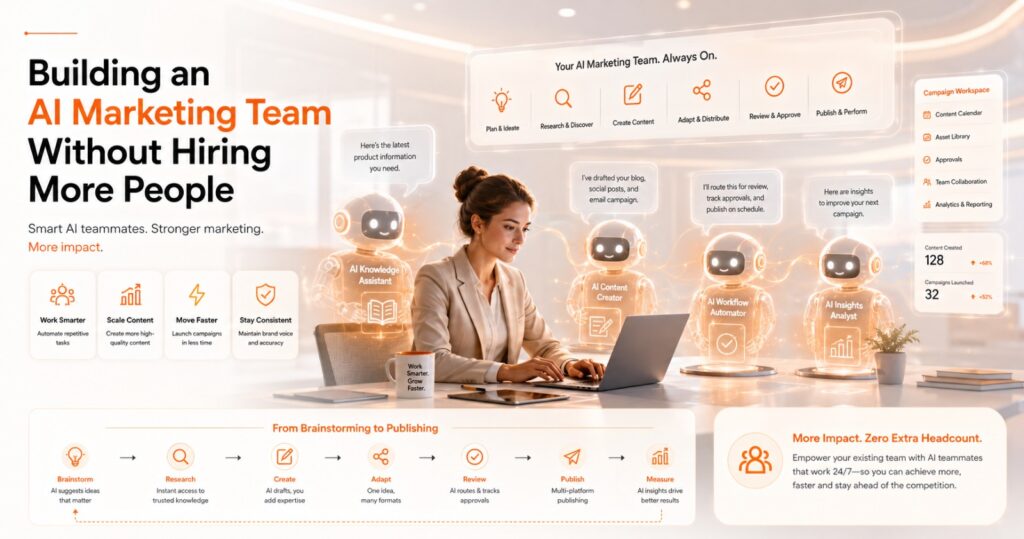
An AI marketing team combines human creativity with AI-powered assistants, content workflows, knowledge systems, and business automation.
Rather than replacing marketers, AI helps them complete repetitive work faster, access business information instantly, create more content, and coordinate campaigns efficiently.
At Moptra, we help businesses introduce practical AI-powered marketing workflows. As a result, existing teams can increase their output without increasing headcount.
What Is an AI Marketing Team?
An AI marketing team is a marketing function in which human professionals work alongside AI-powered systems.
Instead of completing every task manually, marketers use AI to support different stages of the marketing process.
For example, AI can assist with:
- Research and information retrieval
- Content brainstorming
- Blog and social media creation
- Campaign planning
- Content repurposing
- Internal reviews
- Marketing approvals
- Publishing preparation
- Customer query resolution
- Workflow coordination
The purpose of an AI marketing team is not to remove human involvement.
On the contrary, its purpose is to give people more time for work that requires creativity, judgment, strategy, and customer understanding.
The Difference Between AI Tools and an AI Marketing Team
Using one AI writing tool does not automatically create an AI marketing team.
A complete AI marketing team requires connected systems and structured workflows.
For instance, a basic AI tool may generate a social media caption. An AI-powered workflow, however, can retrieve approved product information, create the caption, adapt it for different platforms, route it for review, and prepare it for publishing.
Traditional AI Tools
A traditional AI tool normally completes one task after receiving a prompt.
Example
A marketer asks the tool to write a LinkedIn post about a new product.
Limitation
The output may not use the latest product information. In addition, it may fail to follow the correct brand voice or connect with the company’s approval process.
AI Marketing Workflows
An AI marketing workflow connects business information, content creation, automation, and human review.
Example
The workflow retrieves approved product information, generates platform-specific content, and sends it to the appropriate reviewer.
Advantage
Consequently, the team receives a more accurate and usable result with less manual coordination.
Why Marketing Teams Are Reaching Their Productivity Limits
Modern marketing involves far more than writing articles or creating advertisements.
A single campaign may require:
- A long-form blog article
- A product landing page
- LinkedIn posts
- Instagram captions
- Email announcements
- Video scripts
- Customer FAQs
- Sales enablement content
- Website updates
- Internal communication material
Moreover, every asset requires research, writing, editing, review, approval, and publishing.
As content demands increase, marketers spend more time managing tasks and less time developing ideas. Eventually, this imbalance limits both productivity and creativity.
Common Marketing Productivity Challenges
Marketing teams regularly face operational problems that slow campaign execution.
Time Spent Searching for Information
Before creating content, marketers often need to locate product details, service descriptions, customer stories, brand guidelines, and approved messaging.
The Productivity Problem
Unfortunately, this information may be spread across documents, presentations, shared folders, emails, and internal systems.
Business Impact
As a result, teams waste time searching. They may also use inconsistent or outdated information in customer-facing content.
Repetitive Content Creation
The same campaign message often needs to be adapted for several channels.
The Productivity Problem
A blog, social media post, email, landing page, and video script may communicate the same core idea in different formats.
Business Impact
Consequently, marketers repeat similar work instead of focusing on campaign strategy, customer insights, and creative direction.
Slow Reviews and Approvals
Content often passes through several stakeholders before publication.
The Productivity Problem
Teams may need to send reminders, collect feedback, track versions, and confirm approvals manually.
Business Impact
Even when the creative work is complete, campaigns may still be delayed by operational bottlenecks.
How to Build an AI Marketing Team Without Hiring More People
Building an AI marketing team does not require replacing your existing marketing technology.
Instead, the best approach is to identify repetitive activities and introduce AI where it can create immediate value.
1. Give Marketers an AI Knowledge Assistant
One of the most valuable additions to an AI marketing team is an AI Knowledge Assistant.
This assistant can answer questions using approved business information, including:
- Product documentation
- Service descriptions
- Frequently asked questions
- Brand guidelines
- Knowledge bases
- Case studies
- Marketing materials
- Internal documents
Instead of searching through multiple folders, marketers can ask questions in natural language.
How an AI Knowledge Assistant Supports Marketing
A marketer may ask:
- What are the main features of this product?
- Which industries use this service?
- What messaging has already been approved?
- What are the most common customer questions?
- How should this solution be positioned?
The assistant then retrieves relevant information from the organization’s approved knowledge sources.
Faster Research
First, marketers spend less time searching for information.
Content Benefit
Writers can begin with accurate product and service details.
Business Outcome
Therefore, the organization can produce content faster while reducing factual errors.
Consistent Messaging
Additionally, the same approved information becomes available to every team member.
Content Benefit
Different campaigns use consistent terminology, product claims, and positioning.
Business Outcome
Customers receive a more unified brand experience across every channel.
2. Use AI to Generate Content First Drafts
Creating a first draft is often one of the most time-consuming parts of content production.
AI can accelerate this stage by generating structured drafts for:
- Blog articles
- Website pages
- Landing pages
- Product descriptions
- Email campaigns
- Social media posts
- Frequently asked questions
- Marketing announcements
- Video scripts
- Sales collateral
Rather than beginning with a blank page, marketers receive a useful starting point.
Afterward, human team members can improve the tone, add customer insights, strengthen the story, and verify the final content.
AI Should Accelerate Creativity, Not Replace It
AI is most effective when it handles repetitive drafting and content organization.
What AI Can Handle
For example, AI can prepare outlines, summaries, headline variations, content structures, and first drafts.
What Marketers Should Handle
Meanwhile, marketers should control campaign strategy, storytelling, positioning, emotional relevance, and final editorial decisions.
Best Result
Ultimately, AI provides speed while human marketers provide meaning, originality, and creative judgment.
3. Build Brand-Safe AI Content Workflows
Generic AI outputs often sound similar because the system does not understand the business.
A brand-safe AI content workflow addresses this problem by using company-specific information and content standards.
The workflow may reference:
- Brand voice guidelines
- Approved terminology
- Product information
- Service information
- Existing marketing content
- Audience profiles
- Restricted claims
- Preferred content structures
Why Brand-Safe AI Content Matters
Fast content is not valuable when it is inaccurate or inconsistent.
Brand Consistency
AI-generated content should reflect the organization’s established communication style.
Governance Requirement
Therefore, each asset should follow approved language, positioning, and messaging guidelines.
Human Control
Before publication, marketing teams should review and approve the final content.
Information Accuracy
Similarly, AI should use trusted business information rather than assumptions.
Governance Requirement
Product features, service details, and business claims should come from approved sources.
Human Control
Whenever technical or commercial information is involved, subject-matter experts should validate the content.
4. Create Multi-Platform Content from One Core Asset
Modern campaigns operate across several digital channels.
However, creating separate content for every platform increases workload and can lead to inconsistent messaging.
AI-powered multi-platform content generation allows teams to create one strong source asset and adapt it for different channels.
How One Blog Can Become a Complete Campaign
A long-form blog article can be transformed into:
- LinkedIn posts
- Instagram captions
- Email newsletter copy
- Website snippets
- Short-form video scripts
- Customer FAQs
- Sales presentation content
- Thought leadership posts
As a result, one well-developed idea can support an entire marketing campaign.
Platform-Specific Adaptation
Although the core message remains consistent, the format changes for each channel.
LinkedIn Version
For LinkedIn, the content may focus on business insights and professional discussion.
Format
The post can use a strong opening, short paragraphs, useful insights, and a clear call to action.
Instagram Version
By contrast, Instagram content may use shorter text and more visual language.
Format
The caption can include a conversational hook, simple benefits, relevant emojis, and focused hashtags.
Email Version
For email, the message may focus on a specific customer problem and the next action.
Format
The final asset can include a direct subject line, concise copy, a clear value proposition, and one focused call to action.
5. Automate Marketing Reviews and Approvals
Marketing campaigns often slow down during internal coordination.
AI-powered workflow automation can support:
- Content assignments
- Review requests
- Approval notifications
- Revision tracking
- Status updates
- Publishing preparation
- Deadline reminders
The workflow does not need to make every decision automatically.
Instead, it ensures that the right person receives the right task at the right time.
How Workflow Automation Improves Campaign Delivery
A content asset can move through a predefined review process.
Stage One: Draft Creation
Initially, the marketing team or AI workflow prepares the first draft.
Automated Action
The system assigns the draft to the relevant reviewer.
Status
The content is marked as ready for review.
Stage Two: Business Review
Next, the product or service owner checks the accuracy of the information.
Automated Action
The workflow records feedback and notifies the content owner.
Status
The asset is marked as approved or returned for revision.
Stage Three: Marketing Approval
Finally, the marketing manager reviews brand voice, campaign alignment, and final messaging.
Automated Action
Once approved, the asset is prepared for publishing.
Status
The content is marked as approved for publication.
6. Use AI to Support Content Planning
Marketing teams often struggle to decide what they should create next.
Fortunately, AI can support content planning by reviewing available business information and identifying useful topics.
For example, AI can suggest:
- Blog topics
- Customer education themes
- Frequently asked questions
- Product-related content
- Industry-specific ideas
- Campaign themes
- Repurposing opportunities
- Multi-platform content formats
AI Content Calendars
An AI content calendar can organize content around business priorities, product launches, seasonal campaigns, and customer interests.
Content Planning Inputs
The system can use business goals, audience profiles, previous content, product updates, and campaign priorities.
Planning Output
Based on these inputs, AI can recommend topics, channels, formats, and publishing sequences.
Human Decision
Nevertheless, marketing leaders should decide which recommendations align with the company’s strategy and current priorities.
7. Use AI to Answer Repetitive Business Queries
Marketing teams frequently receive repetitive questions from prospects and website visitors.
These questions may relate to:
- Products
- Services
- Pricing structures
- Business processes
- Company information
- Features
- Use cases
- Frequently asked questions
Moptra helps businesses deploy AI-powered chatbots and agents that answer these queries using approved business information.
Importantly, these assistants are designed for information delivery and query resolution. They are not positioned as complete customer support systems for ticket management, complaint handling, or human-agent operations.
How AI Query Resolution Supports Marketing
An AI assistant can make business information available around the clock.
Visitor Experience
Users receive immediate answers without searching through multiple website pages.
Marketing Benefit
Consequently, prospects remain engaged and gain a clearer understanding of the company’s offerings.
Business Outcome
Marketing teams receive fewer repetitive questions and can focus on more valuable conversations.
How Moptra Helps Businesses Build AI Marketing Teams
At Moptra, we help organizations introduce AI into their existing marketing processes.
Our focus is not on adding disconnected AI tools.
Instead, we help businesses create connected workflows that use approved business information and maintain human oversight.
AI Knowledge Assistants
Moptra builds AI assistants that answer questions using business documents, FAQs, product information, service details, and knowledge bases.
Marketing Use Cases
Marketers can retrieve product details, approved messaging, service information, and other business knowledge.
Productivity Impact
As a result, teams spend less time researching.
Quality Impact
Content begins with more accurate and relevant information.
AI Content Creation Workflows
Moptra helps businesses generate content using company-specific knowledge and marketing objectives.
Marketing Use Cases
These workflows can support blogs, social media posts, website content, FAQs, product descriptions, emails, and video scripts.
Productivity Impact
Teams can create structured first drafts faster.
Quality Impact
At the same time, human marketers retain control over editing, validation, and approval.
Multi-Platform Content Generation
Moptra helps teams adapt one source asset for several digital channels.
Marketing Use Cases
For example, a single article can support social media, email, website, presentation, and video content.
Productivity Impact
Teams reduce repetitive content creation.
Quality Impact
Meanwhile, campaign messaging remains consistent across different platforms.
AI Workflow Automation
Moptra also helps organizations streamline repetitive marketing processes.
Marketing Use Cases
Workflows can coordinate assignments, reviews, reminders, approvals, and publishing preparation.
Productivity Impact
Campaigns move forward with less manual coordination.
Operational Impact
Furthermore, teams gain greater visibility into content status, ownership, and responsibilities.
AI-Powered Chatbots and Information Agents
Moptra provides AI-powered chatbots and agents that answer user queries using approved business information.
Marketing Use Cases
The assistant can explain products, services, FAQs, business information, and available solutions.
Productivity Impact
Marketing teams receive fewer repetitive questions.
Customer Experience Impact
Visitors can access accurate business information at any time.
A Practical Example of an AI Marketing Team
Imagine a growing B2B technology company with a six-person marketing team.
The business wants to increase content production, publish consistently, and launch campaigns faster. However, it cannot hire additional marketers during the current financial year.
Instead, the company introduces AI-powered marketing workflows.
Before AI Implementation
Previously, the team searched for product information manually, wrote every asset from scratch, and tracked approvals through email.
Operational Challenges
Campaigns took too long to launch.
Team Impact
Marketers spent more time coordinating tasks than developing strategy.
Business Impact
Consequently, content output remained limited despite increasing demand.
After AI Implementation
An AI Knowledge Assistant now provides instant access to product documentation and approved messaging.
Meanwhile, AI generates structured drafts for blogs, landing pages, social media posts, email campaigns, and FAQs.
Multi-platform content generation then converts one article into several campaign assets. In addition, workflow automation sends content to reviewers, tracks feedback, and prepares approved material for publishing.
Operational Improvement
The same team can manage a larger content pipeline.
Team Impact
Marketers have more time for strategy, storytelling, customer understanding, and campaign performance.
Business Impact
Therefore, the organization increases marketing output without increasing headcount.
Key Benefits of Building an AI Marketing Team
Increased Marketing Productivity
AI reduces the time spent on research, drafting, content adaptation, and coordination.
Result
As a result, marketing teams complete more work within existing schedules.
Faster Content Creation
AI provides structured first drafts and content variations.
Result
Consequently, campaigns move from idea to publication faster.
Consistent Brand Messaging
AI workflows can reference approved brand and business information.
Result
Customers receive a consistent message across different marketing channels.
Better Use of Existing Content
AI helps transform long-form assets into several content formats.
Result
Therefore, businesses gain more value from every content investment.
Reduced Operational Costs
Organizations can expand their marketing capabilities without proportionally increasing team size.
Result
Over time, marketing operations become easier and more cost-effective to scale.
Greater Focus on Strategy
AI handles repetitive activities while marketers remain responsible for high-value decisions.
Result
Teams can dedicate more time to creativity, customer understanding, innovation, and business growth.
A Practical Roadmap for Getting Started
Businesses do not need to automate their entire marketing department at once.
In fact, a phased approach is usually more effective.
Phase One: Identify Repetitive Work
First, review the tasks that consume the most time.
Questions to Ask
Which activities are repeated every day or every week?
Examples
Common examples include content research, first-draft creation, repurposing, approvals, reminders, and information retrieval.
Objective
Select one or two high-value workflows for the first implementation.
Phase Two: Organize Business Knowledge
Next, collect the information that the AI will need.
Information Sources
Relevant sources may include product documents, service information, FAQs, brand guidelines, and approved marketing content.
Governance Step
Before connecting this information to AI, remove outdated, duplicated, or conflicting content.
Objective
Create a reliable knowledge foundation for AI-assisted marketing.
Phase Three: Build a Controlled Workflow
Afterward, define how content will move from generation to approval.
Workflow Stages
A typical process may include creation, factual review, marketing review, revision, approval, and publishing.
Control Step
Assign clear responsibility for each stage.
Objective
Use AI for speed while maintaining human control and accountability.
Phase Four: Measure Business Impact
Finally, track whether the AI workflow improves marketing performance.
Useful Metrics
Relevant metrics may include content production time, publishing frequency, approval time, campaign output, and available team capacity.
Evaluation Step
Compare the process before and after AI implementation.
Objective
Expand automation only when it delivers measurable productivity or quality improvements.
The Future of AI Marketing Teams
The most effective marketing teams of the future may not be the largest.
Instead, they will be the teams that combine human expertise with intelligent systems.
AI will increasingly become a standard productivity layer across:
- Research
- Planning
- Content creation
- Content repurposing
- Information retrieval
- Workflow coordination
- Publishing preparation
- Customer query resolution
However, marketing professionals will continue to lead strategy, creativity, positioning, and customer understanding.
AI will simply help them execute their ideas faster and more consistently.
Conclusion
Building an AI marketing team does not mean replacing people.
Rather, it means giving existing marketers better systems.
AI Knowledge Assistants reduce research time. Meanwhile, AI content workflows accelerate drafting and content repurposing. Workflow automation simplifies reviews, approvals, and campaign coordination.
In addition, AI-powered chatbots can answer repetitive business queries using approved company information.
Together, these capabilities enable marketing teams to increase output without increasing headcount.
At Moptra, we help businesses build practical AI-powered marketing workflows that use trusted business information, maintain human oversight, and improve everyday productivity.
Ultimately, the future of marketing will not be defined only by team size.
It will be defined by how effectively human creativity and AI work together.
Frequently Asked Questions
What is an AI marketing team?
An AI marketing team combines human marketers with AI-powered assistants and workflows that support research, content creation, knowledge retrieval, campaign coordination, and marketing automation.
Can a business scale marketing without hiring more people?
Yes. For example, businesses can use AI to reduce repetitive work, accelerate content creation, simplify approvals, and adapt content for several channels. Human marketers, however, should remain responsible for strategy and final decisions.
Can AI replace an entire marketing team?
No. AI works best as a productivity partner. Human marketers remain essential for strategy, creative direction, storytelling, brand positioning, customer understanding, and editorial judgment.
How does an AI Knowledge Assistant help marketers?
An AI Knowledge Assistant answers questions using approved business documents, FAQs, products, services, and knowledge bases. Therefore, it can reduce research time and improve content accuracy.
How does Moptra help businesses build AI marketing teams?
Moptra helps organizations implement AI Knowledge Assistants, content creation workflows, multi-platform content generation, workflow automation, and AI-powered information agents that connect with existing business processes.
How can businesses maintain brand voice when using AI?
Businesses can ground AI in approved brand guidelines, product information, existing marketing assets, preferred terminology, and human review processes. As a result, AI-generated drafts remain more consistent with the company’s identity.
What should a business automate first?
Businesses should begin with repetitive, time-consuming activities such as information retrieval, first-draft creation, content repurposing, review coordination, and repetitive customer query resolution.
Related Posts
What’s New in HCL Commerce a...
In today’s fast-evolving digital commerce landscape, businesses need flexible, scalable, and feature-rich platforms to stay ahe...
Winning Big with HCL Commerce:...
Australia and New Zealand (ANZ) have emerged as hotbeds of e-commerce activity, and businesses in the region are fiercely vying fo...
Improve your conversions with ...
Personalization is essential for increasing customer engagement and conversions. By analyzing past customer behavior and gleaning ...